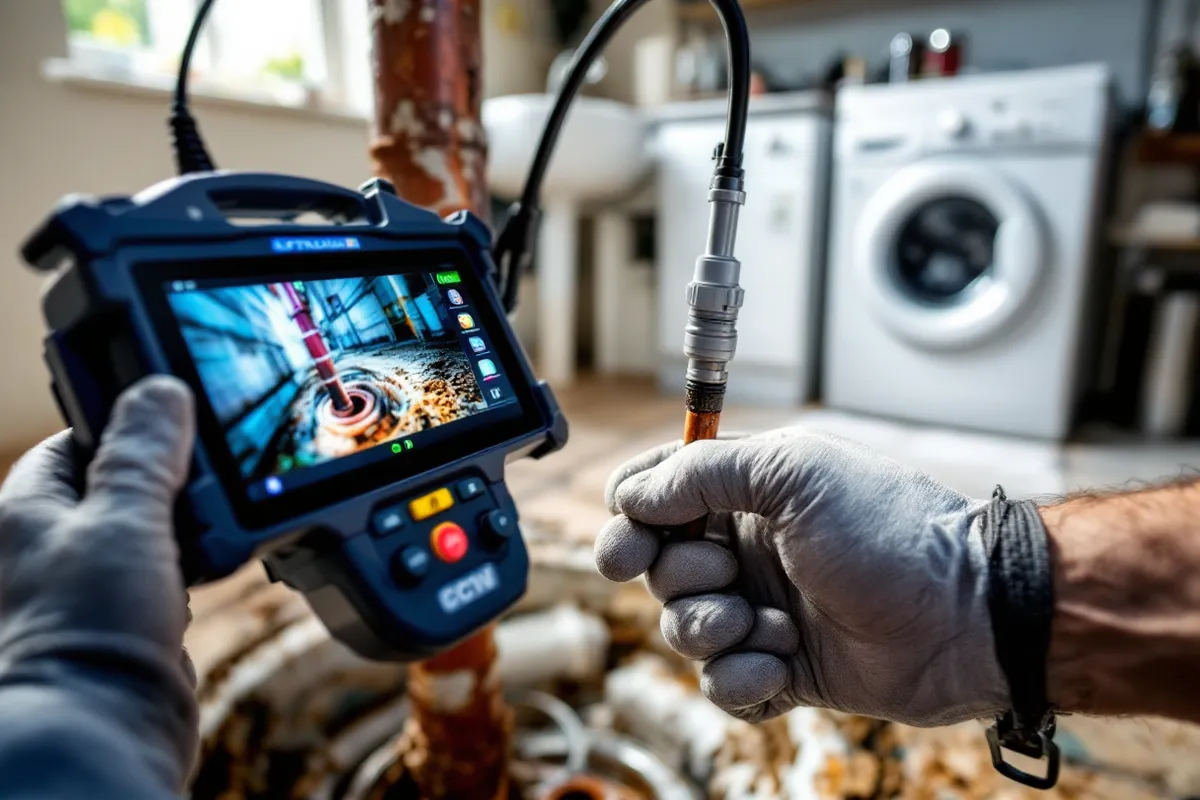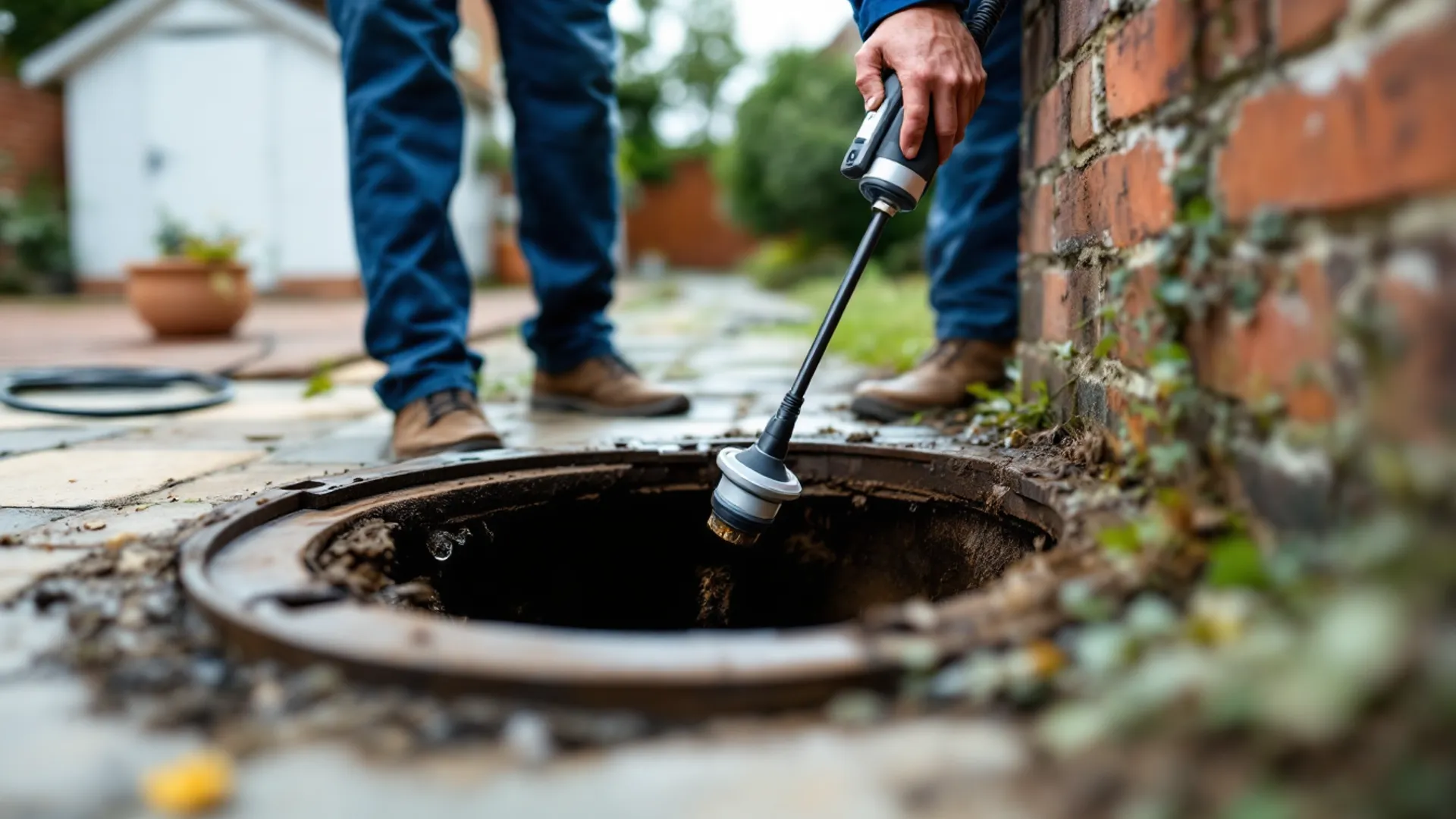
A CCTV drain survey is the most reliable way to find out what’s happening inside a drain or sewer pipe — without guessing, and without excavating. Specifically, this guide covers the full process: what the camera can find, how to read the results, and when each type of survey is the right call.
What is a CCTV drain survey?
A CCTV drain survey pushes a waterproof camera on a flexible rod or crawler into a drain or sewer pipe. In practice, the camera sends live HD footage to a monitor, and the engineer inspects pipe condition in real time. Everything is recorded for the formal condition report.
For example, modern survey cameras cover pipes from 50mm (WC waste pipes) up to 600mm diameter sewer mains, at depths of up to 100 metres from an access point. A pan-and-tilt camera head lets the engineer rotate 360° to examine the full pipe circumference, not just the bottom.
When do you need a CCTV drain survey?
Before buying a property
A pre-purchase CCTV survey is one of the most cost-effective surveys you can commission. Standard homebuyer and structural surveys don’t inspect drains — they stop at the inspection chamber cover. A drain survey reveals:
- Cracked, fractured or collapsed sections needing relining or repair
- Root ingress from garden or street trees
- Misconnections (surface water pipes discharging into the foul sewer, or vice versa)
- Illegal modifications by previous owners
- Shared sewer ownership boundaries
Drainage repairs range from a few hundred pounds for a patch repair to tens of thousands for full pipe replacement. As a result, finding problems before exchange gives you grounds to renegotiate the purchase price or require the seller to fix the issue.
After a recurring blockage
If a drain keeps blocking after jetting, there’s almost always a structural cause — root ingress, a collapsed invert, a back-fall, or an incorrect modification. For this reason, a CCTV survey identifies the cause so repairs fix the actual problem, not just the symptom. Without it, you may jet the same blockage every few months and never resolve it.
Insurance claim evidence
Many building insurers require a CCTV survey and condition report before approving a claim for drain collapse or subsidence linked to drainage failure. In practice, submitting a claim without survey evidence often leads to delays or rejection.
New build snagging
Drains in new-build properties go through building control inspection and pressure testing, but surveys regularly find defects. Specifically, poor joint connections, incorrect gradients, and debris left inside during construction are all common. A pre-move-in survey gives you evidence to raise a snagging claim while the developer is still responsible.
Drain adoption applications
Sewer adoption under Section 102 of the Water Industry Act requires a CCTV condition report to the water company’s specification. Submit this before the adoption application is agreed.
What can a CCTV survey find?
Root ingress. Tree and shrub roots exploit hairline cracks and loose joints. They enter the pipe and grow until they cause a full blockage. In particular, root ingress is most common in older clay pipe systems and near mature trees in front gardens and pavements.
Fractures and cracks. For example, ground movement, root pressure, traffic loading, and material fatigue all cause pipe fractures. Fine cracks become severe cracks and then collapse.
Collapsed pipes. A fully collapsed section shows as a sudden wall of debris on the camera. This needs full excavation and pipe replacement.
Joint displacement. Pipe sections that have separated at the joint allow groundwater ingress and debris to accumulate. Common in clay-pipe systems after ground movement.
Back-fall. A section where the pipe gradient runs backwards — water and solids can’t flow in the correct direction. Usually an installation defect or the result of ground movement.
Deposits and scale. Grease, limescale, concrete, and mortar that have narrowed the effective bore of the pipe.
Misconnections. Surface water downpipes connected to the foul sewer (an environmental offence), or foul drainage discharging to a surface water system.
Vermin. Rats use sewer systems extensively. A damaged pipe or poorly fitting cover gives them access to a property.
What does a CCTV drain survey cost?
In practice, a standard residential CCTV survey — one access point, up to 30–40 metres of drain — is quoted individually, including footage and a written report. Pre-purchase surveys covering the full drain run of a house usually fall within this range.
As a result, more complex surveys cost more: larger properties, multiple access points, deep sewers, or surveys needing a crawler robot for large-diameter pipes all attract higher fees.
Understanding the survey report
In practice, a professionally produced CCTV survey report follows the WinCan or Panoramo coding standard used by water companies and local authorities. Each defect receives:
- A standard code (e.g., RB for root ball, FB for fracture break, DEF for deformation)
- A severity grade on a 1–5 scale
- A distance from the access point so it can be located for repair
- A video still captured in the report
The report recommends a condition grade (A–D, or equivalent) and specifies the recommended action for each defect — from “monitor” for minor surface corrosion to “immediate repair” for active collapse.
Can defects be repaired without digging?
Many can. For example, the main no-excavation repair techniques are:
CIPP (Cured-in-Place Pipe) lining. A resin-impregnated felt liner is inserted into the pipe and expanded against the pipe wall using air pressure, then cured. This leaves a smooth, jointless structural lining inside the original pipe — repairing cracks, fractures, joint displacements, and moderate root ingress without excavation.
Patch lining. A short resin patch targets a specific defect rather than the full run — used where only one section needs repair.
Root cutting. An electro-mechanical root cutter removes root masses from inside the pipe. This is usually combined with relining to prevent regrowth.
In some cases, however, excavation is unavoidable. Where a pipe has fully collapsed or access is otherwise impossible, open-cut repair or pipe bursting — pulling a new pipe through the collapsed one — may be the only option.