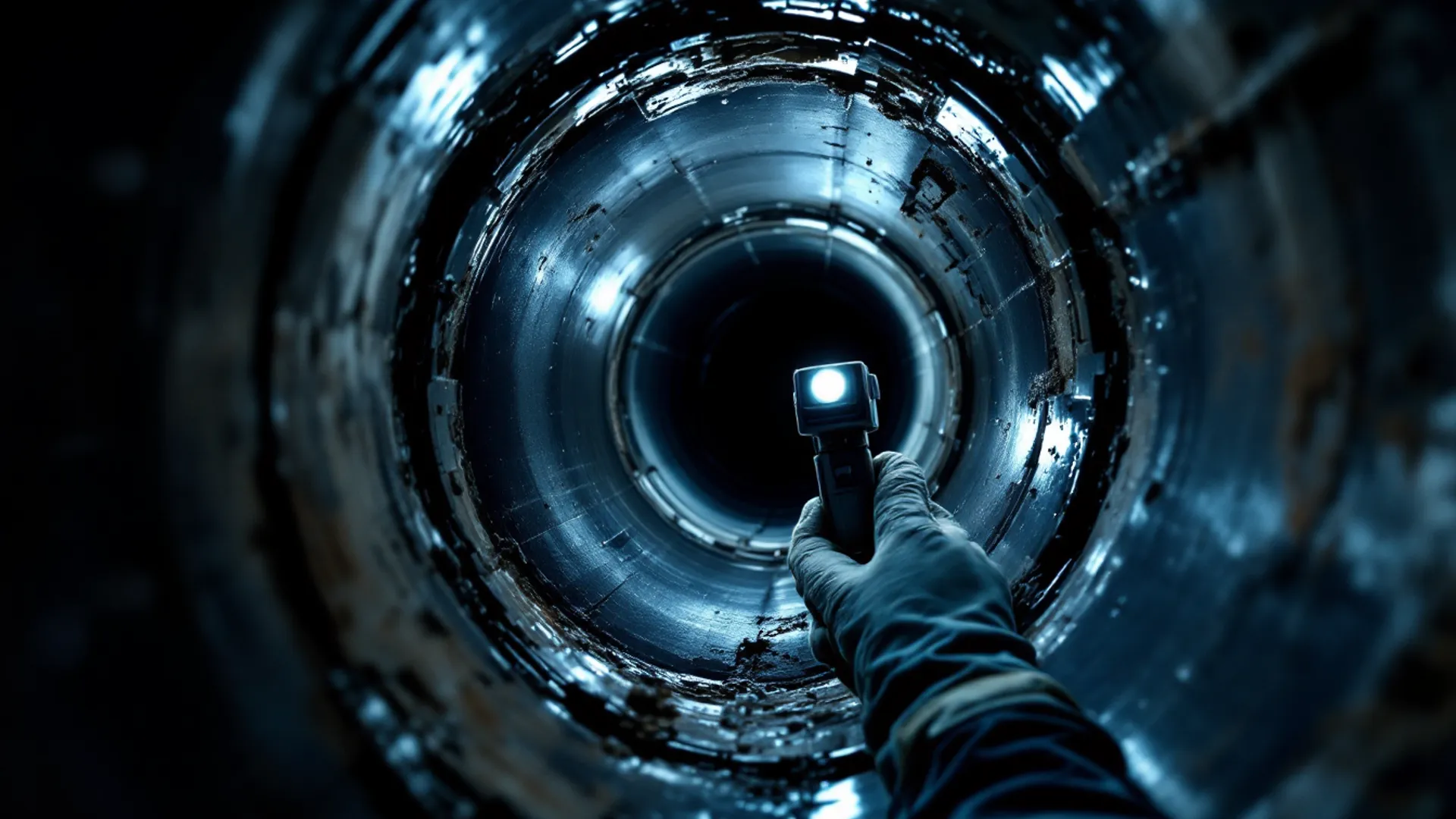
A CCTV drain inspection can feel like a black box. An engineer arrives with equipment, spends an hour on site, and produces a report you might not fully understand. This guide explains exactly what happens during the inspection, what the engineer is looking for, and how to interpret the report.
Before the camera goes in: pre-survey jetting
However, a dirty drain gives a poor camera image — the camera can’t see through water, silt, or grease deposits. In most cases, the drain is jetted clean before the camera is deployed. This is either included in the survey price or quoted separately.
After jetting, the drain should be running clear. If a blockage can’t be cleared (because of a collapse or severe root mass), the camera is deployed anyway to document the blockage. But The camera’s view may be limited.
The camera equipment
Push-rod cameras: Additionally, a flexible cable with a camera head on the end, manually pushed into the drain. Effective for shorter domestic drain runs (up to 80–100m). The operator feeds the cable into the drain from an access point (typically an inspection chamber) and the camera transmits live footage to a monitor.
Self-propelled crawlers: Specifically, used for larger-diameter pipes (150mm+). The camera unit is a wheeled vehicle that moves independently along the drain. Common in commercial and public sector drainage work.
Camera specifications: For example, professional survey cameras produce HD footage; budget “inspection cameras” (available for DIY purchase) produce lower-resolution footage that misses fine defects. Always ask about camera specification if the report is for a significant purpose (house purchase, insurance claim).
What the engineer is looking for
As a result, as the camera travels along the drain, the engineer documents:
Structural defects: Meanwhile, - Fractures and cracks: Longitudinal (along the pipe) or circumferential (around the pipe). Graded by severity.
- Collapsed sections: Where the pipe body has broken and soil has entered.
- Deformation: Ovalling or flattening of the pipe (common in pitch fibre pipes).
- Displaced joints: Pipe sections that have shifted out of alignment.
- Root ingress: Tree roots growing through joint cracks.
- Joint defects: Open joints, missing or failed jointing material.
Service conditions: Furthermore, - Debris accumulation: Silt, grease deposits, debris caught on defects.
- Infiltration: Groundwater entering through cracks (visible as moisture on the pipe wall or active seepage).
- Exfiltration: Sewage visible escaping outward (the camera sees soil or roots visible through a crack, or a depression where the pipe has subsided).
- Obstruction: Any partial or complete blockage.
Pipe characteristics: In particular, - Material: Clay, concrete, UPVC, pitch fibre — each has characteristic appearance and typical defects
- Diameter: Measured or confirmed against known records
- Gradient: Assessed from the camera footage; any sags (sections of backward gradient) are noted
Defect grading: the WRc system
Consequently, the Water Research Council (WRc) grading system is the UK standard for drain condition reporting. Defects are graded in two categories:
Structural defects (D-grades): Similarly, - D1: Minor defect. Structural integrity maintained. Monitor.
- D2: Moderate defect. Monitor closely.
- D3: Significant defect. Remediation required but not urgently.
- D4: Severe defect. Urgent remediation needed.
- D5: Critical defect. Immediate action required — collapse imminent.
Operational defects (F-grades): Moreover, - F1–F5: Functional defects (deposits, encrustation, roots) graded by severity of restriction to flow.
However, a report that lists only D1–D2 defects with no D4–D5 findings is reassuring. A report with multiple D4–D5 findings requires prompt action.
Reading the report
Additionally, a properly structured survey report includes:
Header information: Specifically, date, reference, access point, pipe diameter, material, survey length.
Defect table: Each defect listed with:
- Distance from the camera entry point (e.g., “8.2m from chamber 1”)
- Defect code and description
- Severity grade
- Photo still from the footage at that point
Condition summary: For example, overall assessment of the pipe condition.
Recommendations: As a result, what action the surveyor recommends — monitor, jet, reline, excavate.
Footage: Meanwhile, the full video recording, usually on USB or via download link.
Questions to ask the surveyor
- What were the most significant defects found?
- Does the condition suggest relining is appropriate, or is excavation needed?
- How urgent is the remediation?
- Did the camera reach the full length of the drain, or were there sections that couldn’t be accessed?
- Are there any sections that should be re-inspected (e.g., a section that was blocked and couldn’t be fully viewed)?
Acting on findings
D1–D2 only, no F defects: Furthermore, the drain is in reasonable condition. Routine maintenance (annual jetting) is appropriate. Re-survey in 3–5 years.
D3 defects, manageable F defects: In particular, plan remediation — relining is usually appropriate. Not an emergency, but schedule within 6–12 months.
D4–D5 defects: Consequently, prioritise remediation. If the drain is actively failing (complete blockage, groundwater infiltration significantly elevating surcharge risk), address promptly.
Root ingress (F4–F5): Similarly, root cut and reline. If you don’t reline after cutting, roots will return.
Pitch fibre deformation: Moreover, assess whether relining is viable (depends on degree of deformation). Get a specialist opinion.