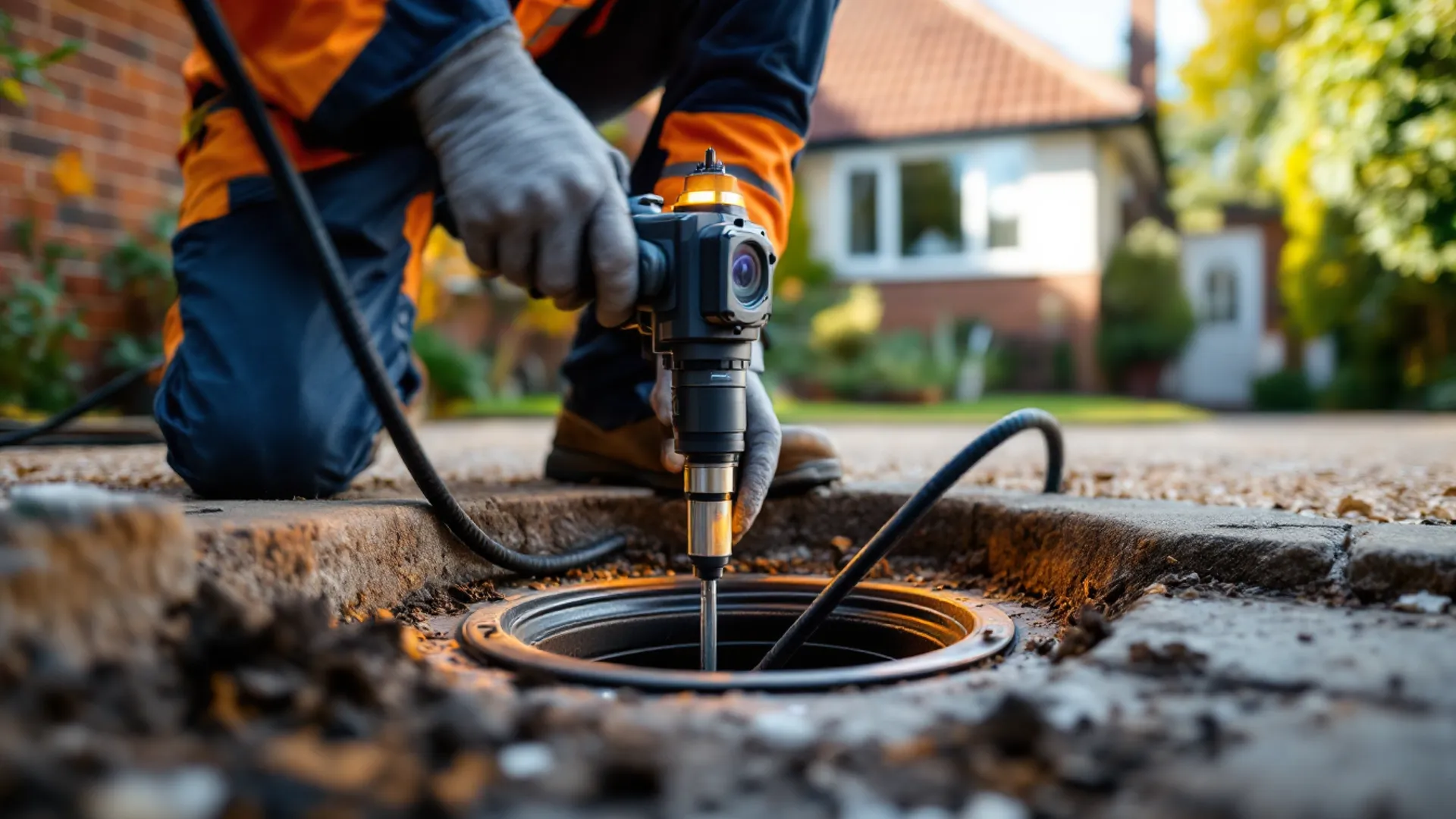
A standard homebuyer’s survey covers the structure of a property — walls, roof, windows, floors. What it almost never covers is the drainage system. Yet drainage problems are among the most expensive defects a buyer can inherit: a collapsed sewer under the garden can cost tens of thousands to excavate and relay. A pre-purchase CCTV drain survey costs a fraction of that and is one of the highest-return due-diligence steps available to any homebuyer.
What a pre-purchase drain survey covers
However, a CCTV drain survey inserts a high-definition camera into the drains and records everything it finds. The camera travels along the underground pipe runs, inspecting:
- Structural condition — cracks, fractures, collapsed sections, deformation
- Root ingress — tree roots that have penetrated through joints or cracks
- Joint displacement — pipes that have shifted out of alignment (common in clay systems on shrinkable clay soils)
- Infiltration — groundwater entering the pipe (indicates damage or open joints)
- Exfiltration — sewage escaping outward through cracks (a contamination risk)
- Blockages and debris — accumulated sediment, grease, or foreign objects
- Condition of inspection chambers — are the covers intact? Is there evidence of overfilling?
Additionally, the resulting report (typically 10–25 pages) includes the recorded footage, defect locations measured from the camera access point, a condition grading for each pipe run, and recommendations.
What problems come up most often
Root ingress Specifically, is the single most common finding in pre-purchase surveys, particularly in properties with mature trees and older (pre-1970) clay pipe drainage. Roots can look minor on camera but cause complete blockage within months and will eventually fracture the pipe.
Displaced joints For example, are almost universal in Victorian and Edwardian properties. The question is severity — minor displacement is noted but not urgent; major displacement where adjacent pipe ends are no longer touching becomes a defect that needs remediation.
Collapsed sections As a result, are less common but catastrophic when found. A collapsed section of main drain — even a short one — means excavation, and excavation under a path, garden or worse, a building extension, is expensive. Drain relining (CIPP — cured-in-place pipe) can resolve some collapses without excavation, but not all.
Shared sewers Meanwhile, — many older properties have drains that cross neighbouring land or are shared between multiple properties. This affects who is responsible for maintenance and repair. The survey will show exactly where shared sections are.
What the survey cannot tell you
Furthermore, a pre-purchase drain survey inspects the underground drainage on the property being purchased. It does not:
- Inspect the sewer beyond the property boundary (that’s the water company’s responsibility once adopted)
- Assess above-ground plumbing inside the house (pipework under sinks, baths, waste pipes)
- Guarantee that no problems will arise in the future
- Assess surface water drainage or land drainage beyond the main drains
In particular, for properties on septic tanks or small package treatment plants, a separate specialist inspection of the tank and soakaway is recommended.
Timing: when to commission the survey
Consequently, the ideal time to commission a pre-purchase drain survey is after offer accepted, before exchange of contracts. This gives you:
- Enough time to get the results and, if needed, negotiate with the seller
- A valid reason to renegotiate the purchase price if significant defects are found
- The ability to walk away without losing your deposit if critical defects emerge
Similarly, don’t wait until after exchange. Once contracts are exchanged, you’re legally committed and any defects you discover are your problem.
Moreover, if you’re in a competitive market and don’t want to invest survey costs before offer acceptance, a short scope survey (main run only) is a lower-cost option that can identify obvious major defects quickly.
Using survey findings in negotiation
However, a CCTV survey report with a schedule of defects is a legitimate negotiation tool. Common approaches:
Request a price reduction Additionally, equal to the estimated remediation cost. Get at least one quote from a drainage contractor before using this approach — a specific costed quote to relay the collapsed section under the path is much more effective than “there are problems with the drains.”
Request the seller remediate before completion. Specifically, sellers sometimes prefer to fix rather than reduce price, particularly if they’re in a chain and need to protect their own onwards purchase price.
Use it to buy insurance. For example, some drainage-specific home buyers’ protection policies use the survey report as the basis for cover — effectively insuring against any undisclosed latent defects in the assessed drains.
WinCan-compliant reports for mortgage lenders and insurers
As a result, professional CCTV drain surveys use WinCan software to produce standardised reports that mortgage lenders, insurers, and legal professionals can interpret consistently. If your solicitor or mortgage lender asks for a drain survey, make sure the contractor produces a WinCan-compliant report. Not just a contractor’s letter and a USB stick with video.
Meanwhile, drains Cleared survey reports are WinCan-compliant and include HD footage, condition ratings for every pipe section, a measured defect schedule, and remediation recommendations. Reports are typically delivered within 24–48 hours of the survey.
What happens if the survey finds serious problems?
Furthermore, you have three choices:
- Negotiate a price reduction or seller remediation as described above
- Accept the risk — if you know the costs and they’re manageable within your budget, you may choose to proceed and address the defects post-purchase (sometimes sensible on older properties where you already factor in renovation)
- Withdraw — if the drainage defects are severe and the seller won’t negotiate, you are not yet legally committed until contracts exchange, and walking away (while losing survey and legal costs) may be the right decision
In particular, the survey report gives you the information to make that decision with open eyes rather than hoping for the best.