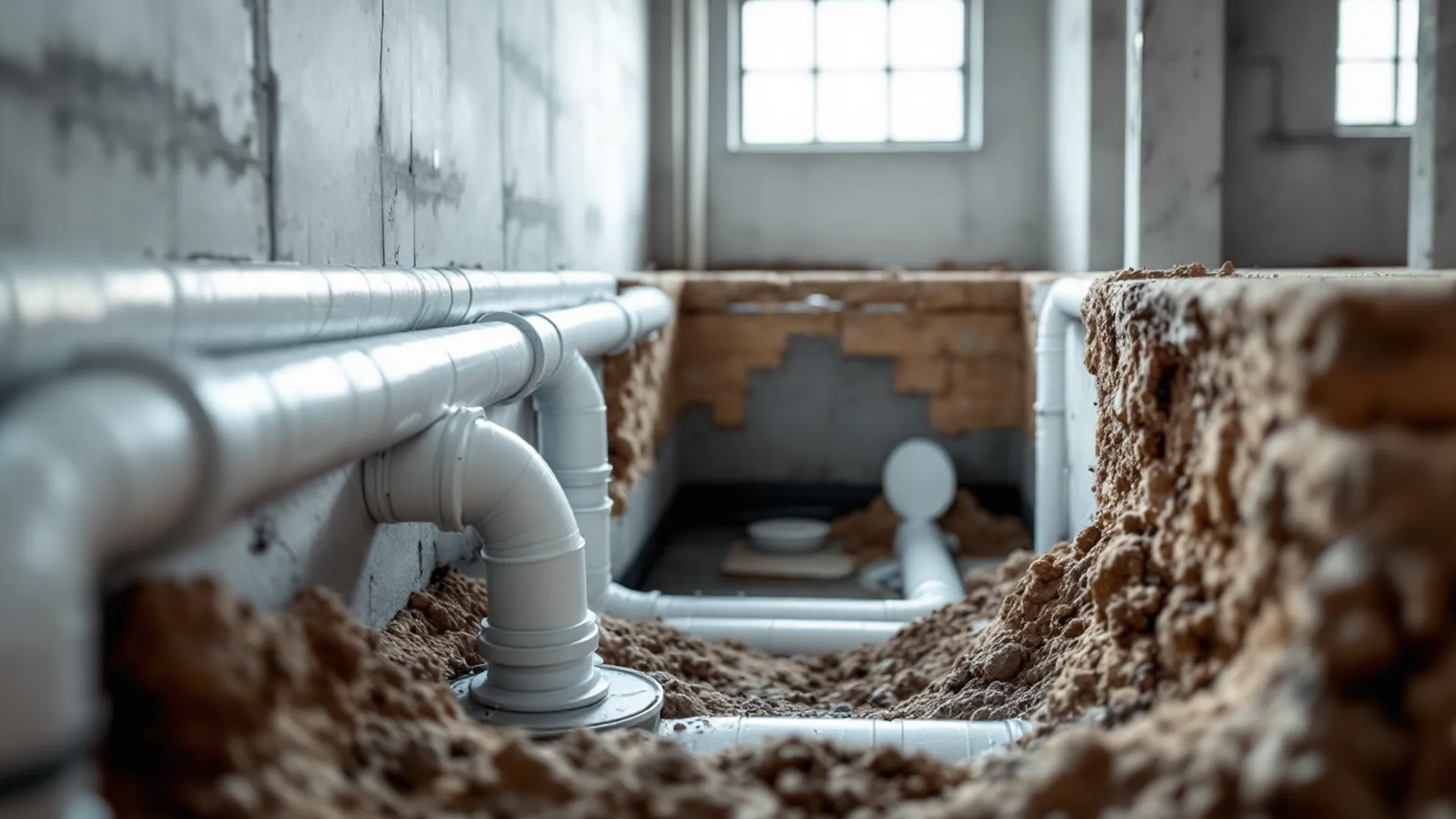
New build buyers are often surprised to discover that brand-new drainage isn’t automatically problem-free. Construction debris, incorrect gradients, SUDS systems that haven’t bedded in, and adoption issues with drainage infrastructure create real problems for new build owners. Here’s what to know before you complete.
What drainage a new build should have
However, modern new builds built under current Building Regulations have:
Separate foul and surface water systems: Additionally, sewage and wastewater (foul water) goes to the foul sewer; rainwater from roofs and paved areas goes to a surface water drain, soakaway, or SUDS feature. Combined drainage is not permitted in new construction.
UPVC pipework: Specifically, modern drainage uses PVC or UPVC pipes with push-fit rubber ring joints throughout. These are long-lasting, flexible, and do not corrode.
Minimum gradients: For example, part H requires sufficient gradient for self-cleansing — 1:40 minimum for 100mm pipes with low flow, 1:80 acceptable for higher-flow pipes.
Inspection chambers: As a result, access chambers at all bends and junctions, and at intervals along straight runs, for future maintenance.
SUDS: Meanwhile, all new developments (and under Schedule 3 of the Flood and Water Management Act, enforced from April 2024) must include sustainable urban drainage systems — soakaways, permeable surfaces, attenuation features — that manage surface water on site rather than sending it directly to the sewer.
Common new build drainage defects
Construction debris in drains: Furthermore, mortar, plaster, concrete, and general construction waste frequently enters drain pipes during construction. This debris accumulates in the lower sections of the drain and can cause early blockages or slow drainage.
Incorrect gradients: In particular, a pipe laid at insufficient gradient (too flat) accumulates deposits rather than self-cleansing. This may not be immediately apparent — the drain works initially, but becomes problematic within a year or two as deposits build. Particularly common in drains running under the building slab where gradients are constrained by the structure.
Damaged pipes under slabs: Consequently, heavy plant equipment (concrete mixers, diggers) driven over areas with unprotected buried pipes can crack them. These cracks are invisible unless a CCTV survey is carried out.
SUDS features not bedding in: Similarly, soakaways, infiltration trenches, and permeable paving need to settle and may have variable performance in the first year. Problems should be reported to the developer during the defects period.
Adoption delays: Moreover, the water company’s adoption of the new development’s sewer infrastructure sometimes lags years behind occupation. During this period, the sewers are technically private and it’s not always clear who is responsible for them.
Pre-completion checks
However, before completing on a new build:
Ask which sewers are to be adopted. Additionally, the developer should be able to tell you which sewers are to be adopted by the water company (and when) and which will remain private. Private shared sewers have ongoing maintenance costs that owners need to be aware of.
Ask about SUDS maintenance responsibilities. Specifically, who maintains the SUDS features (soakaways, attenuation ponds, permeable paving)? In some developments these are adopted by the local authority; in others they remain the responsibility of a management company or individual homeowners.
Commission a post-completion CCTV survey. For example, this is the best protection against inherited defects. Carry it out within 6 weeks of completion (before the developer’s defects period expires, typically 2 years for NHBC properties but check your warranty). Any defects found can be reported under the defects liability clause.
During the defects period (first 2 years)
As a result, the developer remains responsible for correcting latent defects in construction during the defects period. For drainage:
- Blocked or slow-draining systems (where the cause is construction debris or incorrect gradient, not the owner’s use)
- SUDS features not performing as designed
- Cracked or damaged pipes found on CCTV survey
- Inspection chambers not correctly sealed or finished
Meanwhile, report defects to the developer formally (in writing, with reference to the specific issue and the date observed). Follow up through the NHBC or your warranty provider if the developer doesn’t respond within a reasonable period.
After the defects period
Furthermore, once the defects period ends, drainage maintenance is the homeowner’s responsibility. The practical priorities for a new build are simpler than for older properties:
Annual kitchen drain jetting: In particular, modern UPVC drains with correct gradients rarely block without FOG accumulation in the kitchen. Annual jetting after year 3–4 is appropriate for most households.
SUDS maintenance: Consequently, check soakaway condition annually (particularly after the first winter — frost can affect soakaway installations). Clear permeable paving of surface debris. Report any SUDS performance changes to the SUDS asset manager (local authority or management company) if they maintain them, or manage yourself if they’re your responsibility.
Perimeter drainage: Similarly, new builds frequently have perimeter drainage around the building slab. Check that gully covers remain in position and aren’t blocked with construction debris or soil migration.
New build vs older property: drainage comparison
| Factor | New build | Older property |
|---|---|---|
| Pipe material | UPVC — long life | Clay or pitch fibre — age concerns |
| Joint type | Push-fit rubber — flexible | Rigid cement or pitch — susceptible to movement |
| Root ingress risk | Very low | Moderate to high |
| Construction debris risk | Moderate (first 3 years) | Very low |
| Combined drain risk | None (separate systems required) | Common in properties pre-1970 |
| SUDS compliance | Yes | No (older properties pre-date SUDS) |
| Maintenance need | Low initially | Higher |