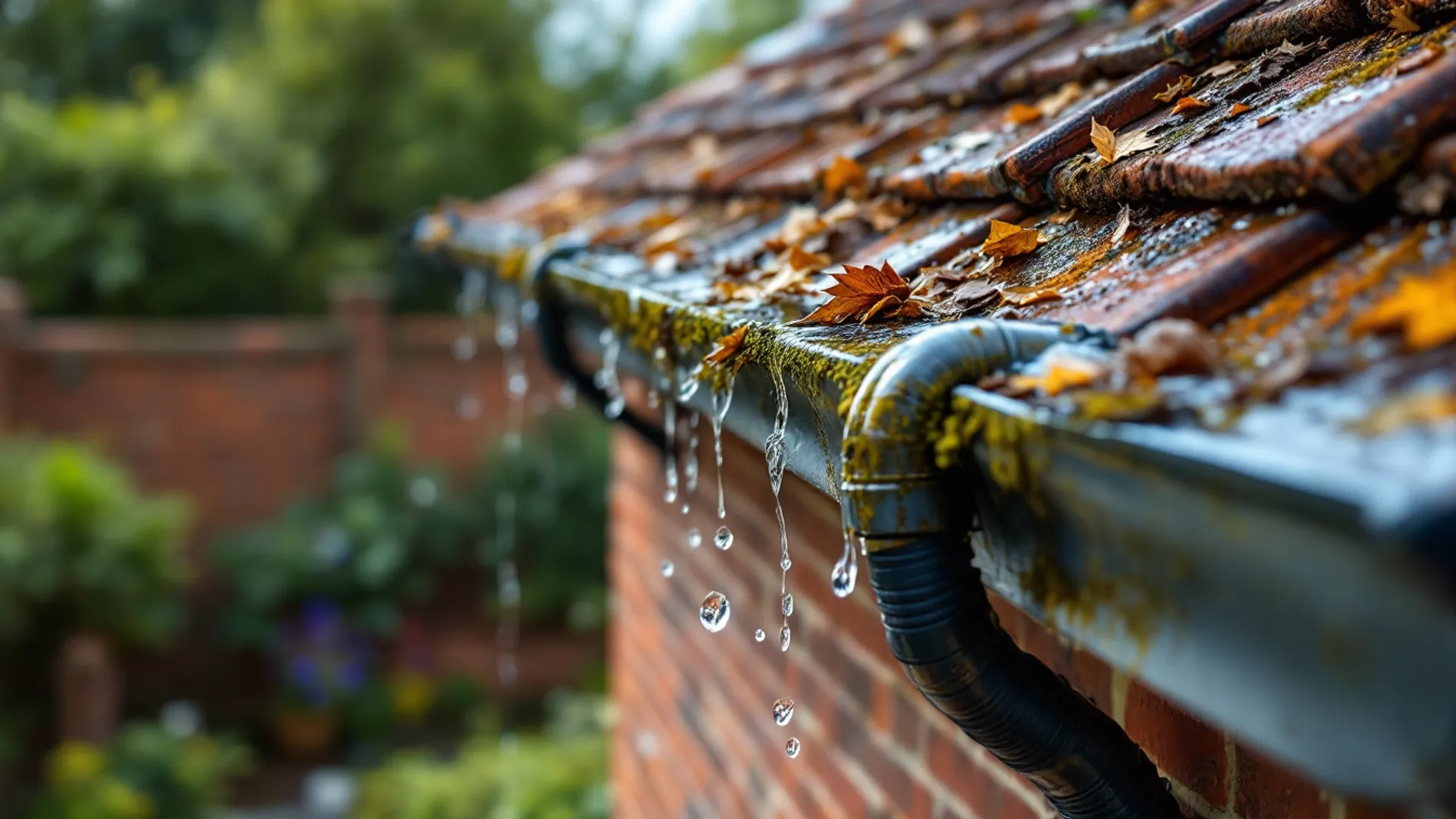
Gutters are one of the most neglected elements of a property and one of the most consequential when they fail. A blocked or leaking gutter doesn’t just make water run down the wall. Over time it saturates the brickwork, causes damp penetration, damages window frames and their sills, stains rendering, and creates conditions for frost damage in winter. In older properties with solid brick walls (no cavity), a persistently overflowing gutter can cause serious internal damp within one or two seasons.
How gutter systems work
However, the guttering system collects rainwater from the roof surface, channels it to downpipes, and delivers it to the drainage system. Either a combined sewer, a separate surface water drain, or a soakaway. Problems arise when:
- Gutters become blocked with debris and overflow
- Gutter joints or connections fail and leak
- Gutters sag and lose fall (gradient), creating standing water
- Downpipes block internally or disconnect at joints
In older properties, cast iron guttering (typically ogee or half-round profile) is still common and performs well when maintained. But Corrodes if painted surfaces are not maintained. Modern properties use UPVC which doesn’t corrode but can become brittle with UV degradation and distort in extreme heat.
How often should gutters be cleared?
Additionally, as a minimum: annually, in late autumn after the leaves have fallen. Properties with overhanging trees — particularly conifers, which shed needles year-round — may need clearing twice yearly (spring and autumn).
Specifically, properties in coastal locations may find salt-laden debris accumulates faster. Gutters adjacent to moss-covered roofs fill with moss fragments as rain washes them off. Moss and lichen growth on tiles is itself a maintenance issue worth addressing.
Signs of a gutter or downpipe problem
During rain: For example, - Water overflowing from the gutter (visible from ground level)
- Water pouring out of a joint in the gutter run
- Water running straight off the eaves without going into the gutter (gutter has sagged away from the fascia)
- Water running out of the base of a downpipe or its wall junction
Between rain events: As a result, - Damp or watermarked staining on the wall below the gutter or downpipe
- Efflorescence (white salt deposits) on brickwork under the gutter line
- Green algae or moss growth on walls in a strip corresponding to where water runs
- Peeling paint on fascias and soffits
- Internal damp in rooms adjacent to external walls under the gutter line
- Birds nesting in downpipe outlets (a surprisingly common gutter blockage cause)
DIY gutter maintenance: what you need
A ladder with a standoff: Meanwhile, a standoff bracket keeps the ladder away from the guttering, preventing damage and giving you better access. Never rest a ladder directly against plastic guttering — it will crack.
Gutter scoop: Furthermore, a curved plastic scoop that fits inside the gutter profile. Removes debris in handfuls.
Hosepipe or pressure washer: In particular, to flush residual debris towards the downpipe after scooping.
Mirror and torch: Consequently, to inspect downpipe outlets and bends you can’t see directly.
Ladder safety: Similarly, work from a stable footing, always have someone with you when working at height, never overreach from a ladder position, and wear gloves — gutter debris carries bacteria.
When not to DIY: Moreover, - Gutters more than two storeys high
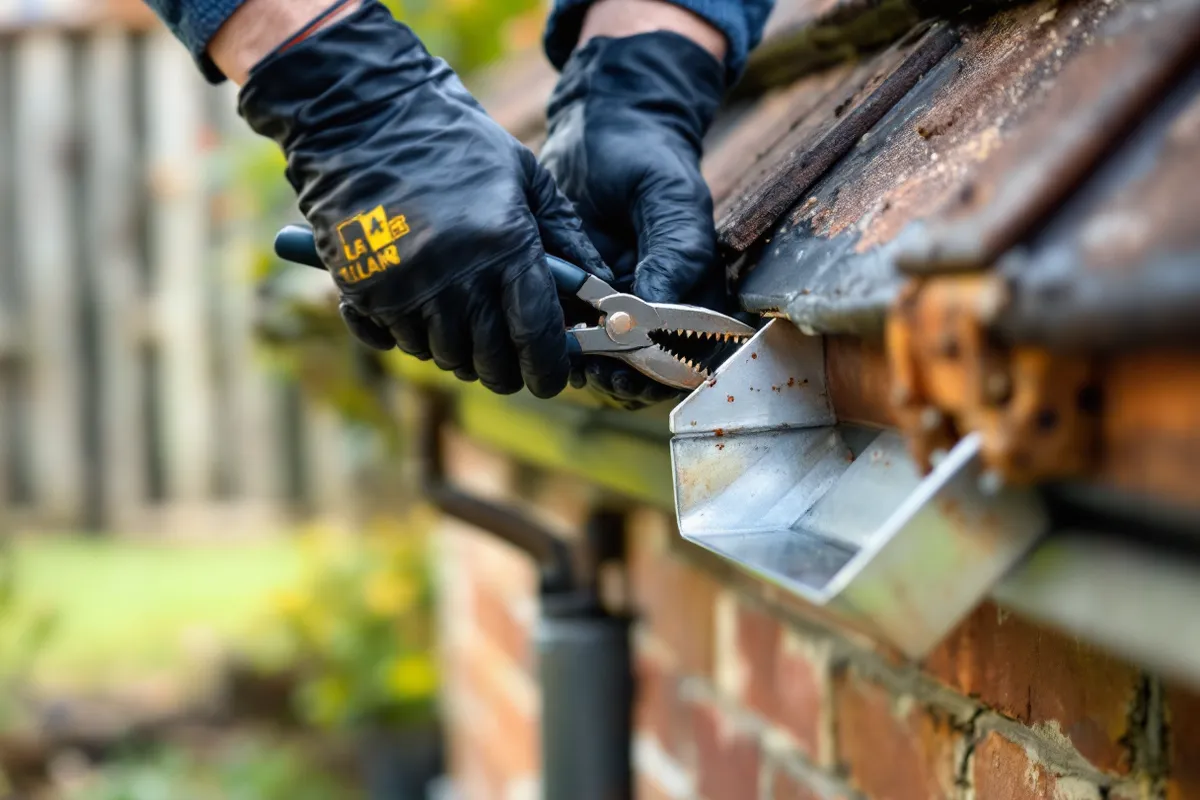
- Lead-lined or cast iron gutters (heavier, fragile, and specialist)
- Any roof or fascia work required
- If you’re not comfortable working at height
What drainage engineers do when clearing gutters
However, a professional gutter clearance typically uses:
-
Gutter vacuum equipment — high-powered vacuum units with long carbon fibre poles that allow gutters to be cleared from ground level, without a ladder, for heights up to three storeys. Much safer and faster than ladder work.
-
CCTV inspection of downpipes — a camera probe confirms downpipes are clear from the gutter outlet to the underground drainage connection.
-
Written report — notes any repairs needed (cracked joints, displaced sections, rusted brackets) for the property owner to action.
Common repairs
Gutter joints leaking: Additionally, uPVC joints use rubber seals that harden and crack with age (typically 20–30 years). Replacement seals are inexpensive; the joint is opened, seal replaced, joint reassembled. Cast iron joints traditionally used lead-based putty — modern replacement with silicone sealant works well.
Sagging gutters: Specifically, gutters need to fall at least 1:500 (2mm per metre) to drain properly. A sagging section holds standing water, which encourages moss growth and, in frost, ice formation that can crack the gutter. Re-positioning or adding fascia brackets restores the fall.
Cracked UPVC sections: For example, hairline cracks in UPVC can be temporarily sealed with waterproof silicone. Full section replacement is straightforward — UPVC gutter sections snap together and are available from any builder’s merchant.
Disconnected downpipe: As a result, downpipes connect via push-fit or screwed brackets at regular intervals. A disconnected section can allow water to spray against the wall. Re-connecting and ensuring the fall direction is correct restores function.
Downpipe clearance
A blocked downpipe — typically caused by compacted debris at a swan-neck bend, a leaf guard that has filled with debris, or an underground blockage at the gully — is more troublesome than a blocked gutter because the blockage is often invisible.
Meanwhile, signs of a blocked downpipe: gutter overflows even when the gutter channel itself appears clear; water appears from the wall at a downpipe joint.
Furthermore, clearance methods:
- Water hose or pressure washer directed down from above
- Drain rods from the bottom upward
- CCTV camera to locate the blockage point
In particular, if the downpipe discharges to an underground drain and that drain is blocked, the water backs up through the downpipe. Check the underground gully for debris blockage first.
Lead valley gutters and parapet gutters
Consequently, some older properties (particularly Georgian and Victorian) have lead-lined valley gutters between roof slopes, or parapet gutters concealed behind parapets. These are specialist structures that require specialist maintenance — lead work repairs, re-pointing around upstands, and ensuring the outlet weeps are clear. These are not DIY maintenance items. A roofing specialist or drainage engineer with lead work experience should carry out any repairs.