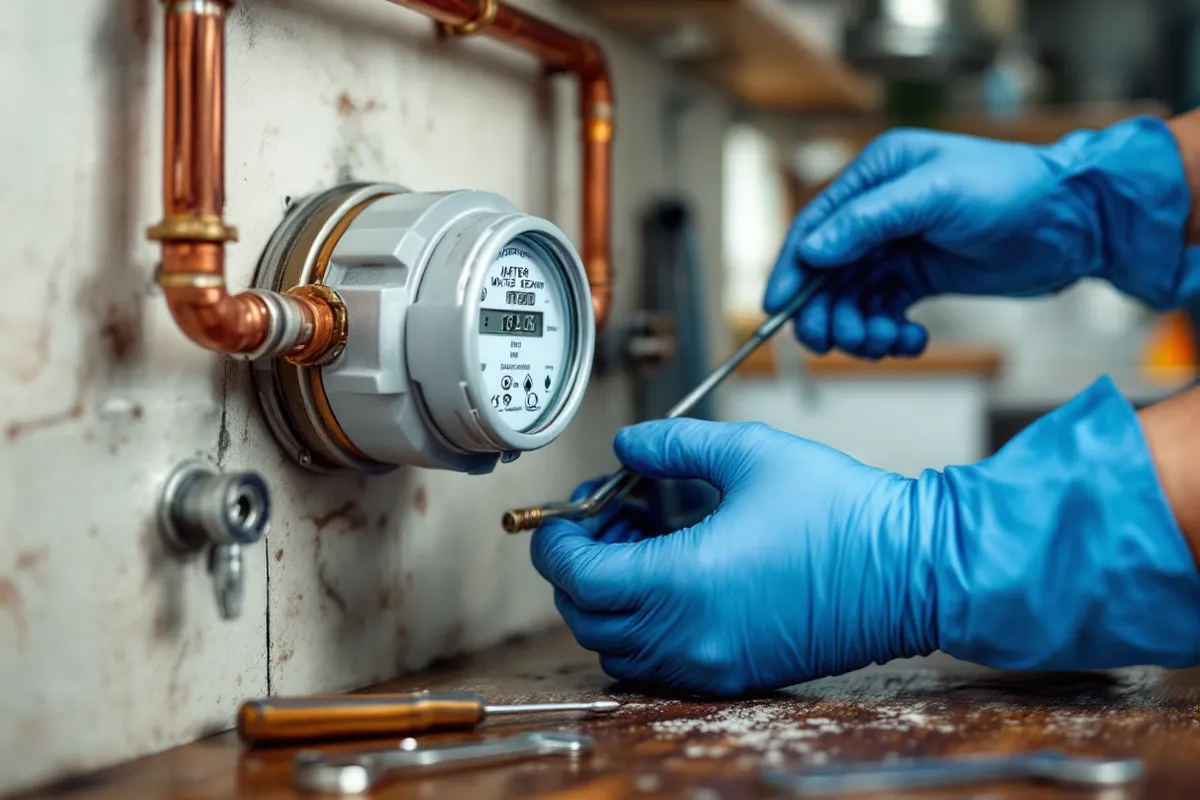
Your water meter is the most underused diagnostic tool in your home. Beyond tracking consumption and billing, it provides a definitive test for whether your property has a hidden leak. A test that takes less than a minute to perform and can reveal a problem before it causes serious damage. Here’s everything you need to know about finding, reading, and using your meter.
Where is my water meter?
However, in most UK properties, the water meter is:
- In a small square box in the pavement or footpath outside your property (the most common location for metered households) — lift the plastic cover with a flathead screwdriver
- Inside the property, usually under the kitchen sink, in the utility room, or adjacent to where the supply pipe enters the building
- In an external meter box on the front wall of the property
Additionally, not all UK properties are metered — you may be on a rateable value charge rather than a meter. If you’re not sure whether you’re metered, check your water bill or contact your water company.
How to read the meter
Specifically, uK water meters display consumption in cubic metres (m³). The reading is a series of digits:
- Black digits on white background: The main reading in m³ — these are what your water company bills you for
- Red digits on red background: Litres (thousandths of a cubic metre) — useful for fine monitoring
For example, read the black digits from left to right, ignoring any leading zeros and ignoring the red digits for billing purposes.
Example: If the display shows 00123.456, your reading is 123 m³ (and 456 litres). You’ve used 123,456 litres since the meter was installed.
As a result, some meters have a rotating dial or a spinner that shows water is currently flowing. Any movement when all taps are closed indicates active water use (or a leak).
The overnight leak test
Meanwhile, this is the single most useful thing you can do with your water meter. A definitive test for whether your property has a hidden leak.
How to run it:
- Note the meter reading before bed (write it down, including the red digits)
- Turn off everything that uses water: dishwasher, washing machine, ice maker, outside taps
- Don’t use any water overnight
- Read the meter in the morning
Interpreting the result:
- Meter reading identical: No leak (or a very slow one)
- Meter reading slightly higher: You have a leak. Each litre difference represents ongoing loss. A meter that advances by 10 litres overnight (a small amount) means roughly 3,650 litres lost per year
- Meter reading has advanced significantly: You have a significant leak — call a plumber
A more precise test: If you suspect a very small leak, note the exact reading at a specific time, return exactly one hour later (with no water use in between), and calculate the loss. This is more accurate than the overnight test because it controls for any inadvertent water use.
What meter readings can tell you
Sudden increase in consumption: Furthermore, compare last month’s meter reading with the same period last year (your bill will show historical data, or you can read the meter yourself monthly). A sudden jump in consumption without corresponding increase in household size or activity is a warning sign.
Gradual increase over years: In particular, a slowly rising consumption trend may indicate an increasingly leaky toilet cistern, a dripping outside tap, or a failing ball valve in the header tank.
Zero consumption: Consequently, if the meter shows no change over a period and you’re sure you used water, the meter itself may have failed. Report it to your water company.
How much water should a household use?
Similarly, as a rough benchmark for UK households:
- Single occupancy: 100–130 litres per day
- Two occupants: 200–260 litres per day
- Family of four: 400–500 litres per day
Moreover, usage above these figures with the appropriate household size may indicate a leak or an inefficient appliance.
Identifying the leak’s location
However, if the meter test confirms a leak, the next question is where. A simple sequence:
- Turn off the internal stopcock (under the kitchen sink) — this isolates all internal plumbing
- Watch the meter — if it still advances, the leak is in the supply pipe between the meter and the stopcock (underground, typically the pipe running from the pavement box into the house)
- If the meter stops when the stopcock is off, the leak is inside the property — proceed through individual rooms
Additionally, for internal leaks, the toilet is the most common culprit. Add a few drops of food colouring to the toilet cistern and wait 15 minutes without flushing. If colour appears in the bowl, the flush valve is leaking (a very common, very wasteful fault that’s invisible without this test).
When to call a leak detection specialist
Specifically, if the meter test confirms a leak but you can’t find it visually, call a leak detection specialist. Modern acoustic correlation equipment and thermal imaging can locate leaks in buried pipes and concealed plumbing without any exploratory excavation.
For example, this is particularly important for leaks in the supply pipe between the meter and the property. This pipe is often buried under the driveway or path and cannot be found without specialist equipment.
As a result, water companies will sometimes investigate a leak on your side of the meter boundary as a courtesy, particularly for elderly or vulnerable customers. But Generally the supply pipe inside your boundary is your responsibility.