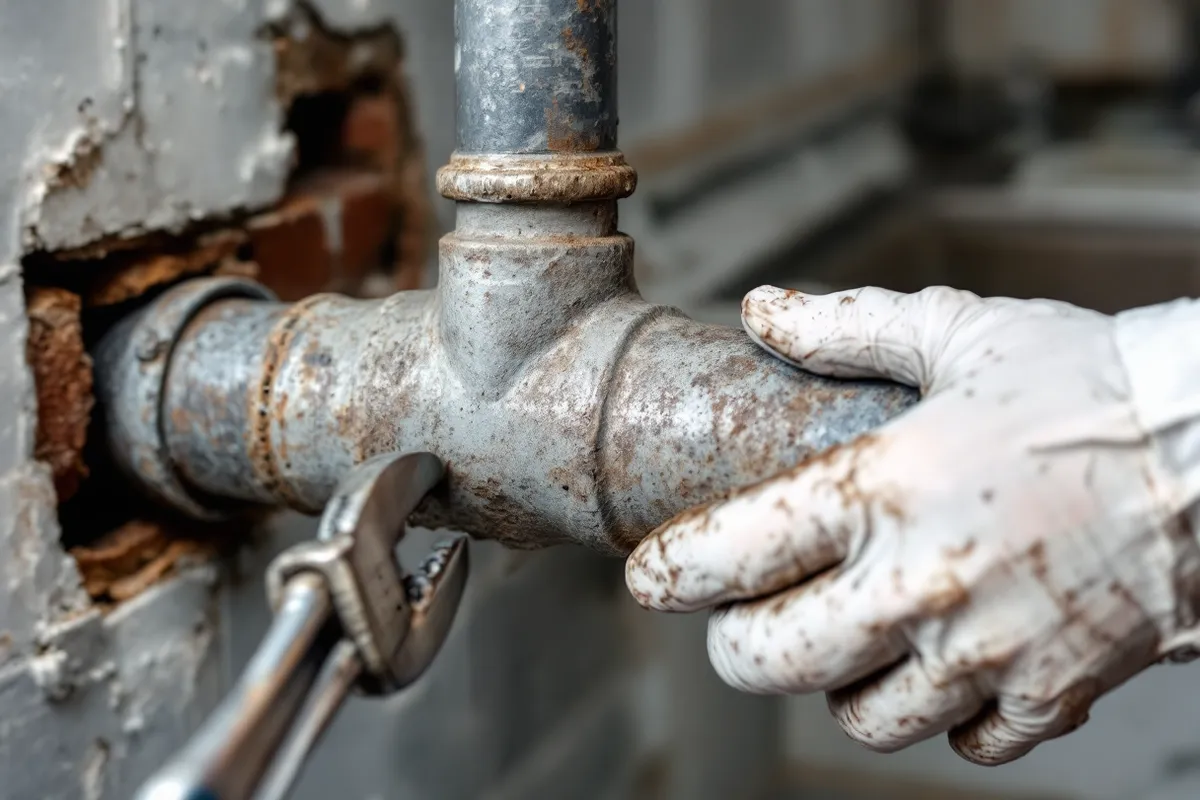
Lead water pipes were standard in UK construction until they were banned in the 1970s. An estimated 1.8 million lead supply pipes remain in use in England, predominantly in properties built before 1970, and disproportionately in older urban areas. Lead is a neurotoxin with no safe exposure level. Even low concentrations affect cognitive development in children and are associated with health risks in adults. This guide covers identification, risk reduction, and replacement.
How to identify lead pipes
Location: However, lead supply pipes are most commonly found as:
- The supply pipe from the water main to the property (running from the pavement boundary to the kitchen tap)
- Internal distribution pipes within older properties (less common — many were replaced during renovations)
Identification: Additionally, lead pipes are:
- Dull grey in colour (not copper’s bright orange-red, not plastic’s white or blue)
- Soft — you can scratch the surface with a key to reveal a bright metallic sheen
- Often slightly bellied or swollen at joints (a characteristic of lead plumbing)
- Heavier than plastic pipes of the same size
- Often found with wiped soldered joints (a rounded blob of solder where pipes join)
Specifically, copper pipes are easily distinguished (bright copper colour, rigid). Plastic pipes are light, flexible, and often have printed markings.
Testing: For example, if you’re unsure, your water company will test your tap water for lead concentration free of charge. A concentration above 10 micrograms per litre (µg/L — the current UK regulatory limit) indicates lead is entering the water supply.
Where the lead enters the water
As a result, lead dissolves into water during contact — the longer the water sits in the pipe, the more lead dissolves. This is why the first draw of water in the morning (after the water has sat overnight) has the highest lead concentration.
Meanwhile, lead is most likely to enter water:
- From the supply pipe (the run from the main to the kitchen tap)
- From the internal distribution pipe (if present)
- From lead solder on copper joints (in older properties)
- From lead fittings (cisterns, tanks, taps in very old properties)
The water company’s responsibility: Furthermore, water companies are obliged to maintain lead concentrations at the point of supply within regulatory limits. Where the water entering the property is at or near the regulatory limit, the company’s section of lead pipe (from the main to the boundary of your property) is the likely cause — and they have a duty to investigate and replace their section.
Reducing exposure while lead pipes remain
In particular, if you have lead pipes:
Run the cold tap for one minute before using water for drinking, cooking, or formula preparation. Consequently, this flushes stale water out of the lead pipe. Even a 30-second flush significantly reduces lead concentration.
Use only cold water for drinking and cooking. Similarly, hot water dissolves lead more readily than cold. Never use hot tap water for drinking or cooking — take cold water and heat it separately.
Consider a filter. Moreover, reverse osmosis filters or lead-specific water filters significantly reduce lead in drinking water. A plumber can install an under-sink unit. Note: not all water filters remove lead — check the product specification for lead removal capability.
Particular caution with infant formula. However, infants are the most vulnerable to lead. Formula prepared with lead-contaminated water concentrates the exposure significantly. Use only bottled water or properly filtered water for formula, or run the tap for several minutes before drawing water.
Replacement options
Replacement of the supply pipe (from main to property):
Additionally, the supply pipe has two sections:
- From the water main to the boundary: Water company responsibility. Contact your water company — most run replacement programmes. Some companies offer to replace their section free or at reduced cost as part of a matched replacement scheme.
- From the boundary to the kitchen tap: Homeowner’s responsibility. Replacement involves excavation along the pipe route (often under the front garden/path) and replacing the lead pipe with blue MDPE plastic (the standard for modern supply pipes).
Cost: Specifically, the price for replacing the internal section (boundary to kitchen tap) depends on the route length, what surfaces need to be excavated, and the meter access. Some water companies offer a financial contribution if you replace your section at the same time as they replace theirs.
Replacement of internal lead distribution pipes: For example, if internal lead pipes are present (visible inside the property — under floorboards, in cupboards), these should be replaced at the next opportunity. Any plumbing work in the area is an opportunity to replace the nearby section.
The water company matched replacement scheme
As a result, most English water companies offer a matched replacement scheme. If you arrange for your private section of lead supply pipe to be replaced, the water company will replace their section (from the main to the boundary) at the same time, at their cost. This means the entire supply pipe run from the main to your kitchen tap replaced easily in a single operation.
Meanwhile, contact your water company’s lead pipe replacement team. They will survey the pipe, confirm the scheme terms, and coordinate timing. Some companies also offer a financial contribution towards the cost of the private section replacement.
Furthermore, if your water company hasn’t contacted you about lead pipes, you can request a survey proactively.