Low water pressure is one of the most common domestic plumbing complaints in the UK. The frustrating part is that it has several completely different causes — and the solution for one is entirely wrong for another. This guide walks through diagnosis first, then fixes.
Is the problem mains pressure or internal pressure?
However, the first question to answer is whether the low pressure is coming from the mains supply or from somewhere inside your property. Here’s how to find out:
Check all outlets. Additionally, if every tap and shower in the house is affected simultaneously, the problem is almost certainly at the mains (supply pipe or mains pressure). If only one or two taps are affected, the problem is internal — likely a blocked aerator, partially closed valve, or limescale build-up.
Ask your neighbours. Specifically, if they’ve lost pressure at the same time, it’s a mains issue or a shared supply pipe fault. Your water company may already be aware.
Check for a mains alert. For example, uK water companies publish planned works and emergency disruptions on their websites. What looks like a pressure problem is often a temporary mains interruption.
Common causes of low water pressure
1. Mains pressure is simply low
As a result, some areas of the UK have chronically low mains pressure — particularly rural areas served by older infrastructure. The statutory minimum for a domestic supply under UK regulations is 1 bar (10 metres head) at the boundary of your property. But Many areas with older systems don’t reliably achieve this.
Meanwhile, if your mains pressure is genuinely too low, your options are: contact your water company (they have a legal duty to investigate), install a booster pump, or (in rural areas) upgrade the supply pipe from the mains to the property.
2. Partially closed stopcock or service valve
Furthermore, after plumbing work, stopcocks are sometimes left partially open by accident. Check:
- The mains stopcock (usually under the kitchen sink) — should be fully open (fully anti-clockwise)
- The service valve on the rising main (some properties have both)
- Any isolation valves on the affected fixtures (small flat-head screw valves on the pipe close to the tap or appliance)
In particular, a partially closed stopcock reduces pressure dramatically. Opening it fully is a two-second fix.
3. Blocked or worn tap aerator/flow restrictor
Consequently, modern taps and shower heads contain aerators and flow restrictors designed to reduce water consumption. These small mesh screens trap particles over time and become blocked, particularly in hard water areas where limescale accumulates.
Similarly, to check: unscrew the aerator from the end of the tap spout (usually by hand or with a flat cloth to protect the chrome). Clean it with a descaling solution or white vinegar and refit. If pressure returns immediately, you have your answer.
4. Limescale build-up in pipes
Moreover, hard water (common across southern England, East Anglia and the East Midlands) deposits limescale inside copper pipes over decades. Old copper pipes in hard water areas can become almost completely obstructed with scale, reducing flow to a trickle.
However, this is most evident at individual outlets where the pipe to that outlet is old. It’s also common in shower hoses, flexible supply hoses under sinks, and ball valves in cisterns.
Additionally, a plumber can assess the severity. In bad cases, pipe replacement is the only long-term solution. Chemical descaling can provide temporary improvement.
5. Internal leak
Specifically, a leak in the pipework between the mains stopcock and the outlets reduces pressure by allowing water to escape before it reaches the tap. If your pressure has dropped suddenly (rather than gradually), there may be a leak in a buried or concealed pipe.
For example, signs: damp patches appearing in floors or walls. Your water meter ticking when all outlets are closed; unexplained rises in your water bill; ground subsidence near buried supply pipes.
As a result, leak detection uses acoustic correlation, tracer gas, or thermal imaging to find leaks without opening up walls or floors. Call a plumber if you suspect an internal leak.
6. Boiler pressure (for hot water and combination systems)
If the low pressure is only on the hot water side, the problem may be your boiler rather than the water supply. Combi boilers serve hot water directly from the mains. But If the boiler has an internal fault (scale on the heat exchanger, a failing heat exchanger plate, or a pump fault), hot water pressure drops while cold pressure remains normal.
Meanwhile, combi boilers also have an internal pressure check valve. If your boiler pressure (shown on the gauge) is below 1 bar, re-pressurise via the filling loop before calling a plumber.
7. Shared supply pipes in older properties
Furthermore, some older terraced and semi-detached properties share a single supply pipe from the mains, split between multiple properties. If a neighbour has plumbing work done, or if their consumption increases (new household member, refurbishment), your pressure can drop.
In particular, the solution is a dedicated supply pipe from the mains to your property. An improvement that can significantly increase pressure and also removes any legal sharing complications.
Measuring water pressure
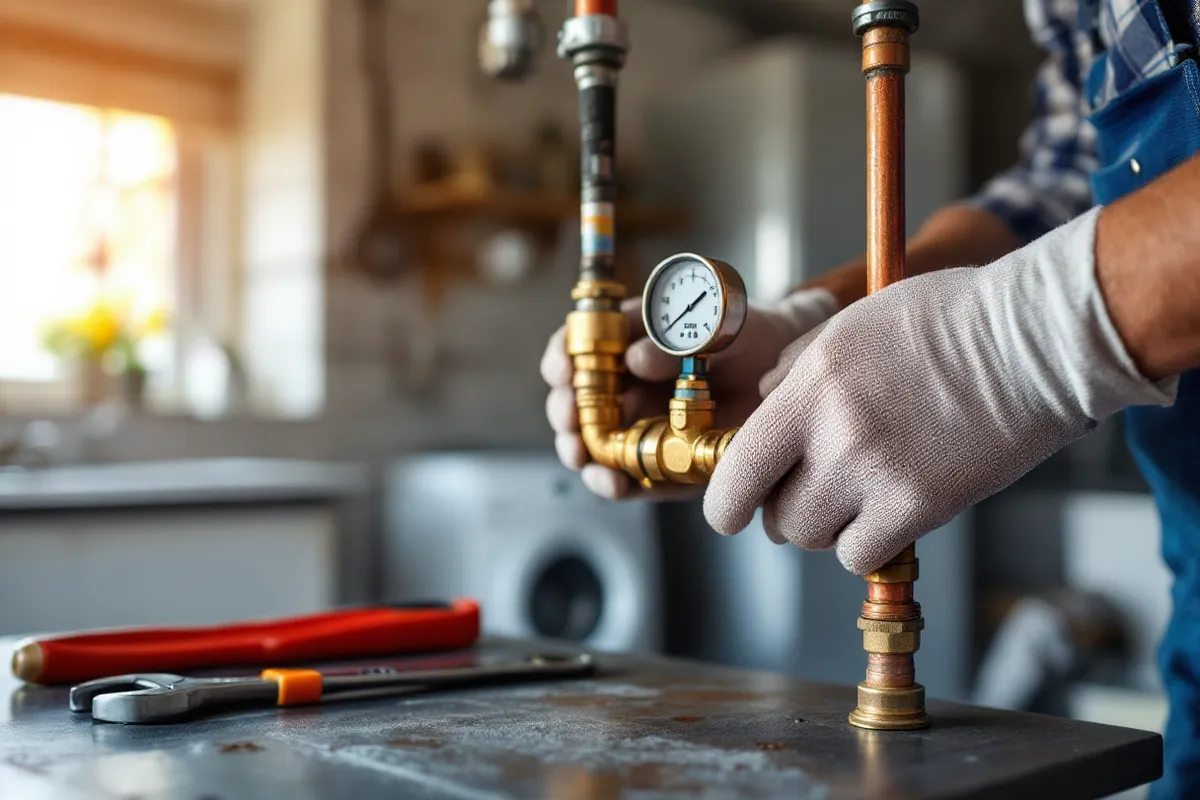
Consequently, a simple pressure gauge that screws onto an outside tap will give you a reading in bar. This is inexpensive from a plumber’s merchant. A reading below 1.5 bar at the outside tap is noticeably low; below 0.5 bar is very low.
Similarly, if you have a flow-type problem rather than a pressure problem (taps running slowly but pressure gauge reads normal), the issue is flow restriction. Aerators, partially closed valves, or scale — rather than the mains pressure itself.
When to call a plumber
- You’ve checked aerators, valves and neighbours, and the problem persists
- Pressure has dropped suddenly with no obvious cause
- You suspect an internal leak
- Only hot water is affected (boiler or system fault)
- Your water meter shows flow when everything is off