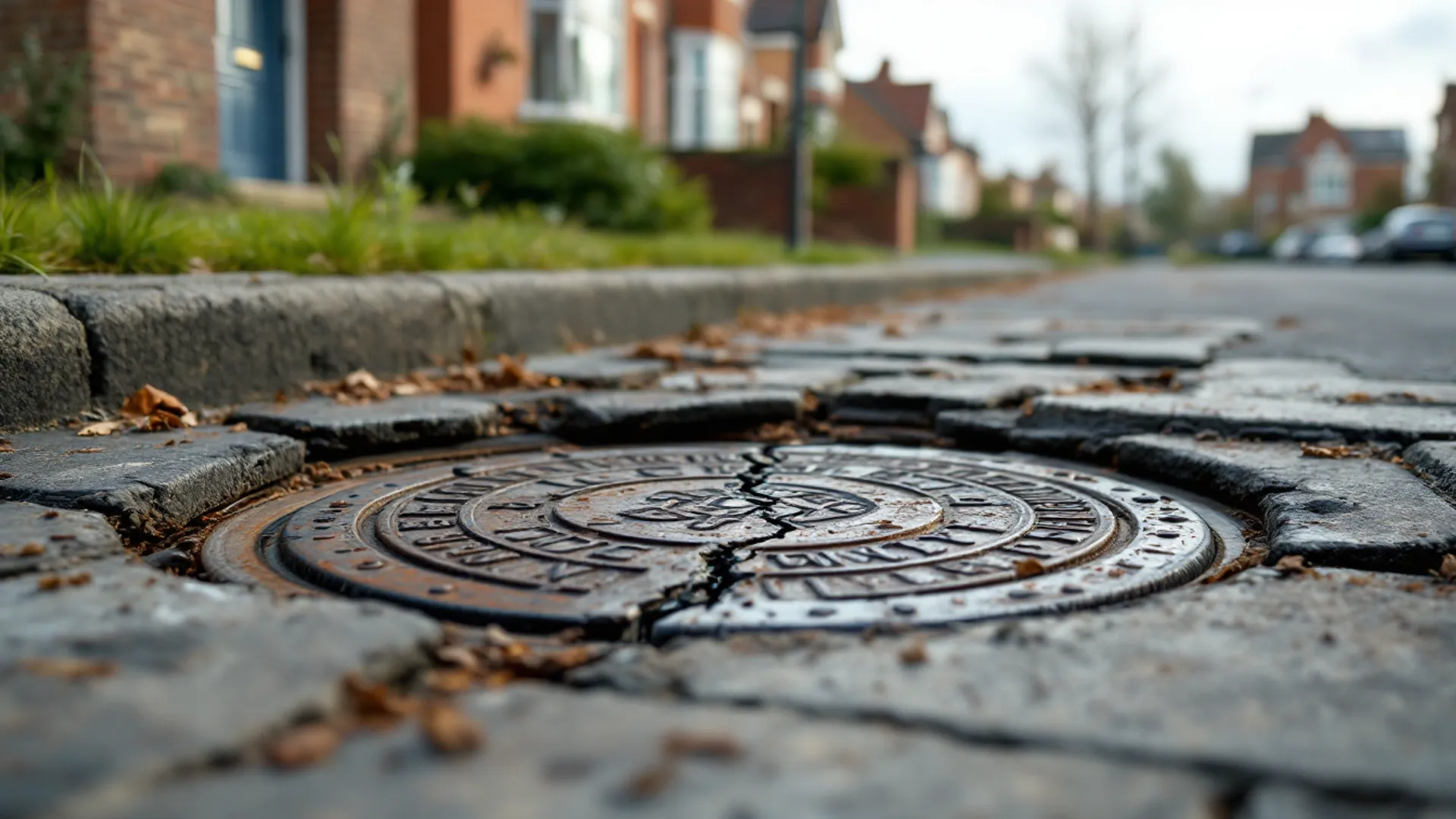
A damaged or ill-fitting manhole cover is a surprisingly common maintenance issue, and one that has more implications than just aesthetics. A cracked cover admits surface water and soil into the drain, allows sewer gas to escape, creates a trip hazard. In a driveway, can fail under vehicle loading. Here’s what to look for and how to choose the right replacement.
Types of manhole cover
Class A (light duty): However, pedestrian areas only. Not suitable for vehicles. Load rating 1.5 tonnes. Most garden inspection chambers use this type.
Class B (medium duty): Additionally, light vehicle loading — typical for driveways and domestic carparks. Load rating 12.5 tonnes.
Class C/D (medium to heavy duty): Specifically, higher vehicle loads, used in commercial areas and car parks. Load ratings up to 40 tonnes.
Class E/F (heavy duty): For example, roads and areas with heavy commercial vehicle traffic. Load ratings up to 90 tonnes. For public highway use only.
As a result, for domestic properties:
- Garden/lawn: Class A (pedestrian) — cast iron or plastic cover
- Driveway: Class B minimum — cast iron, ductile iron, or recessed cover with infill
- Adjacent to or in the road: Class D or above — this is typically the water company’s responsibility if it’s over a public sewer
Materials
Cast iron: Meanwhile, traditional material. Heavy, strong, and long-lasting. Self-sealing when properly seated on a frame. The most common in older properties. Cast iron covers can rust; surface rust is cosmetic, but deep corrosion can weaken the frame and cover body.
Ductile iron: Furthermore, stronger and less brittle than grey cast iron. More commonly used for Class D and above. Suitable for driveway use.
Plastic: In particular, lightweight, corrosion-resistant, typically green or black to blend with garden areas. Not suitable for vehicle loading. Fine for pedestrian areas in gardens.
Recessed (block infill): Consequently, a frame with a recessed tray that’s filled with matching block paving, tarmac, or concrete. Used in driveways to make the cover invisible within the paved surface. The most aesthetically desirable option for driveway covers.
Checking the frame
Similarly, before replacing the cover, assess the frame:
Is the frame sound? Moreover, frames can corrode or crack independently of the cover. A damaged frame allows the cover to rock, which causes rapid wear and ultimately cover failure.
Is the frame level? However, a sunken frame (the cover sits below the surrounding surface) indicates either the frame has subsided or the surrounding surface has risen. A sunken cover in a lawn is usually cosmetic; in a paved area, it creates a trip hazard and an overflowing runoff channel.
Does the cover seat correctly on the frame? Additionally, a rocking cover should be replaced; rocking accelerates edge wear and eventually the cover breaks.
Specifically, if the frame needs replacement (not just the cover), the work is more involved. The frame is embedded in concrete or mortar around the chamber walls and requires breaking out.
Measuring for replacement
For example, measure the frame opening (the clear opening — the size of the aperture, not the overall frame size). Standard UK frame openings are:
- 450mm × 450mm (single-seal, most common in gardens)
- 600mm × 450mm (rectangular)
- 600mm × 600mm (double-seal)
- 750mm × 600mm and larger for chambers requiring human entry (manhole covers as opposed to inspection chamber covers)
As a result, the frame size (outer dimension) and the clear opening (inner dimension) are both needed when ordering.
Installation
Replacing a cover only (frame in good condition): Meanwhile, this is a straightforward drop-in replacement. Clean the seating face of the frame, drop in the new cover. Check it sits flat and doesn’t rock. For covers with seating compound (old-fashioned lead-and-hemp seals), clean this out before fitting the new cover.
Replacing frame and cover: Furthermore, more involved. The old frame needs to be broken free from its mortar bed. The chamber top brickwork or concrete may need repair once the old frame is removed. The new frame is bedded in mortar (typically a semi-dry mix) and levelled carefully. The cover is fitted after the mortar has cured (24–48 hours). In a paved driveway, the surrounding paving may need to be lifted and reset to achieve a flush finish.
Recessed covers in paved driveways: In particular, the recessed frame is installed in the same way as a standard frame. Once cured, the recess is filled with the infill material (block paving, tarmac, or resin-bound gravel cut to size). If the infill material is block paving, individual blocks can be cut to fit; if it’s tarmac, a specialist is needed for a good finish.
What drives the price
| Scenario | What affects the price |
|---|---|
| Cover only replacement (garden, Class A) | Lightest-duty cover, simplest fit |
| Cover only replacement (driveway, Class B) | Heavier-duty cover for vehicle loading |
| Frame and cover replacement (garden) | Frame plus cover, garden setting |
| Frame and cover replacement (driveway, block infill) | Frame plus cover, driveway-rated |
| Recessed cover in tarmac driveway | Recessed infill needs a specialist finish |
Consequently, materials for a Class B cover (suitable for most domestic driveways) vary in price depending on size and material. Installation is straightforward but requires correct concrete or mortar work for a lasting result.