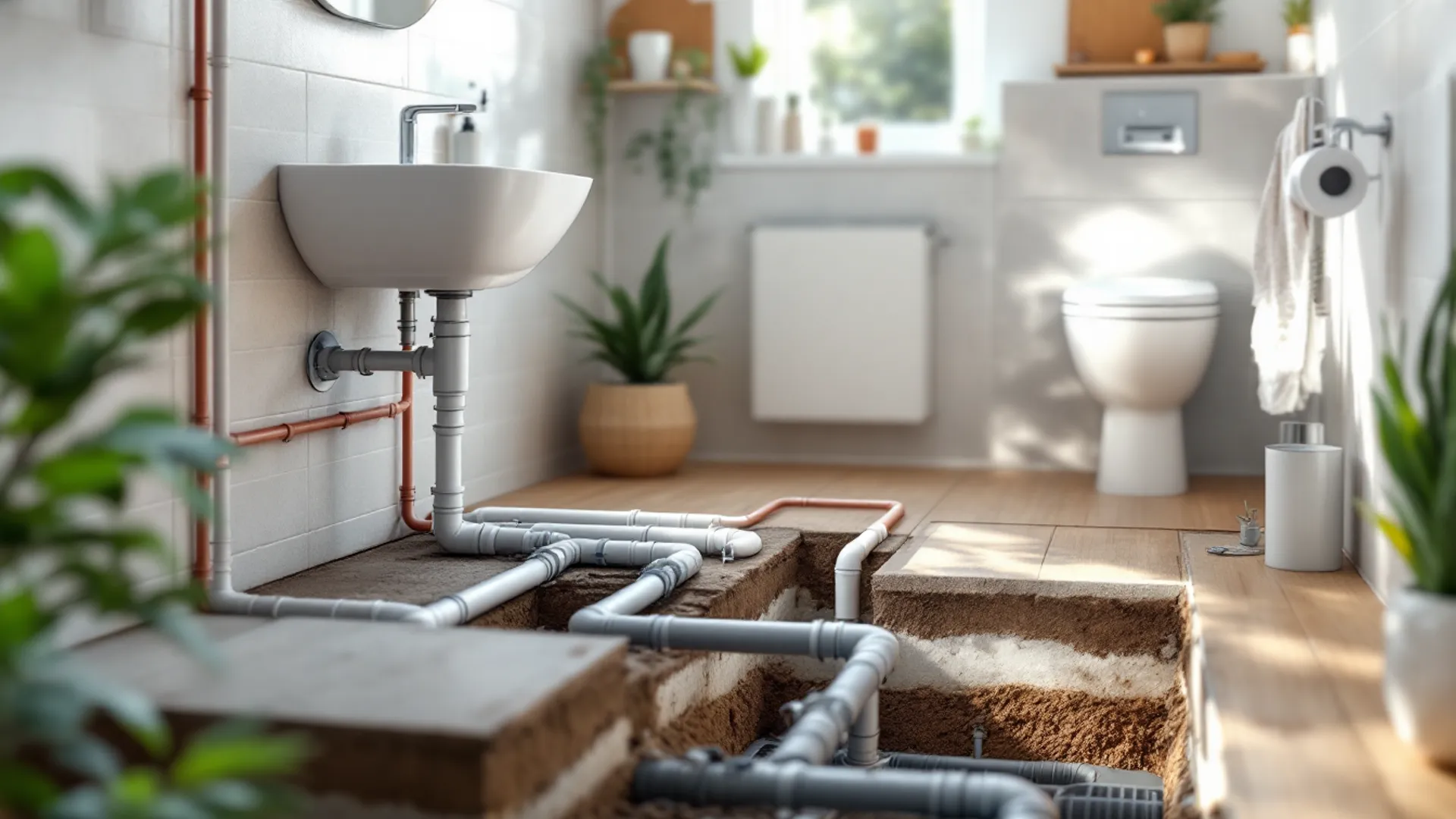
A new bathroom — whether a full family bathroom in a loft extension or an en-suite bathroom in a master bedroom — is one of the most transformative home improvements. It’s also one where drainage constraints can fundamentally affect what’s possible and where the installation will go. Getting the drainage design right before layouts are finalised prevents expensive changes later.
The drainage hierarchy: where the waste goes
However, every waste outlet in a bathroom (toilet, shower, bath, basin) produces wastewater that needs to reach the underground drain. The route it takes is constrained by:
Gradient: Additionally, waste pipes need to flow by gravity to the soil stack or external drain. For 40mm waste pipes (bath, shower, basin), a minimum gradient of 1:40 is required (British Standards). For 100mm soil pipes (toilet waste), 1:40 minimum, 1:80 acceptable if the flow rate is high enough to maintain self-cleansing velocity.
Specifically, if you’re adding a bathroom on the top floor of a property, the waste pipes need to run down from that floor to the soil stack. Which typically runs internally from the ground floor to above the roof. The run length and gradient affect how far the new bathroom can be from the soil stack.
Soil stack proximity: For example, toilets must connect to a soil stack (or directly to an outside drain at ground level). Soil stacks are typically 100mm pipes, and a toilet connection can normally be made anywhere along the stack length. The maximum distance from the toilet to the soil stack depends on pipe gradient, diameter, and whether the waste pipe remains within recommended limits. As a practical guide: 6m maximum for a single 100mm pipe at 1:40 gradient.
Above-ground run limits: As a result, bath and shower waste can run further than toilet waste before connecting to the soil stack (40mm pipe at 1:40 can run approximately 3m before gradient requirements become challenging). If the new bathroom is far from the soil stack, waste runs may need to be concealed in boxing, raised floors, or false ceilings.
Soil stack: the limiting constraint
Meanwhile, the soil stack position is usually the critical constraint on where a new toilet can go. If the new bathroom is far from the existing soil stack, options include:
-
Extend the waste pipe run: Increase the pipe diameter to 100mm (or 110mm) for the whole run, allowing a greater length before gradient becomes too steep.
-
Use a macerator/saniflo: A macerator unit grinds toilet waste and pumps it under pressure through a small-bore pipe (22–32mm) to the soil stack or a suitable outlet. This removes gradient and distance constraints entirely. Macerators allow toilets to be located almost anywhere in a property — but they have a pump that can fail, they’re noisier than gravity drainage, and they have running costs.
-
Add a new soil stack: A new 100mm stack can be run from the new bathroom down to the underground drainage. This is significant construction work but gives a clean, conventional drainage solution.
The building into the wall vs surface-mounted debate
Furthermore, new waste pipe runs can be:
- Boxed in (timber or plasterboard boxing, painted or tiled)
- Run in wall chases (routed into the plasterwork — labour-intensive but clean)
- Surface-mounted (visible pipes, acceptable in utility spaces, not typical in bathrooms)
In particular, the impact on the finished bathroom appearance is significant. Bathroom designers typically box in all pipework, but boxing reduces room dimensions. In a small en-suite, even 100mm of boxing around a soil pipe run noticeably reduces the space.
Wet room and shower room drainage specifics
Consequently, wet room floors must be tanked (waterproofed) and fall to the drain. The fall must be consistent — a typical specification is 1:60 fall from all edges to the drain. This means the floor level at the drain is lower than the floor level at the entry to the room by approximately 15–20mm for a 1m run.
Similarly, if the wet room is installed on a timber joist floor:
- Joists must be cut or notched to achieve the floor fall (this requires structural assessment)
- Or the floor is built up around the drain rather than the drain level being lowered
- Alternatively, a low-profile shower tray with a specific low-level drain can reduce the required fall depth
Moreover, the drain in a wet room must be accessible for maintenance. A floor drain cover that removed easily, and a waste trap that cleaned easily from above, is standard specification.
Where not to put a bathroom
Over structural beams: However, soil pipes and waste runs cannot cross major structural beams without significant structural work. Loft conversions particularly — any bathroom must work with the structural frame of the conversion.
Adjacent to a party wall in a terrace: Additionally, soil stack positioned on a party wall is possible but requires party wall notice procedures, appropriate noise insulation, and careful access design.
Where the waste has to run up: Specifically, gravity drainage runs down. Waste can’t run horizontally to find a route that then goes up to the stack — the gradient must be consistent downward. Macerators solve this but with the compromises noted above.
Building regulations notification
For example, any new bathroom installation (not just replacement like-for-like) is subject to Building Regulations Part P (electrical), Part L (energy efficiency), and Part H (drainage). In practice:
- The electrical work must be carried out or notified to a registered competent person
- New drainage connections must comply with Part H and be notified to building control or carried out by a competent person scheme member (such as CIPHE-registered plumbers)
- Completion certificate from building control protects you and future buyers
As a result, don’t skip the notification — properties with unauthorised bathroom additions can have difficulty with mortgage lenders and sales.