A blocked outside drain often doesn’t announce itself until the water is already pooling. Then it needs to be sorted quickly. Standing water around the foundation of a property, or backing up into an outbuilding, causes rapid damage. This guide covers what to do, common causes, how to clear it yourself, and when the water company (not you) is responsible.
What is an outside drain?
However, most properties have one or more of the following outside drainage points:
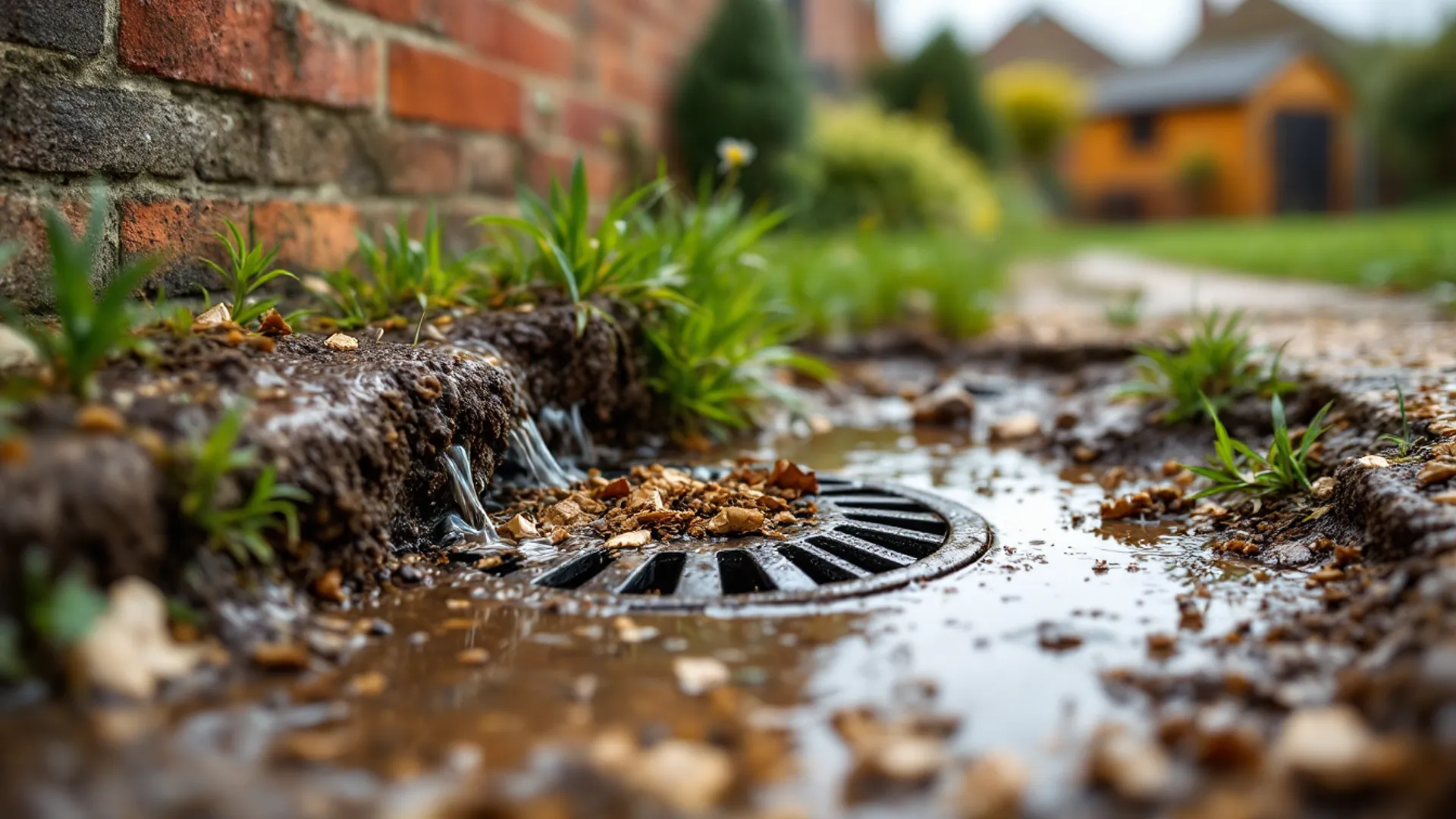
- Gully pots: Square or round drainage grates at ground level, collecting water from downpipes, kitchen outlets, utility outlets, and surface water
- Inspection chambers / manholes: Access points to the underground drain, with a solid cover at ground level
- Soakaways: Underground pits that allow water to drain into the surrounding soil (for surface water only)
- Channel drains / linear drains: Long drainage grates across driveways and paths
Additionally, a blockage can occur in the gully pot itself (collected debris, leaves, grease), in the underground pipe connecting to the sewer, or in the sewer beyond the property boundary.
Immediate steps when an outside drain is blocked
1. Identify which drain is affected. Specifically, is water backing up from one gully? Is the inspection chamber lid rising (indicating the drain is surcharging beneath it)? Knowing which outlet is the problem helps locate the blockage.
2. Remove surface debris. For example, with gloves, lift the gully grate and scoop out any accumulated debris — leaves, silt, moss, food waste from kitchen outlets. Sometimes the gully pot itself is completely full of compacted debris and this alone is causing the problem.
3. Flush with a hose. As a result, run a garden hose at full pressure into the gully for a minute. If water drains away normally, the blockage was in the pot or trap and you’ve cleared it. If water rises and backs up, the blockage is in the underground pipe.
4. Check the inspection chamber. Meanwhile, lift the manhole cover (use a screwdriver in the slot — they’re not bolted) and look inside. The channel should be clear and empty. If the chamber is full of water (or sewage), the blockage is downstream from this point. If the channel is clear and empty, the blockage is between the gully and the chamber.
5. Rod from the chamber. Furthermore, with drain rods, push into the outlet of the chamber towards the downstream sewer. Often you’ll feel the blockage. Repeated push-twist movements can sometimes clear it.
When to call a professional
In particular, if rodding from the chamber doesn’t work, or if the chamber is completely full, call a drainage engineer. An engineer with a jetting rig can clear almost any blockage from a downstream access point.
Consequently, professional equipment is essential for:
- Blockages more than 10–15 metres into the drain run
- Root ingress (rodding can’t cut through established roots)
- Grease blockages further down the system
- Any situation involving sewage backing up at ground level (health risk — don’t DIY this)
Common causes of outside drain blockages
Leaves and organic debris: Similarly, the most common cause of gully pot blockages, particularly in autumn. Regular clearing (once or twice a year with gloves and a scoop) prevents this.
Fat, oil and grease (FOG): Moreover, kitchen drain outlets carry grease from cooking. FOG cools and solidifies on the pipe walls, accumulating until the pipe is blocked. Jetting emulsifies and removes it.
Root ingress: However, tree and shrub roots enter through cracks or open joints in older clay pipe drainage. They grow over years to fill the pipe completely.
Collapsed pipe: Additionally, ground movement (particularly on shrinkable clay soils), vehicle loading over unprotected pipes, or age-related pipe failure can cause sections to collapse. Blockages at a collapsed section are persistent — they clear briefly and immediately recur.
Silt and sediment: Specifically, clay soils, sandy soils after heavy rain, and debris from construction activity can silt up drain runs. Regular jetting prevents accumulation.
Displaced joints: For example, pipes that have shifted out of alignment create a lip that catches debris. Each piece that catches creates the foundation for the next, until a full blockage forms.
Who is responsible for the blocked drain?
This question matters because responsibility determines who pays.
Your private drain: As a result, the pipe that connects your property to the sewer, running within your property boundary. Maintenance and blockage clearance is your responsibility.
The sewer: Meanwhile, from the point where your drain connects to the public sewer (marked on the water company’s sewer map), maintenance is the water company’s responsibility. You pay sewerage charges for this.
Shared drains: Some drains serve multiple properties before connecting to the sewer. Since the 2011 sewer transfer, most shared drains have become the water company’s responsibility — but check the sewer map to confirm.
How to check: Furthermore, your water company provides a public sewer map online (search “[water company name] sewer map” or look for “statutory map of public sewers”). The drains marked on your property are private; those in the highway or connecting multiple properties may have been adopted.
In particular, if the blockage is in the public sewer, report it to your water company. They have a legal obligation to clear it and do not charge for doing so.
How to prevent outside drain blockages
- Fit leaf guards to downpipe outlets (removes most leaf debris before it enters the drain)
- Don’t pour cooking oil or fat down the kitchen drain — let it cool, solidify, and bin it
- Clear gully pots annually (autumn, after leaf fall)
- Have drain runs jetted every 2–3 years as preventive maintenance, or annually if there are trees nearby
- If you have clay pipes and nearby trees, a CCTV survey every 3–5 years monitors root ingress before it becomes a full blockage