Pitch fibre pipe is a mid-20th century drainage material that was widely used in UK residential construction from approximately 1945 to 1970. It was cheaper and lighter than clay pipe and was installed in millions of post-war properties across Britain. It’s now reaching the end of its design life. And many of these pipes are failing, causing drainage problems in properties built or extended in the 1950s, 60s and early 70s.
What is pitch fibre?
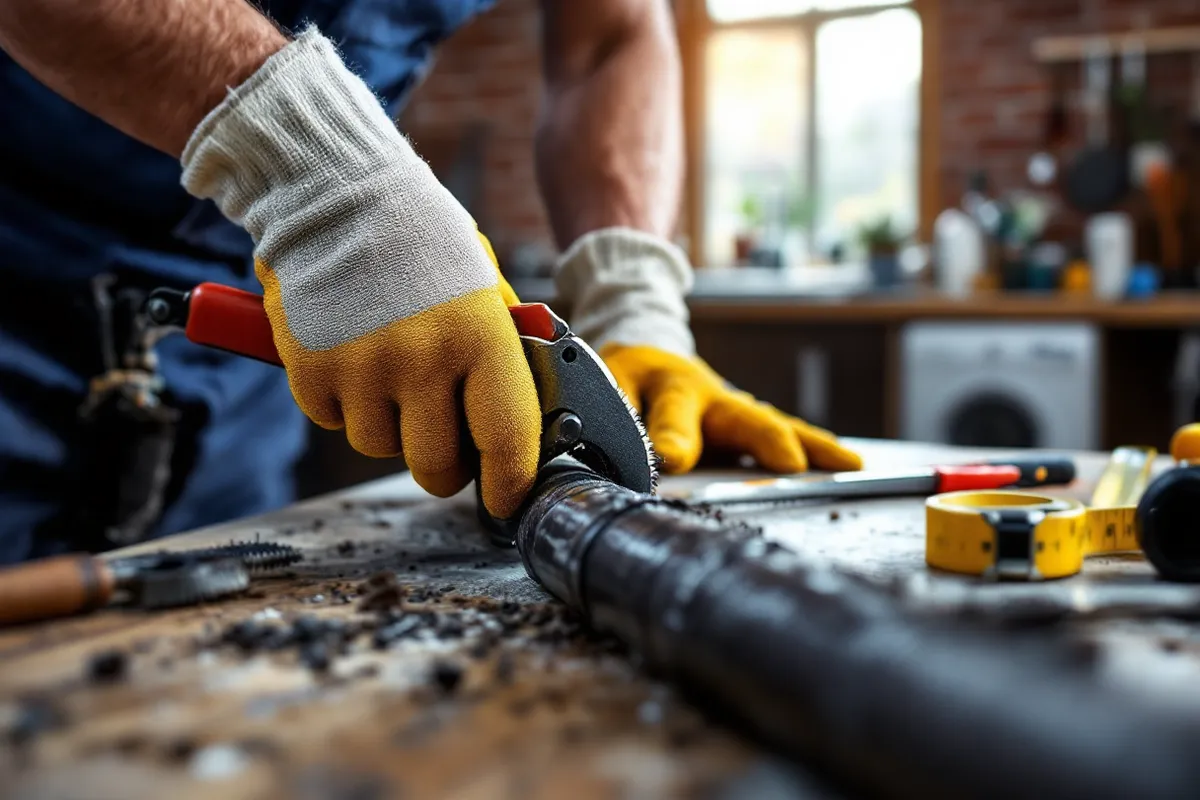
However, pitch fibre pipe (also called bituminised fibre pipe) is made from compressed wood cellulose fibres saturated with coal tar pitch. The resulting material is strong, light, moderately flexible, and was cheap to produce and install. It was used primarily for underground drainage (not water supply) and was installed in diameters of 75mm, 100mm and 150mm.
Additionally, unlike clay pipe, pitch fibre can’t be identified by appearance above ground — it’s underground. The only way to confirm whether a property has pitch fibre drainage is a CCTV drain survey.
How to identify pitch fibre on CCTV
Specifically, pitch fibre looks distinctly different from clay or plastic on a drain camera:
- Colour: Typically dark brown to black, with a slightly fibrous texture
- Shape: The critical indicator — pitch fibre ovulates (deforms) under load and over time. Instead of the circular cross-section of a healthy pipe, pitch fibre pipes deform into an oval or egg shape. Severe cases look almost flat.
- Surface condition: Delamination (the inner surface peeling in layers) is common in older pitch fibre. Flaking, rough internal surface.
- Joints: Pitch fibre used push-fit coupling sleeves. These joints can slip apart as the pipe body contracts and expands over decades.
Why pitch fibre fails
Deformation (ovalling): For example, this is the primary failure mode. Pitch fibre softens under ground pressure and thermal cycling. The pipe body slowly flattens, reducing the bore, causing blockages, and eventually collapsing. Deformation is progressive — a mildly ovalled pipe will continue deforming.
Delamination: As a result, the fibrous layers separate, creating flaps that catch debris and eventually block the pipe. Delaminated material washes downstream and can block inspection chambers.
Joint displacement: Meanwhile, as the pipe body shrinks and moves, the push-fit coupling joints slip. This creates open joints that allow infiltration (groundwater in) and exfiltration (sewage out).
Blistering: Furthermore, in some cases, hot water (from kitchen drains or heating system overflow pipes) causes blistering — raised bubble formations on the internal surface that reduce the bore.
What to do if you have pitch fibre pipes
Step 1: Get a CCTV survey. The survey establishes the current condition of your pitch fibre drainage:
- What proportion of the pipe has deformed and by how much?
- Are there active joints that have slipped?
- Are there areas of delamination?
- Is the overall drain still functional?
In particular, the severity rating guides the urgency of action. Mildly deformed pitch fibre may be functional for several more years; severely ovalled or partially collapsed pitch fibre needs prompt action.
Step 2: Understand your options.
Option A — Proform/rounding tool treatment: Similarly, a specialist hydraulic pig tool is driven through the pitch fibre pipe to physically round it back to its original circular cross-section. This requires specific conditions — the pipe must have sufficient residual strength to be re-rounded without fracturing. Not all pitch fibre is suitable (heavily delaminated or severely deformed pipes can’t be re-rounded). Where it works, the rounded pipe is immediately relined.
Option B — CIPP relining (with or without re-rounding): Moreover, after re-rounding where possible, or directly for mildly deformed pipes, CIPP lining is installed. The liner is resistant to the biological environment of the drain and, critically, is circular — providing a new pipe interior that resists deformation. The liner is installed inside the existing pitch fibre shell.
However, For pitch fibre, relining is technically more challenging than relining clay pipes. The ovalled shape makes achieving a consistent liner contact more difficult. Ensure the contractor has specific experience relining pitch fibre.
Option C — Excavation and replacement: Additionally, for severely deformed or collapsed pitch fibre, or where relining is not technically viable, excavation and replacement with UPVC is the only option. Given the age of these properties and the typical depth of installation, this is often a significant disruption.
Cost comparison
| Option | What affects the price |
|---|---|
| Re-rounding + relining | Extra step to correct the shape first |
| Relining only (mild deformation) | Least involved, when the pipe qualifies |
| Excavation and replacement | Most involved — full dig and replace |
Pitch fibre and house purchase
If you’re buying a post-war property (built between approximately 1945 and 1975), pitch fibre drainage is a meaningful risk that a standard structural survey will not identify. A pre-purchase CCTV drain survey for these properties should specifically look for pitch fibre and assess its condition.
Specifically, finding pitch fibre in a pre-purchase survey is not necessarily a deal-breaker — but it is a negotiating point. The cost of relining or replacement depends on scope and needs factoring into the purchase price, or the seller needs asking to address the issue before completion.
Does my lender care about pitch fibre?
For example, some mortgage lenders will flag pitch fibre drainage in a survey report and require either a condition report (CCTV) confirming it’s functional, or evidence of relining before lending. If you’re in this situation, commissioning and completing the relining before completion resolves the lending issue.