Plumbing myths circulate persistently because they’re often partially true, passed down from a time when plumbing was different, or simply feel intuitively correct. Here are ten myths that lead UK homeowners to make decisions that cost more than the correct action would have.
Myth 1: “Bleach unblocks drains”
Reality: However, bleach is an oxidising disinfectant. It kills bacteria and whitens stains. It does not dissolve fat, hair, soap scum, or the vast majority of organic material that causes domestic blockages. Pouring bleach into a blocked drain achieves nothing except disinfecting the standing water.
Additionally, what actually works: enzyme/biological cleaners (for maintenance), caustic soda (for grease and hair, with hazard precautions). Mechanical removal (hair removal tools, plunger) for the physical blockage.
Myth 2: “Flushable wipes are safe to flush”
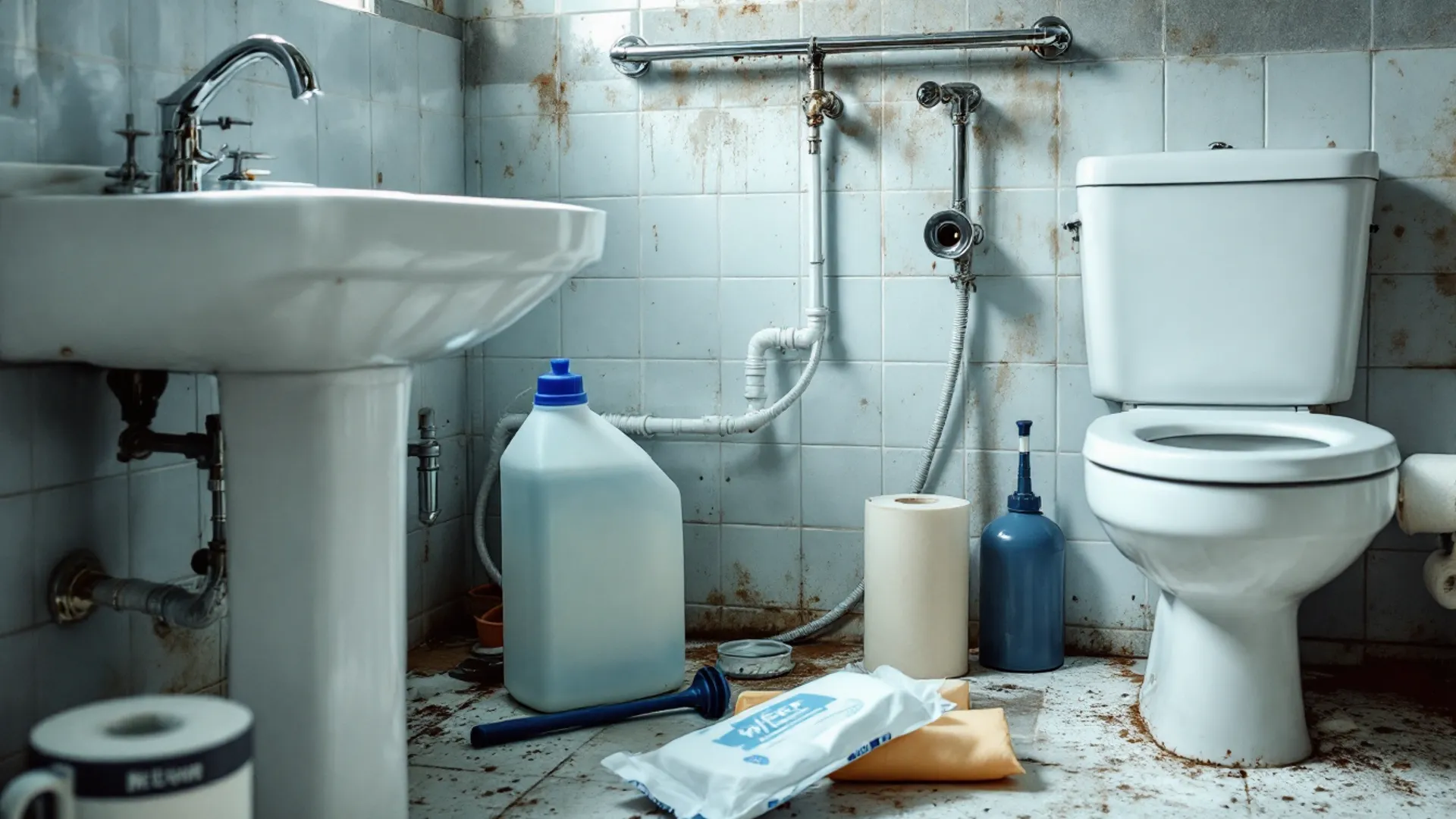
Reality: Specifically, despite being labelled “flushable”, the vast majority of wet wipes are made from non-woven synthetic fibres that do not disintegrate in water the way toilet paper does. They bind with grease in sewers, forming “fatbergs” — dense solid masses that cause major blockages. The UK’s water companies remove hundreds of tonnes of wet wipe material from sewers every year.
For example, only toilet paper needs flushing. Everything else — including products labelled “flushable” — should go in the bin.
Myth 3: “Running hot water while pouring fat down the drain prevents blockages”
Reality: As a result, hot water liquefies fat and carries it a short distance down the drain. As the water cools (which happens within a few feet of the sink in an underground drain), the fat resolidifies and deposits on the pipe wall. You’ve moved the deposit from the visible trap to the less-accessible underground section.
Meanwhile, the correct approach: let fat cool, solidify, and go in the bin.
Myth 4: “You don’t need to bleed radiators if the heating works”
Reality: Air accumulates in central heating systems constantly — from micro-seepage, from the water supply, and from hydrogen gas produced by corrosion. Radiators with air pockets at the top have reduced output because hot water can’t fill the full volume. The radiator still heats, but not at its full capacity.
Furthermore, annual bleeding maintains full radiator output and reduces the load on the boiler, slightly reducing gas consumption.
Myth 5: “More water pressure is always better”
Reality: In particular, excessively high water pressure (above approximately 3 bar) accelerates wear on washing machine and dishwasher solenoid valves, causes water hammer, stresses pipe joints, and increases water usage. UK water regulations specify that mains pressure should not exceed 7 bar at the boundary, but internal pressure above 3 bar causes problems.
Consequently, a pressure-reducing valve (PRV) installed on the mains supply protects all downstream fittings if your mains pressure is very high. Symptoms of high pressure: taps that spit rather than flow smoothly, water hammer in pipes, appliances failing unexpectedly.
Myth 6: “You don’t need a CCTV survey if the drain isn’t blocked”
Reality: Similarly, the most expensive drainage problems are structural defects that don’t cause blockages until they’re at a catastrophic stage. A displaced joint, a slow root ingress, or a section of pitch fibre gradually ovalling all proceed silently for years. When they finally cause a blockage, the underlying defect is often at D4–D5 severity.
Moreover, CCTV surveys on older properties every 3–5 years identify developing defects at D2–D3 stage, when the cheaper relining option is still available — not D4–D5 stage, where more expensive excavation may be required.
Myth 7: “All boiler pressure drops mean a leak”
Reality: However, very gradual pressure drops (losing 0.2–0.3 bar over 2–3 months) are within normal parameters for a sealed system. Some micro-seepage through joints and fittings is normal. If you’re repressurising once every 6 months, that’s probably fine.
Additionally, rapid pressure drops (losing 0.5+ bar in a week), or pressure that requires frequent repressurising, indicates a real leak. Either in the system pipework or at the pressure relief valve. These need investigation.
Myth 8: “Chemical descalers can fix a kettling boiler”
Reality: Specifically, a kettling boiler (the rumbling or banging sound when heating) is caused by scale on the heat exchanger. Chemical descalers introduced through the filling loop can help with mild scale, but established scale (after years without inhibitor maintenance) requires either a full powerflush with descaling chemistry, or heat exchanger replacement.
For example, chemical descalers are maintenance products. They prevent and slow scale formation; they are not adequate treatment for a boiler that’s already seriously scaled.
Myth 9: “You can’t reline a drain under a building”
Reality: CIPP relining is specifically valuable for drains in inaccessible locations — under buildings, under slabs, under drives. Provided there’s an access point at each end of the defective section, the liner can be introduced and pulled through the pipe from above or below. This is precisely the scenario where relining offers the greatest advantage over excavation.
Myth 10: “Old clay drains always need replacing”
Reality: As a result, victorian clay drainage in stable ground with good jointing can last indefinitely. The pipe body of vitrified clay is chemically inert and mechanically strong. What deteriorates is the jointing. Where joint deterioration is present, CIPP relining seals the affected joints without touching the clay pipe body.
Meanwhile, the assessment of whether clay drains need replacing comes from a CCTV survey — not from their age. A 100-year-old clay drain in good condition is fine; a 50-year-old pitch fibre drain with significant deformation may need replacing.