Walk down the cleaning aisle of any supermarket and you’ll find shelf after shelf of drain cleaning products. The marketing is confident: pour in, wait, clear drain. The reality is more nuanced. Chemical drain cleaners work well for some types of blockage and are largely useless for others — and some are genuinely hazardous. Here’s an honest assessment.
The three chemical types and what they actually do
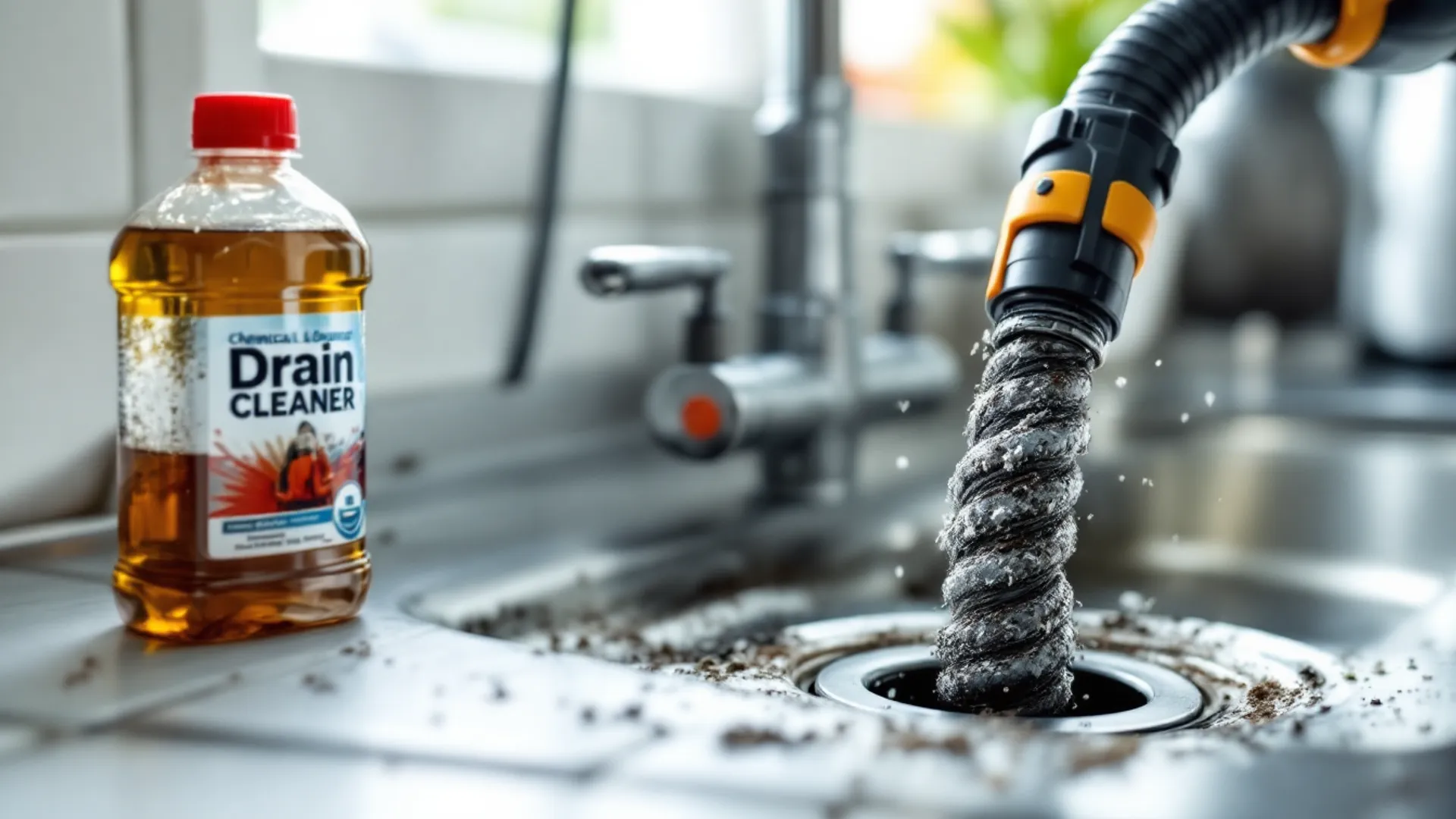
Caustic/alkaline cleaners (sodium hydroxide, lye): However, these are the most powerful over-the-counter chemical drain cleaners. Sodium hydroxide (caustic soda) dissolves proteins, fats and grease through a saponification reaction. It generates heat as it reacts with water, which helps melt solidified fat. Examples: Mr Muscle Advanced Gel, Drano Max Gel.
Additionally, Effective for: Fresh, soft grease and soap blockages in kitchen drains. Hair blockages (hair is protein and dissolves in caustic solutions, given enough time).
Specifically, Not effective for: Solid foreign objects, root ingress, compacted grease deep in the pipe, mineral scale.
For example, Hazards: Caustic soda is seriously corrosive. Contact with skin, eyes or mucous membranes causes chemical burns. Dangerous if mixed with acidic drain cleaners (toxic chlorine gas). Damages chrome fittings and can, over repeated use, soften push-fit plastic joints. Do not use on aluminium pipes.
Acid cleaners (sulfuric acid, hydrochloric acid): As a result, stronger than caustic cleaners, these dissolve mineral scale, hair, soap scum and organic matter. Generally not available in standard retail (only from specialist trade suppliers in the UK). Used by professionals in specific circumstances.
Meanwhile, Hazards: Extremely corrosive. Can react explosively with caustic cleaners if the drain hasn’t been thoroughly flushed between uses. Not suitable for most DIY applications.
Enzyme/biological cleaners (Buster, Bio-Drain, Harpic Odour Fresh): Furthermore, contain bacterial cultures and enzymes that digest organic matter — fat, soap, hair, food residue. Work slowly (24–72 hours) but safely. Non-corrosive, safe for all pipe materials, safe to use regularly as maintenance.
In particular, Effective for: Maintenance (preventing slow build-up), soft organic blockages, eliminating odours. Not effective for: Established dense blockages (insufficient penetrating force), inorganic blockages, anything beyond organic matter.
Chemical vs mechanical: what actually clears a blockage
For a fully or significantly blocked drain, chemical cleaners have one fundamental limitation: they can’t penetrate to the blockage if the drain is full of water. The chemical sits on top of the standing water and has little contact with the blockage material. This is why many people try chemical cleaners, wait, and find the drain still blocked.
Consequently, mechanical methods — plunging, rodding, or professional jetting — work directly on the blockage material regardless of water depth.
Comparison by blockage type:
| Blockage type | Chemical (caustic) | Biological | Mechanical (DIY) | Professional jetting |
|---|---|---|---|---|
| Fresh grease (kitchen) | ✓ | ✓ (slow) | Limited | ✓✓ |
| Hair (bathroom) | ✓ (slow) | Limited | ✓✓ (snake) | ✓✓ |
| Toilet paper accumulation | Limited | Limited | ✓ (plunger) | ✓✓ |
| Foreign object | ✗ | ✗ | ✓ (snake/auger) | ✗ (retrieval needed) |
| Root ingress | ✗ | ✗ | ✗ | ✓✓ (cutting nozzle) |
| Underground grease accumulation | ✗ | ✗ | ✗ | ✓✓ |
| Collapsed pipe | ✗ | ✗ | ✗ | ✗ (structural repair) |
When chemical cleaners are the right choice
- Slow drain (not fully blocked) in kitchen: A weekly enzyme treatment and monthly caustic treatment can maintain flow and prevent full blockage
- As a maintenance product: Enzyme cleaners used monthly keep drain walls clean
- Bathroom hair removal follow-up: After mechanically removing the hair plug, an enzyme cleaner digests the residual organic coating
When chemical cleaners waste your time and money
- Fully blocked drain with standing water: The chemical has no pathway to the blockage
- Root-filled drain: No chemical will dissolve woody roots; mechanical cutting is needed
- Underground section: Chemicals dilute too quickly in the water column to reach blockages more than a few metres into the system
- Foreign object blockage: A toy, wipe, or bottle cap requires retrieval, not chemistry
Safety precautions for caustic drain cleaners
Similarly, if you do use caustic drain cleaners:
- Wear rubber gloves (not cloth gloves) and eye protection
- Never mix with other drain cleaning products (particularly acidic ones)
- Ventilate the area — fumes are irritating
- Don’t use in a fully blocked drain where the chemical will have no drainage
- Flush thoroughly with large amounts of cold water after treatment
- If contact with skin occurs, flush immediately with large amounts of cold water; seek medical advice if irritation persists
The professional option: high-pressure jetting
Moreover, for blockages that don’t respond to DIY methods, professional high-pressure jetting is the universal solution. Water at 2,000–4,000 psi:
- Penetrates standing water to reach the blockage
- Dislodges any organic blockage type (grease, hair, food, soap)
- Cleans the pipe walls after clearing the central blockage
- Works through root masses with a cutting nozzle
- Priced individually for a standard domestic clearance
This is cheaper, faster, and more effective than repeated chemical treatments that don’t work. If you’ve tried chemicals twice and the drain is still slow or blocked, call a drainage engineer.