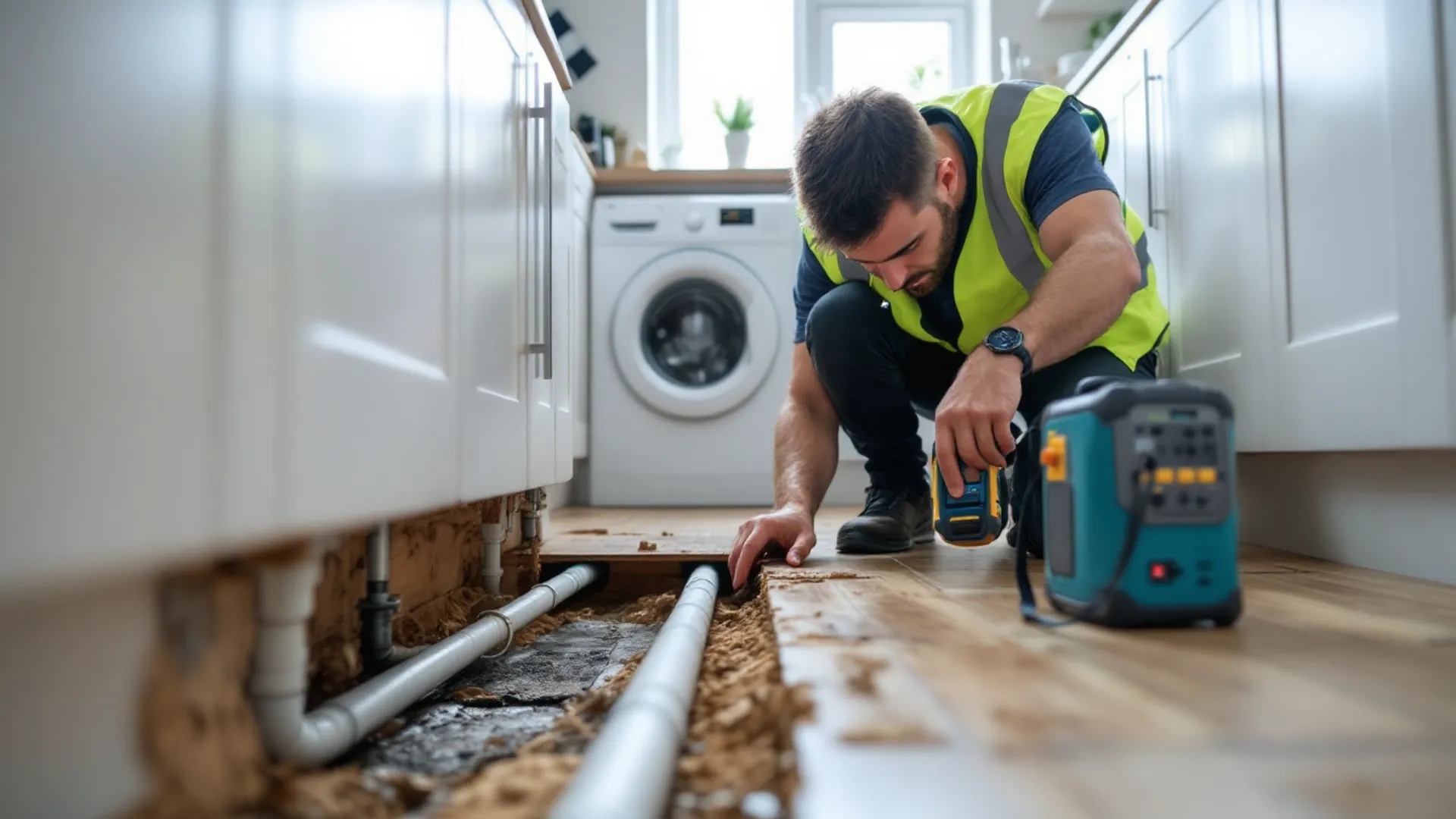
Leak detection surveys locate hidden water leaks in buried pipes and concealed plumbing without destructive investigation. The cost of the survey is almost always less than the cost of exploratory excavation. And far less than the cost of water damage if the leak continues undetected.
What drives leak detection pricing
| Scenario | What affects the price |
|---|---|
| Residential investigation, single system | The most straightforward case |
| Residential investigation, complex/multiple systems | More systems to check |
| Underground supply pipe, acoustic correlation | Depends on pipe access |
| Thermal imaging survey (underfloor heating, hot pipe) | Depends on the pipe run |
| Tracer gas investigation | More time-consuming than acoustic |
| Commercial property investigation | Scaled to system size |
| Full investigation including written report | An add-on to any of the above |
Every survey is quoted individually once the scope is confirmed, and includes VAT. Request a free quote and we’ll give you a fixed price before we start.
What’s included in a leak detection survey
Additionally, a residential leak detection survey typically includes:
- Initial assessment and meter test to confirm and quantify the leak
- Investigation using the appropriate technology (acoustic, thermal, or gas) for the suspected leak type
- Identification of the leak location to within 10–30cm
- Verbal report of findings
- Recommendation for repair
Written report: Specifically, a detailed written report with photographs, the investigation methodology, findings, and repair recommendations is usually quoted as a supplement or included in the higher-priced packages. For insurance claims, a written report is essential.
What drives the cost
Duration of investigation: For example, a simple leak in a visible pipe takes 30 minutes. A leak in a buried supply pipe under a concrete driveway, where the pipe run is long and access points are limited, may take 3–4 hours of correlation work.
Technology required: As a result, acoustic correlation is the most efficient for pressurised pipes. When the pipe layout makes correlation impossible (very short runs, unusual materials), tracer gas is needed — a more time-consuming process that requires draining and re-pressurising the pipe, adding cost.
Multiple systems: Meanwhile, if the meter test shows a leak but it’s not clear whether it’s in the supply pipe or the heating circuit, or whether it’s in the foul drain (another type of leak detection entirely), investigating multiple possibilities increases cost.
Access difficulty: Furthermore, if the suspected leak area is under a heavily built-up section (under a garage slab, under a conservatory, beneath a thick concrete raft), the acoustic sensitivity needed is higher and the investigation takes longer.
Location: In particular, London and south east England typically command a premium on all trade prices.
The cost of not finding the leak
Consequently, a hidden leak that’s not located and repaired:
-
Continuous water loss: a small leak (dripping rate) loses 15–30 litres per day; a significant leak loses 100+ litres per day. On a metered supply, every litre lost is a litre you’re paying for.
-
Structural damage: water in the soil around a building affects foundation stability. Water under a concrete slab causes corrosion of rebar and slab degradation. Water in a floor void causes timber decay and mould.
-
Insurance claim costs: a leak that causes significant structural damage may result in a claim for tens of thousands — the deductible alone typically exceeds the cost of finding the leak in the first place.
-
Progressive worsening: leaks don’t self-heal. A hairline crack in a pipe under pressure widens over time.
When to call a leak detection specialist vs a plumber
Call a plumber Similarly, if:
- The leak is visible (you can see or hear it)
- It’s in an accessible above-ground pipe
- The location is obvious from the drip, stain, or wet patch
Call a leak detection specialist Moreover, if:
- The meter test confirms a leak but you can’t find it
- You have a damp patch on a wall or floor with no visible cause
- The boiler pressure keeps dropping (indicating a heating circuit leak)
- A pipe runs through a wall or floor that would need to be opened to investigate without technology
- The leak is suspected in a buried supply pipe
However, a general plumber who “has a go” at finding a leak by opening up walls or floors without specialist equipment can cause significant collateral damage without finding the leak. Specialist leak detection is almost always the right first step once the leak is confirmed but not visible.
Insurance and leak detection
Additionally, many home insurance policies include a trace and access provision. Covering the cost of locating (tracing) and accessing a leak, even if the repair cost isn’t directly covered. This provision typically covers:
- Leak detection survey cost
- The cost of exposing the pipe (cutting tiles, lifting floorboards, creating a small excavation)
- Not the repair of the pipe itself (unless covered elsewhere in the policy)
Specifically, check your policy schedule for the exact trace and access limit. If you have this cover, report the suspected leak to your insurer before commissioning leak detection. They may arrange an approved contractor and cover the cost directly.