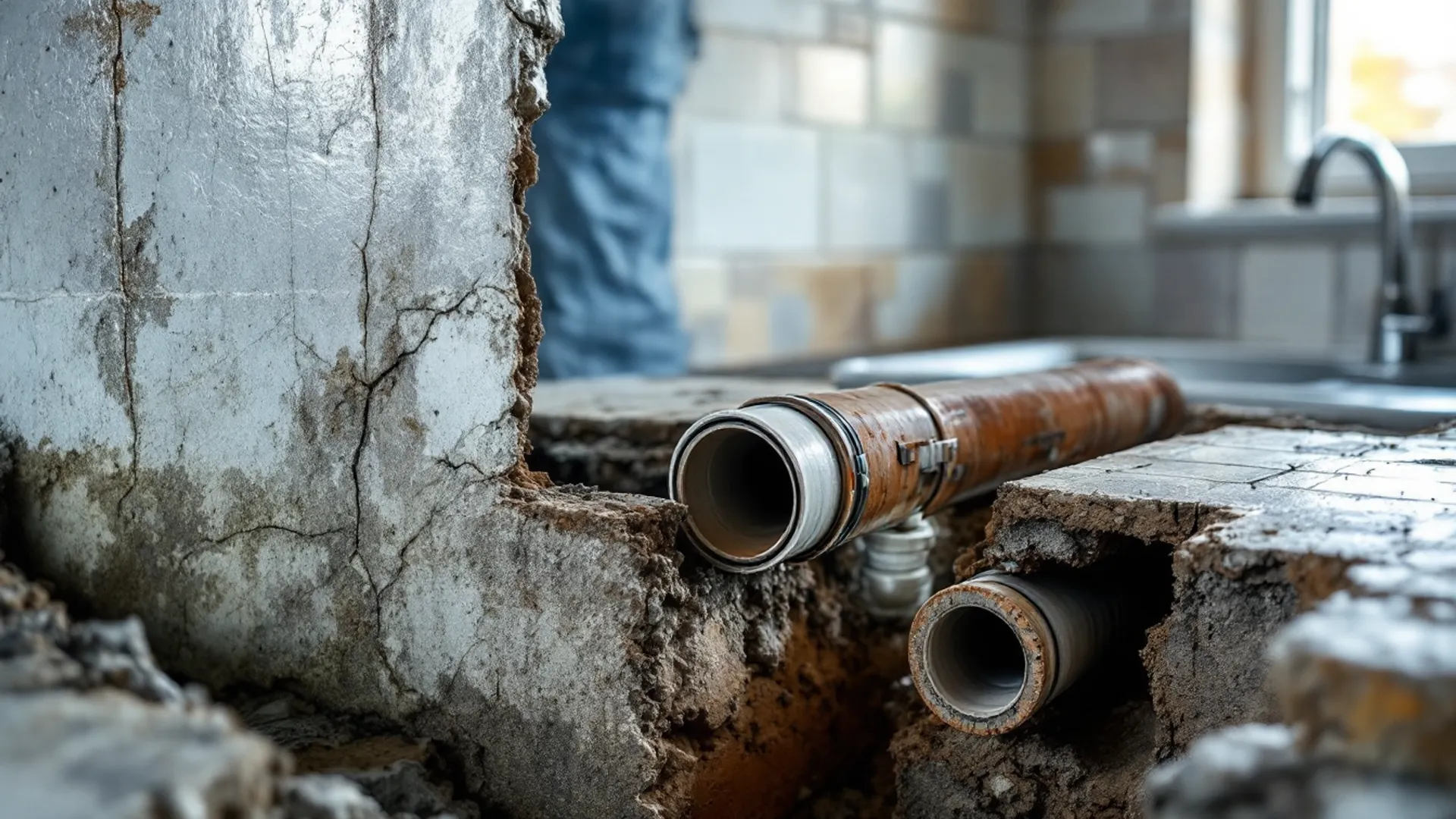
The question of whether to repair or replace drain pipes is one of the most significant decisions in drainage maintenance. And one where the advice you get significantly depends on who you ask. A relining contractor may favour lining every defect; an excavation contractor may lean toward replacement. Understanding the decision criteria independently helps you evaluate advice and choose the right solution.
How long do drain pipes last?
Vitrified clay pipes — the Victorian and Edwardian standard — are chemically inert and structurally strong. A well-laid clay drain in stable ground can last 100+ years. What degrades is the jointing: the cement-and-hemp joints used until the mid-20th century crack and open up over time, allowing root ingress and ground water infiltration. The pipe body may be sound while the joints have failed.
Pitch fibre pipes However, — used in the 1950s–70s as an alternative to clay — have a finite lifespan that many are now reaching. Pitch fibre (a paper-based pipe impregnated with bitumen and pitch) deforms under load, particularly in warm or wet soils. Delamination, ovalling, and collapse of pitch fibre pipes is now extremely common in properties from this era. Most pitch fibre drainage needs either lining or replacement.
UPVC/plastic pipes Additionally, — the standard from the 1970s onward — have a much longer theoretical lifespan (50+ years) and are largely trouble-free unless subjected to physical damage, ultraviolet degradation (above-ground), tree root intrusion at joints, or poor installation (insufficient gradient, lack of bedding support).
Concrete pipes Specifically, — used in commercial and public drainage — can last indefinitely in good conditions but are vulnerable to aggressive groundwater, sulfide corrosion in sewers (the “crown rot” that attacks concrete from the top), and physical damage from ground movement.
Signs drain pipes need attention
Persistent or recurring blockages: For example, if the same drain blocks every few months despite professional clearance, there’s a structural reason — a partial collapse catching debris, a displaced joint, or established root growth. CCTV identifies which.
Multiple outlets draining slowly simultaneously: As a result, suggests the underground main run has developed a restriction — either a building blockage or a structural deformation narrowing the bore.
Subsidence or ground movement: Meanwhile, cracking in driveways or paths directly above buried drain runs, or settlement in areas where drain pipes lie, can indicate drain failure affecting the surrounding ground.
Sewage smell indoors or in the garden: Furthermore, an exfiltrating pipe (one leaking sewage outward) creates ground contamination and gas migration into buildings. See our sewer smell guide.
Garden areas persistently wet in dry weather: In particular, groundwater from a leaking drain saturates the surrounding soil, creating soft spots and wet areas directly above the drain run.
Root growth patterns: Consequently, vigorous plant growth in a strip above the drain run in dry weather — the drain is acting as an irrigation pipe.
The CCTV survey: the decision-making tool
Similarly, no informed decision about drain replacement or repair can be made without a CCTV condition survey. The camera footage and resulting report show:
- The type of defect (crack, fracture, deformation, collapse, root ingress, displaced joint)
- The severity of each defect using standardised grading (WRc D1–D5 for structural defects)
- The location of each defect measured from the access point
- The extent of affected pipe — one section, or the whole run?
Moreover, this information drives the decision:
- D1–D2 defects: Minor — monitor, or reline as precaution
- D3 defects: Moderate — remediation required; relining usually appropriate
- D4–D5 defects: Severe/critical — urgent action; relining or excavation depending on type
- Collapse: Excavation required
Relining (CIPP) vs excavation: the decision matrix
| Defect type | Relining appropriate? | Excavation required? |
|---|---|---|
| Hairline longitudinal cracks | Yes | No |
| Root ingress through joints | Yes (after root cutting) | No |
| Displaced joints (minor–moderate) | Yes | No |
| Severe joint displacement | Possible | Sometimes |
| Deformed pipe (pitch fibre, under 20%) | Yes | No |
| Collapsed section | No | Yes |
| Severely deformed pipe (over 25%) | No | Yes |
| Open fractures with soil ingress | Depends | Often yes |
| Subsidence affecting pipe alignment | No | Yes |
The excavation process: what to expect
However, when excavation is unavoidable, the typical process is:
- Mark-up and protection: Service marks (gas, water, electric) are checked. The surface above the excavation is marked and photographed.
- Excavation: By hand or mini-digger depending on depth and access, typically 0.6–2.5m depth for domestic drains
- Pipe exposure and assessment: The failed section is exposed. The exact failure is visible — a useful confirmation before committing to new pipe.
- Pipe replacement: New UPVC or clay pipe is laid to the required gradient, bedded in gravel or sand, and jointed.
- Inspection chambers: If the chamber was part of the failure, it’s replaced with a modern pre-formed unit.
- Backfill and reinstatement: The excavation is backfilled in compacted layers; the surface is reinstated.
- CCTV confirmation: A camera pass of the new work confirms correct installation before the trench is closed.
Relining vs excavation: what drives the price
Additionally, a general comparison for a typical 3-metre defective section of 100mm domestic drain:
| Solution | What affects the price |
|---|---|
| Spot CIPP relining, 3m | Least disruptive, no digging |
| Excavation and relay, 3m, garden | Lawn is the simplest surface to reinstate |
| Excavation and relay, under path/drive | Paving adds reinstatement work |
| Excavation under a concrete slab | Most involved — breaking out and replacing concrete |
Specifically, the cost advantage of relining is significant, which is why it’s the first choice for most defects. The situations where excavation wins on cost are rare: when the defect is very severe and covers the full pipe section, or when the pipe is in a location where relining access is impossible.