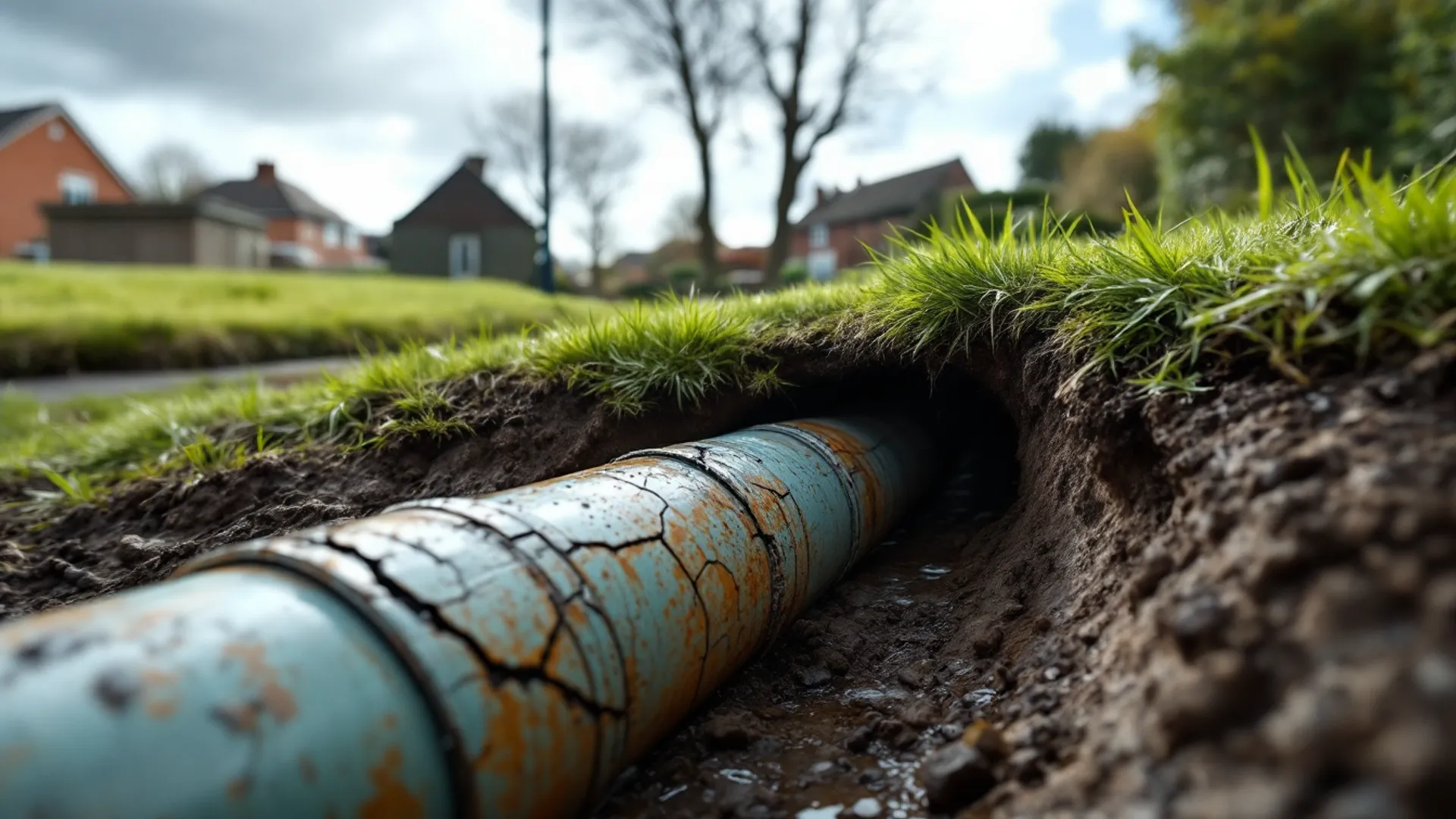
Pitch fibre pipe — a bitumen-impregnated paper pipe widely used as an economical alternative to clay in post-war housing — was installed at scale across the UK between approximately 1945 and 1975. Properties in this age bracket across the UK now represent a significant drainage risk: pipe installed in that era is now 50–80 years old, at or beyond the end of its expected life.
What is pitch fibre?
Pitch fibre was a wartime innovation that offered a cheaper, lighter alternative to the traditional vitrified clay pipe. It was manufactured from paper or wood pulp impregnated with bitumen and coal tar pitch. Unlike clay, pitch fibre is not inert — it degrades over time, softening and deforming under load and soil pressure.
The characteristic failure mode is ovalling: the pipe’s circular cross-section deforms into an oval shape, progressively restricting flow and eventually trapping debris until the pipe blocks entirely. In advanced cases, pitch fibre pipes collapse and require excavation.
How to identify pitch fibre
You cannot tell from above ground whether your property has pitch fibre drainage. A CCTV survey is the only reliable method. On camera, pitch fibre is identifiable by its dull dark surface (compared to the glassy surface of clay), the characteristic oval deformation, and often visible delamination at the inner surface.
What are your options?
Early-stage pitch fibre deformation (less than 20% ovalling) can often be addressed by CIPP relining — inserting a resin liner that forms a new pipe inside the old one. This is significantly cheaper than excavation and suitable in most cases where access is available at both ends of the affected run.
More advanced deformation or collapse requires excavation and replacement with modern UPVC pipe.
What to do now
If your property dates from 1945–1975 and you haven’t had a CCTV drain survey in the last five years, book one now. Identifying pitch fibre deformation at an early stage gives you the option of relining rather than the more disruptive and expensive excavation route.
Contact us to arrange a CCTV drainage condition survey. We carry out WinCan-compliant surveys with HD footage and written reports, including a clear assessment of any pitch fibre found.