Drains Cleared
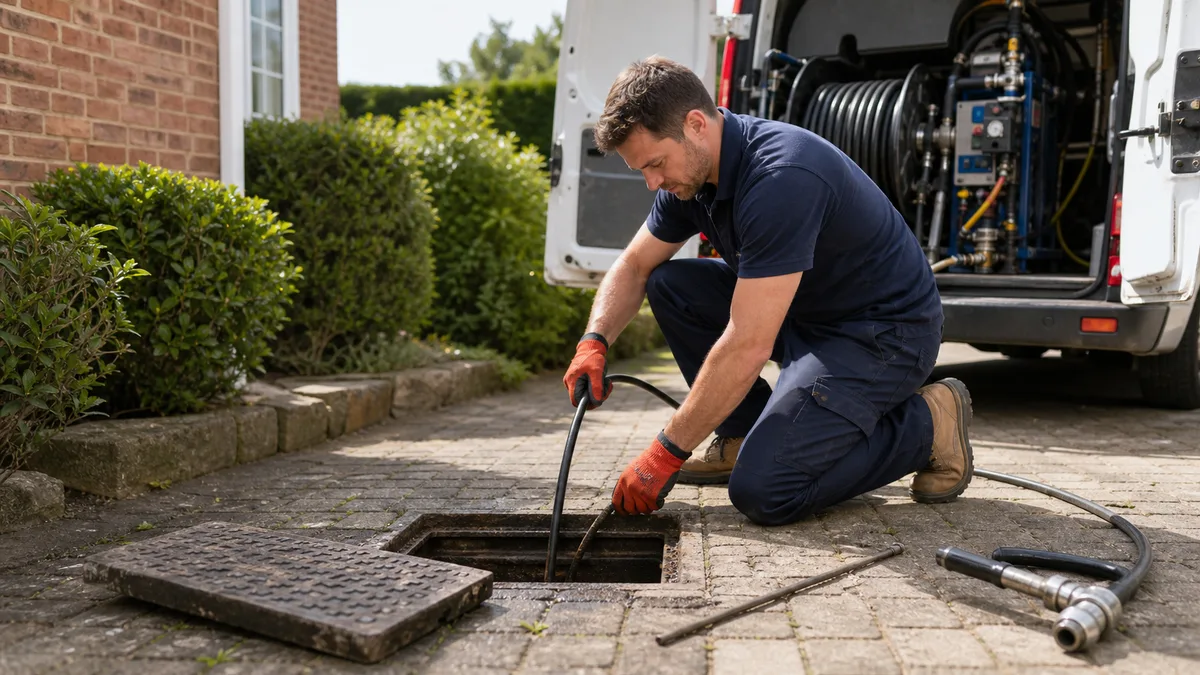
Blocked outside drain being cleared with professional equipment

Blocked Drain Clearance in Clydebank

Unlike generic plumbers, Drains Cleared specialises exclusively in blocked-drain recovery — our vans carry 4000psi jetters and CCTV as standard, not as an upsell. Serving G81, G82, G83, G84.
G81G82G83G84
We route to vetted local engineers covering G81, G82, G83 and G84 with a 60-minute response target for drain emergencies across Clydebank and the surrounding area.

Blocked Drains in Clydebank

Clydebank's combined-sewer infrastructure—where foul water and rainwater share one pipe—creates recurrent blockage emergencies, especially in Victorian and Edwardian terraces. Modern estates fare slightly better, but all Clydebank properties ultimately connect to the same aging municipal system. Winter rains and autumn leaves can trigger surcharge within hours.

Blocked drains in Clydebank result from combined-sewer overload during heavy rain, tree-root penetration of 100-year-old clay pipes, and grease accumulation in narrow Clydebank laterals. CCTV surveys diagnose fractures and collapse; high-pressure jetting clears blockages; pipe relining prevents future failure in shared foul/surface systems.

Drainage in Clydebank — what local engineers know

Clydebank's combined-sewer network was engineered in the 1880s–1920s for populations a fraction of today's size. West Dunbartonshire Council has made incremental upgrades, but most of Clydebank's municipal system remains original clay and brick. Heavy rainfall overwhelms Clydebank's combined sewers; surface water and foul waste back up into properties on the shared network. Tree roots penetrate Clydebank's century-old clay and ceramic pipes, exploiting minor fractures and creating blockage points. Grease and wet wipes accumulate in narrowed Clydebank laterals. Victorian terraces in Clydebank often have brick drainage channels that fracture and settle over 140+ years of use. Scottish Water manages the municipal system beyond the property boundary; Clydebank residents own the private lateral from the boundary to the public sewer.

  • Soft water supply reduces limescale, but slightly acidic pH can accelerate corrosion of copper fittings and lead joints in older Clydebank properties
  • Combined sewerage infrastructure — common in older parts of Clydebank — means foul and surface water share the same pipe, increasing surcharge risk during heavy rainfall
  • Moderate flood risk in parts of Clydebank — drainage systems near low-lying areas can surcharge after prolonged rain, and sump pump maintenance is advisable
  • Freeze-thaw cycles in Clydebank regularly crack exposed copper pipework, outdoor taps, and uninsulated sections in unheated outbuildings
  • With a significant share of properties built before 1920, salt-glazed clay drainage and lead-solder copper pipework are common — pipe collapse, root ingress and joint failure are recurring call-out drivers.

What happens when you contact us in Clydebank

  1. 1 Immediate dispatch. We find the nearest available engineer covering G81/G82 and confirm the ETA before the call ends.
  2. 2 On-site diagnosis — no guessing. The engineer inspects using professional-grade equipment including CCTV where needed and quotes a fixed price before work starts.
  3. 3 Job complete, report issued. You receive a written completion report. All work is guaranteed — same fault returns within the guarantee period, we come back free.

Who's responsible for drains in Clydebank?

In Clydebank, responsibility for a blocked or damaged drain depends on where the fault sits. As a homeowner you are responsible for the drains within your property boundary that serve only your home. Since the 2011 private sewer transfer, Scottish Water is responsible for shared sewers and lateral drains beyond your boundary — even where they run under private land. Road gullies and highway drainage are maintained by West Dunbartonshire.

This matters because it determines who pays. If our engineer's CCTV inspection shows the fault is in a shared sewer, we'll tell you — and you can report it to Scottish Water rather than paying for the repair yourself. The combined sewer layout that dominates Clydebank affects where these boundaries typically fall, and our local engineers know the G81, G82, G83 networks well enough to identify ownership quickly.

Blocked Drains prices in Clydebank

Every Clydebank job is quoted as a fixed price before work starts — what we quote is what you pay, with no call-out fee for providing the quote. However, the final price depends on access (an external inspection chamber is quicker than internal-only access), the pipe material and condition , and how established the blockage or fault is. Request your free quote and we'll confirm the price and your engineer's ETA in the callback.

In summary, Blocked Drains in Clydebank is backed by a 12-month workmanship guarantee. Furthermore, every job includes a written completion report. Consequently, you have full documentation if the same fault recurs.

About drainage in Clydebank

Local facts our engineers use when they arrive.

Population
10,000
Postcode districts
G81G82G83G84
Council
West Dunbartonshire
Water authority
Scottish Water
0
Property mix
Victorian Notable share
Edwardian Notable share
Interwar Notable share
Postwar Large share
Modern Notable share
Sewer type combined
Common local issues
Soft water supply reduces limescale, but slightly acidic pH can accelerate corrosion of copper fittings and lead joints in older Clydebank propertiesCombined sewerage infrastructure — common in older parts of Clydebank — means foul and surface water share the same pipe, increasing surcharge risk during heavy rainfallModerate flood risk in parts of Clydebank — drainage systems near low-lying areas can surcharge after prolonged rain, and sump pump maintenance is advisableFreeze-thaw cycles in Clydebank regularly crack exposed copper pipework, outdoor taps, and uninsulated sections in unheated outbuildingsWith a significant share of properties built before 1920, salt-glazed clay drainage and lead-solder copper pipework are common — pipe collapse, root ingress and joint failure are recurring call-out drivers.

This information helps our engineers arrive prepared.

Illustrative example of typical work

G82 Victorian Terrace: Grease Blockage Cleared; Collapsed Clay Pipe Section Identified by CCTV

Area:
Clydebank
Service:
Blocked Drain Clearance

A 1920s Clydebank terrace (G82) suffered repeated toilet backups during rainy periods. CCTV survey revealed 50 metres of clay drain heavily silted with grease and a 2-metre section with partial collapse from root penetration. Jetting cleared the immediate blockage; we recommended localised relining for the Clydebank lateral section at collapse risk.

This describes typical work performed by engineers in our network. Names and specific details have been omitted to protect customer privacy.

Blocked Drains in Clydebank — FAQs

Why do Clydebank drains always block when it rains?
Clydebank's combined sewers carry both foul and surface water; heavy rain overwhelms capacity. When the municipal pipe fills, blockages form in Clydebank properties, causing toilets and drains to back up within hours of peak rainfall.
Do tree roots really cause blockages in Clydebank drains?
Yes. Roots seek moisture and exploit fractures in clay and concrete pipes common in 100-year-old Clydebank drainage. Clydebank homes near willows, poplars, or large oaks are at highest risk; annual jetting prevents root-caused blockage.
How do I know if my Clydebank property is on a combined or separate sewer?
Most central Clydebank uses combined sewers (older areas built pre-1950). Modern estates in Clydebank often have separate foul and surface lines. Check property deeds or contact Scottish Water; CCTV survey confirms for certain.
How quickly can you clear my blocked drain?
Most urban jobs are attended within 60 minutes, and the majority of blockages are cleared within the first hour on site.
What does it cost to unblock a drain?
Our standard blocked-drain callout starts at a fixed fee with no hidden extras. We quote before we start and only charge for the work we actually do.
Do you guarantee the work?
Yes. Every clearance comes with a written guarantee. If the same blockage returns within the guarantee period we return free of charge.
What causes most blocked drains?
The three biggest culprits are fats, oils and grease from kitchens; wet-wipes and sanitary items flushed down toilets; and root ingress from nearby trees into older clay pipework.

Blocked Drains near Clydebank

We cover towns within and around Clydebank. Click a town to see local engineer availability.

Our Clydebank service area

We route to vetted local engineers covering G81, G82, G83 and G84 with a 60-minute response target for drain emergencies across Clydebank and the surrounding area. We attend callouts across the G81, G82, G83, G84 postcode districts. Nearby coverage includes Paisley, Dumbarton, Glasgow, Coatbridge, Cumbernauld.

View Clydebank on Google Maps

Ready to book in Clydebank?

We route to vetted local engineers covering G81, G82, G83 and G84 with a 60-minute response target for drain emergencies across Clydebank and the surrounding area.

Get your free quote