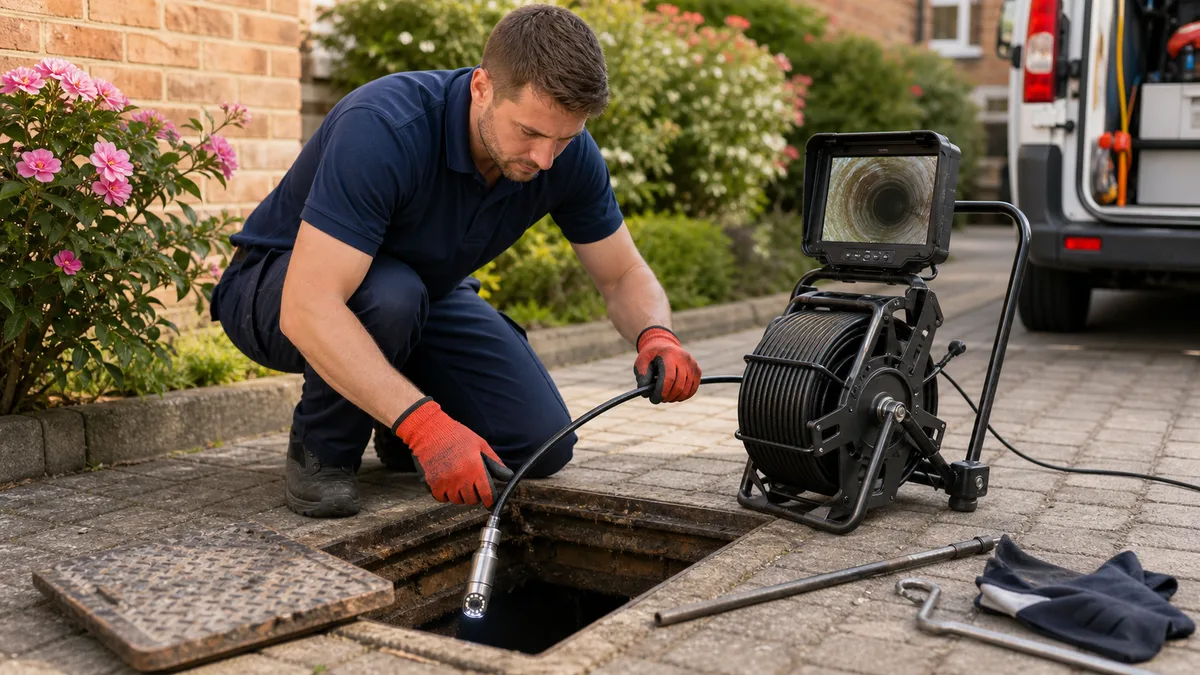
CCTV Survey in Preston
Preston's housing market relies on pre-purchase surveys to identify hidden drain damage before buying. Victorian terraces in PR1-PR2 and Edwardian properties in PR3 often hide cracked, root-invaded, or collapsed clay drains that surveys miss without CCTV technology. The combined sewer system serving Preston properties under United Utilities management means blockages compound quickly. A CCTV drain survey in Preston reveals the true condition of your drainage—preventing expensive surprises after exchange of contracts.
A CCTV drain survey in Preston uses a waterproof camera to inspect pipe interiors, revealing root damage, cracks, collapse, and blockages. United Utilities pre-purchase surveys are standard across Preston PR1-PR3 postcodes, helping buyers identify hidden drainage liabilities before completing purchase.
Drainage in Preston — what local engineers know
Preston's CCTV drain surveys address specific risks tied to South Ribble's housing stock and United Utilities infrastructure. Victorian and Edwardian terraces in Preston PR1-PR2 were built with clay pipe drains that corrode and collapse after 80–100 years. The combined sewer system managed by United Utilities means surface water shares the foul drain run—increasing blockage risk in older Preston properties. South Ribble's post-industrial landscape includes many former mill towns with subsidence risk, which damages drains invisibly. A CCTV inspection in Preston captures all of this: pipe material, age, damage, root intrusion, gradients, and nearby services. Buyers and landlords in Preston PR3-PR4 use CCTV surveys to negotiate pricing or budget for repairs before purchase.
- Soft water supply reduces limescale, but slightly acidic pH can accelerate corrosion of copper fittings and lead joints in older Preston properties
- Combined sewerage infrastructure — common in older parts of Preston — means foul and surface water share the same pipe, increasing surcharge risk during heavy rainfall
- Large Victorian and Edwardian housing stock in Preston means clay soil pipes and brick-built inspection chambers are common — CCTV surveys frequently reveal root ingress and joint displacement
- Preston has Environment Agency flood warning areas nearby along the River Ribble corridor — basement and ground-floor properties can face sewer backflow during heavy rain; non-return valves are strongly recommended.
What happens when you contact us in Preston
- 1 Immediate dispatch. We find the nearest available engineer covering PR1/PR2 and confirm the ETA before the call ends.
- 2 On-site diagnosis — no guessing. The engineer inspects using our high-definition camera system and quotes a fixed price before work starts.
- 3 Job complete, report issued. You receive a written completion report. All work is guaranteed — same fault returns within the guarantee period, we come back free.
Who's responsible for drains in Preston?
In Preston, responsibility for a blocked or damaged drain depends on where the fault sits. As a homeowner you are responsible for the drains within your property boundary that serve only your home. Since the 2011 private sewer transfer, United Utilities is responsible for shared sewers and lateral drains beyond your boundary — even where they run under private land. Road gullies and highway drainage are maintained by South Ribble.
This matters because it determines who pays. If our engineer's CCTV inspection shows the fault is in a shared sewer, we'll tell you — and you can report it to United Utilities rather than paying for the repair yourself. The combined sewer layout that dominates Preston affects where these boundaries typically fall, and our local engineers know the PR1, PR2, PR3 networks well enough to identify ownership quickly.
CCTV Survey prices in Preston
Every Preston job is quoted as a fixed price before work starts — what we quote is what you pay, with no call-out fee for providing the quote. However, the final price depends on access (an external inspection chamber is quicker than internal-only access), the pipe material and condition — significant in Preston, where many homes are Victorian and often run on original clay pipework — and how established the blockage or fault is. Request your free quote and we'll confirm the price and your engineer's ETA in the callback.
In summary, CCTV Survey in Preston is backed by a 12-month workmanship guarantee. Furthermore, every job includes a written completion report. Consequently, you have full documentation if the same fault recurs.