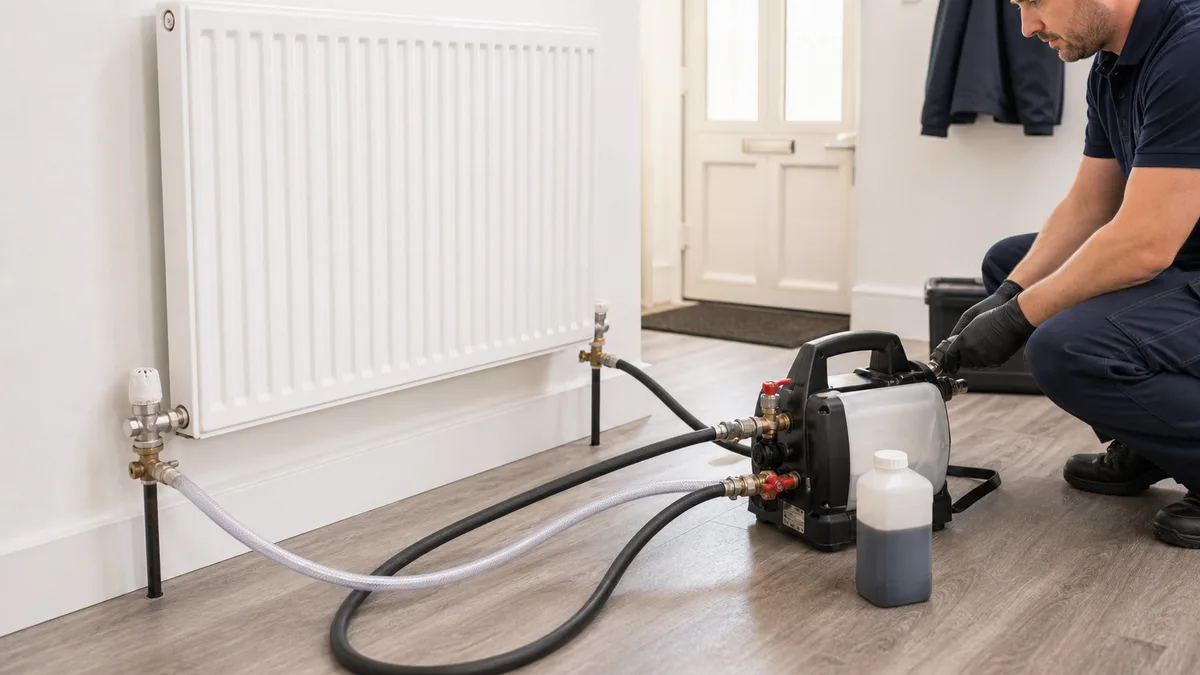
Powerflush in Ealing
Cold upstairs radiators despite a warm boiler, constant boiler cycling, or loud banging from pipes in your Ealing home signal limescale choking your heating system. Ealing's moderately hard water (Anglian Water supply, ~300 mg/L) deposits calcium carbonate inside radiators, boiler heat exchangers, and pipework year after year. A powerflush aggressively circulates chelating chemicals at high velocity to dissolve and flush away accumulated scale, restoring heat output and preventing premature boiler failure. Victorian terraces and post-war semis in W5, W6, W7, W8—especially those with original radiators—benefit most.
Powerflush removes hard water limescale from Ealing heating systems using high-velocity chelating chemical circulation. Ealing's moderate hardness causes buildup over 30–40 years, especially in sealed systems. Powerflush restores heat output, prevents boiler failure, and improves efficiency by 8–15%, costing £600–£1,000 across W5–W8.
Drainage in Ealing — what local engineers know
Anglian Water supplies Ealing at moderate hardness, meaning every litre circulating through heating systems deposits microscopic limestone. Properties built 1945–1980 typically have sealed systems with no inhibitor; scale has accumulated for 40–60 years in many cases. Modern boiler manufacturers recommend powerflush every 15–20 years in hard-water areas to maintain warranty and efficiency. Ealing Council requires new installations to meet water-efficiency standards, but older systems are unregulated. We use industry-standard chelating agents, circulate at 300 litres/minute, and finish with fresh inhibitor to prevent recurrence.
- Hard water supply causes limescale accumulation in boilers, radiators and soil pipe joints — powerflush and descaling demand is high across Ealing
- Separate sewer system across most of Ealing: misconnections (e.g. washing machines plumbed into surface water drains) are a known local issue and can result in environmental enforcement action
- Ageing infrastructure in parts of Ealing means drain blockages from grease, wipes and root ingress remain the most common call-out reasons
What happens when you call us in Ealing
- 1 Immediate dispatch. We find the nearest available engineer covering W5/W6 and confirm the ETA before the call ends.
- 2 On-site diagnosis — no guessing. The engineer inspects using professional-grade equipment including CCTV where needed and quotes a fixed price before work starts.
- 3 Job complete, report issued. You receive a written completion report. All work is guaranteed — same fault returns within the guarantee period, we come back free.