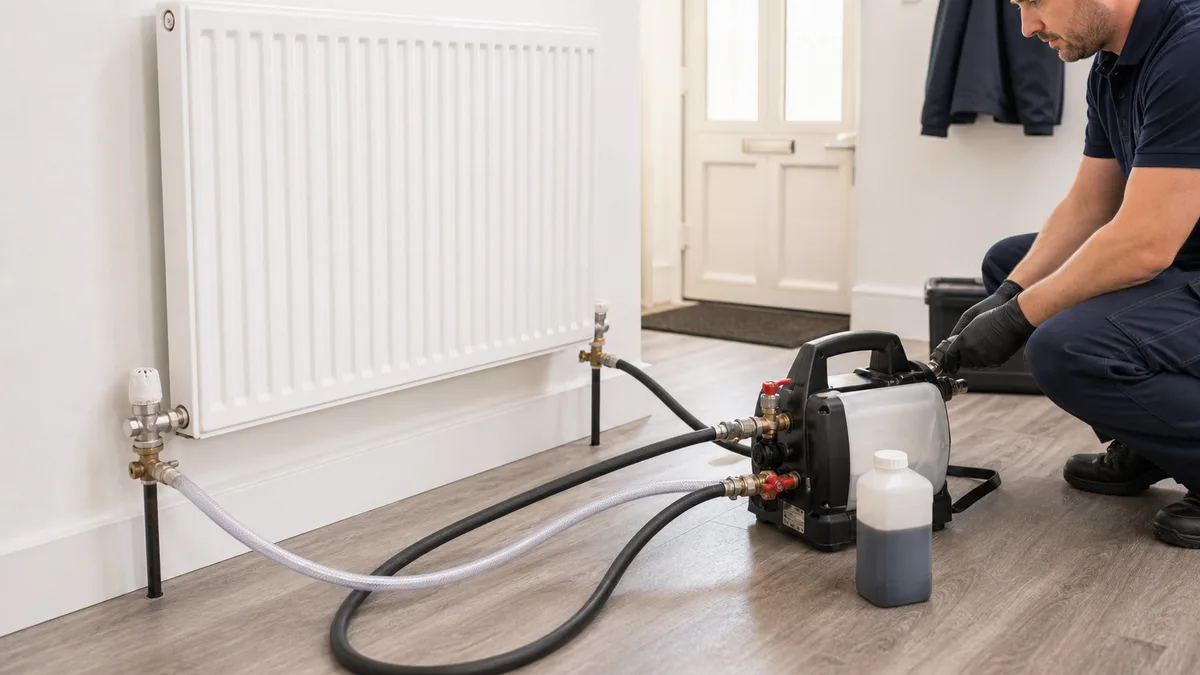
Powerflush in Louth
Louth's Anglian Water supply is hard—calcium and magnesium deposits clog radiators, boilers and pipes in homes across LN11–LN14. Victorian terraces with original cast-iron radiators and 1960s–1980s properties with sealed systems alike suffer from reduced heating output and rising energy bills. Powerflush removes years of limescale and sludge buildup, restoring full boiler efficiency and eliminating cold spots in radiators across Louth.
Powerflush removes hard-water sludge and limescale from radiators and boilers, restoring efficiency. In Louth (Anglian Water, 350+ mg/L hardness), sludge buildup reduces radiator output and boiler life substantially. The cost of a central heating powerflush in Louth depends on system size and how much sludge has built up. Get a fixed-price quote online in minutes; the price is agreed before any work begins, with no call-out fee.
Drainage in Louth — what local engineers know
Anglian Water delivers 350+ mg/L hardness to Louth residents—this is magnified in older heating systems with no inhibitor dosing. Victorian properties with gravity-fed hot water systems accumulate mineral-bearing ground at radiator base valves, blocking flow. Post-war semis and bungaloes across Louth using sealed pressurised systems suffer magnetite sludge—iron oxidation from hard water contact with steel. East Lindsey council's winter heating season (November–March) is long; inefficient radiators in Louth mean families overpay for comfort. Powerflush demand in hard-water Lincolnshire is well above national average.
- Hard water supply causes limescale accumulation in boilers, radiators and soil pipe joints — powerflush and descaling demand is high across Louth
- Separate sewer system across most of Louth: misconnections (e.g. washing machines plumbed into surface water drains) are a known local issue and can result in environmental enforcement action
- Ageing infrastructure in parts of Louth means drain blockages from grease, wipes and root ingress remain the most common call-out reasons
- With a significant share of properties built before 1920, salt-glazed clay drainage and lead-solder copper pipework are common — pipe collapse, root ingress and joint failure are recurring call-out drivers.
- Louth has Environment Agency flood warning areas nearby along the River Lud corridor — basement and ground-floor properties can face sewer backflow during heavy rain; non-return valves are strongly recommended.
What happens when you contact us in Louth
- 1 Immediate dispatch. We find the nearest available engineer covering LN11/LN12 and confirm the ETA before the call ends.
- 2 On-site diagnosis — no guessing. The engineer inspects using professional-grade equipment including CCTV where needed and quotes a fixed price before work starts.
- 3 Job complete, report issued. You receive a written completion report. All work is guaranteed — same fault returns within the guarantee period, we come back free.
Who's responsible for drains in Louth?
In Louth, responsibility for a blocked or damaged drain depends on where the fault sits. As a homeowner you are responsible for the drains within your property boundary that serve only your home. Since the 2011 private sewer transfer, Anglian Water is responsible for shared sewers and lateral drains beyond your boundary — even where they run under private land. Road gullies and highway drainage are maintained by East Lindsey.
This matters because it determines who pays. If our engineer's CCTV inspection shows the fault is in a shared sewer, we'll tell you — and you can report it to Anglian Water rather than paying for the repair yourself. The separate sewer layout that dominates Louth affects where these boundaries typically fall, and our local engineers know the LN11, LN12, LN13 networks well enough to identify ownership quickly.
Powerflush prices in Louth
Every Louth job is quoted as a fixed price before work starts — what we quote is what you pay, with no call-out fee for providing the quote. However, the final price depends on access (an external inspection chamber is quicker than internal-only access), the pipe material and condition , and how established the blockage or fault is. Request your free quote and we'll confirm the price and your engineer's ETA in the callback.
In summary, Powerflush in Louth is backed by a 12-month workmanship guarantee. Furthermore, every job includes a written completion report. Consequently, you have full documentation if the same fault recurs.