Powerflush in Tamworth
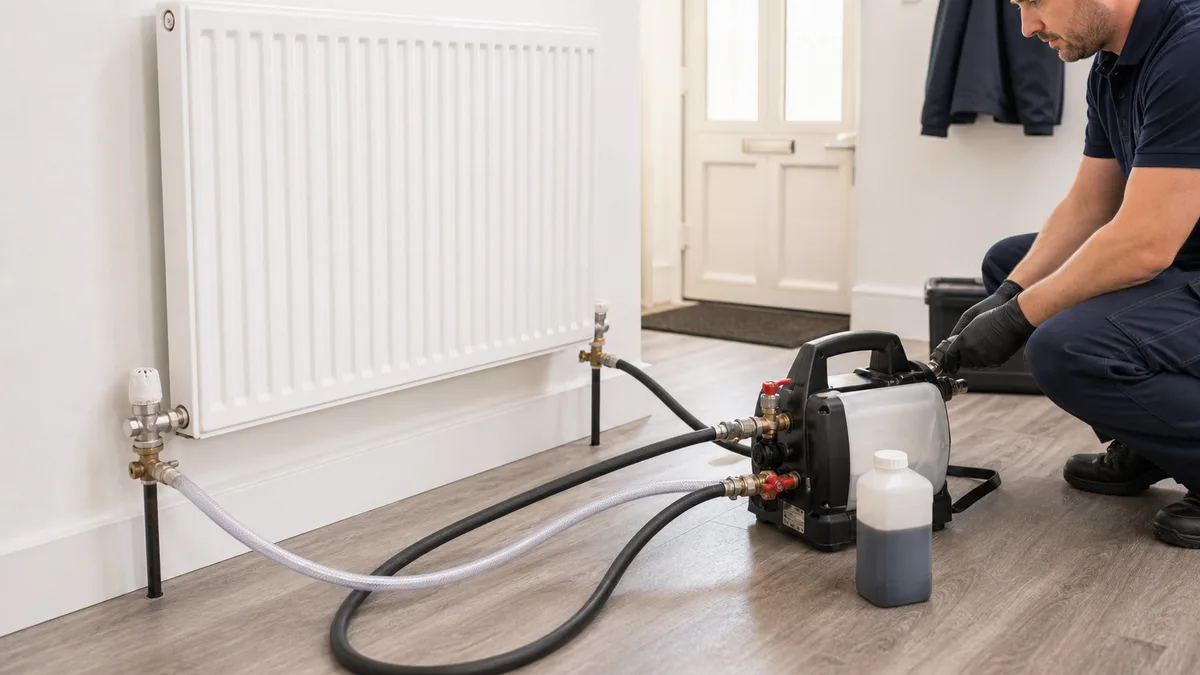
Tamworth's hard water turns boilers, radiators, and pipework into scale factories. Over time, mineral deposits choke your heating system, reducing efficiency and forcing your boiler to work harder. Powerflush clears years of accumulated scale and sludge from Tamworth's heating networks, restoring heat flow and cutting fuel costs. Residents across postcodes B77–B80 notice warmer radiators and lower gas bills after powerflush.
Powerflush in Tamworth removes scale, sludge, and deposits from heating systems clogged by hard water. Tamworth's water hardness makes powerflush essential for maintaining boiler efficiency, improving radiator heat output, and reducing fuel bills.
Drainage in Tamworth — what local engineers know
Severn Trent Water supplies notoriously hard water to Tamworth, with calcium and magnesium carbonates that deposit on boiler heat exchangers and inside radiator tubes. Victorian and Edwardian properties in Tamworth, many with original radiators and long pipework runs, are particularly vulnerable to scale buildup. Modern combi boilers in Tamworth are also at risk; many manufacturers void warranties if powerflush isn't performed during the first 5 years of operation. Tamworth Council encourages residents to maintain heating systems to reduce carbon footprint. Powerflush is the most cost-effective way to restore a clogged heating system.
- Hard water supply causes limescale accumulation in boilers, radiators and soil pipe joints — powerflush and descaling demand is high across Tamworth
- Combined sewerage infrastructure — common in older parts of Tamworth — means foul and surface water share the same pipe, increasing surcharge risk during heavy rainfall
- Large Victorian and Edwardian housing stock in Tamworth means clay soil pipes and brick-built inspection chambers are common — CCTV surveys frequently reveal root ingress and joint displacement
- Tamworth has Environment Agency flood warning areas nearby along the River Tame corridor — basement and ground-floor properties can face sewer backflow during heavy rain; non-return valves are strongly recommended.
What happens when you contact us in Tamworth
- 1 Immediate dispatch. We find the nearest available engineer covering B77/B78 and confirm the ETA before the call ends.
- 2 On-site diagnosis — no guessing. The engineer inspects using professional-grade equipment including CCTV where needed and quotes a fixed price before work starts.
- 3 Job complete, report issued. You receive a written completion report. All work is guaranteed — same fault returns within the guarantee period, we come back free.
Who's responsible for drains in Tamworth?
In Tamworth, responsibility for a blocked or damaged drain depends on where the fault sits. As a homeowner you are responsible for the drains within your property boundary that serve only your home. Since the 2011 private sewer transfer, Severn Trent Water is responsible for shared sewers and lateral drains beyond your boundary — even where they run under private land. Road gullies and highway drainage are maintained by Tamworth.
This matters because it determines who pays. If our engineer's CCTV inspection shows the fault is in a shared sewer, we'll tell you — and you can report it to Severn Trent Water rather than paying for the repair yourself. The combined sewer layout that dominates Tamworth affects where these boundaries typically fall, and our local engineers know the B77, B78, B79 networks well enough to identify ownership quickly.
Powerflush prices in Tamworth
Every Tamworth job is quoted as a fixed price before work starts — what we quote is what you pay, with no call-out fee for providing the quote. However, the final price depends on access (an external inspection chamber is quicker than internal-only access), the pipe material and condition — significant in Tamworth, where many homes are Victorian and often run on original clay pipework — and how established the blockage or fault is. Request your free quote and we'll confirm the price and your engineer's ETA in the callback.
In summary, Powerflush in Tamworth is backed by a 12-month workmanship guarantee. Furthermore, every job includes a written completion report. Consequently, you have full documentation if the same fault recurs.