Drains Cleared
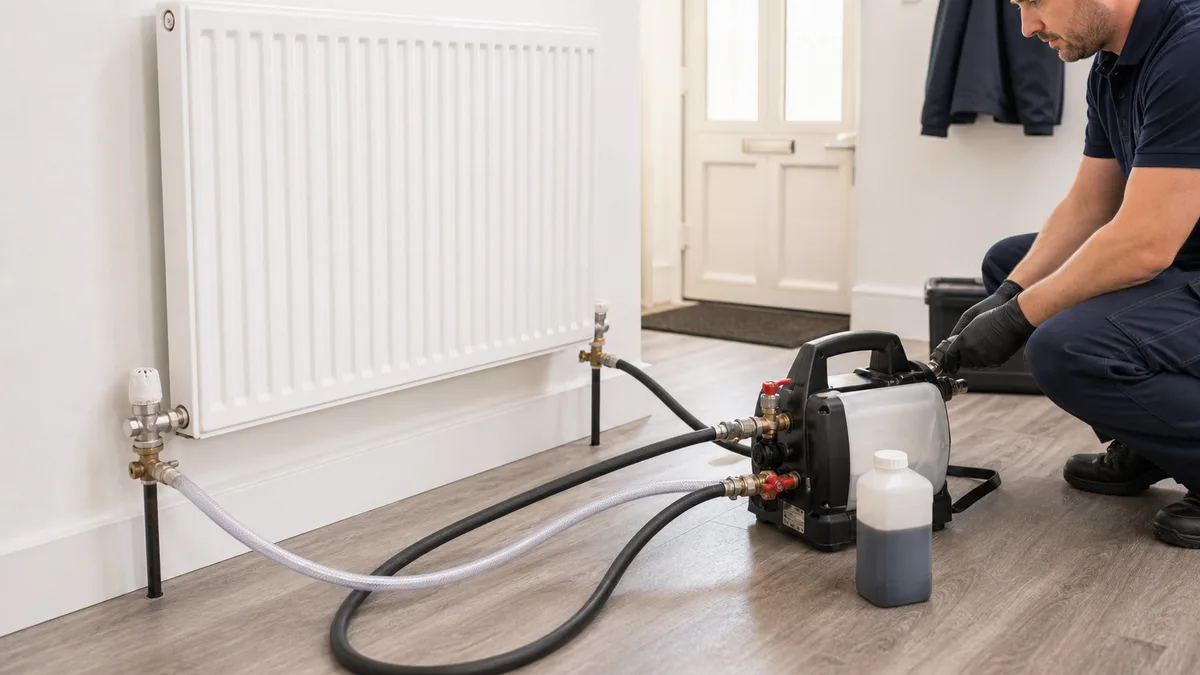
Central heating powerflush machine connected to pipework

Powerflush for Tavistock Heating Systems – Restore Efficiency

We quote the powerflush before work starts, use MagnaCleanse as standard, and document the result with system checks rather than selling a basic chemical flush as a full clean. Serving PL19, PL20, PL21, PL22.
PL19PL20PL21PL22
We route to vetted local engineers covering PL19, PL20, PL21 and PL22 with a 60-minute response target for drain emergencies across Tavistock and the surrounding area.

Powerflush in Tavistock

Many Tavistock properties retain original or early-generation heating systems installed 30–50 years ago, where circulating water has accumulated rust sediment, magnetite sludge, and corrosion byproducts. Soft water from South West Water reduces mineral scaling but does not prevent oxidation in ferrous pipework, especially in gravity-fed systems common in Victorian and Edwardian Tavistock homes (PL19–PL22). A powerflush clears this debris, restoring circulation and boiler efficiency before cold winters strain an already compromised system.

A powerflush in Tavistock removes rust sludge and corrosion deposits from heating systems in older homes, restoring radiator warmth and boiler efficiency. Tavistock's soft-water supply prevents limescale but not ferrous oxidation in 30–50-year-old systems. Powerflush is essential maintenance for Victorian, Edwardian, and mid-century Tavistock heating circuits before winter demands peak performance.

Drainage in Tavistock — what local engineers know

Tavistock's housing stock is 26% Victorian and 14% Edwardian—properties heated by cast-iron radiators and copper microbore pipework, often unaltered since installation in the 1950s–1980s. South West Water's soft supply, while reducing limescale risk, offers no protection against ferrous oxidation and microbiological sludge accumulation within closed heating loops. West Devon Council building regulations now mandate boiler efficiency, but older Tavistock systems can only meet standards if the circulating medium is clean. Power flushing removes blockages in Tavistock's narrow microbore pipework and restores heat transfer across radiator surfaces.

  • Soft water supply reduces limescale, but slightly acidic pH can accelerate corrosion of copper fittings and lead joints in older Tavistock properties
  • Combined sewerage infrastructure — common in older parts of Tavistock — means foul and surface water share the same pipe, increasing surcharge risk during heavy rainfall
  • Large Victorian and Edwardian housing stock in Tavistock means clay soil pipes and brick-built inspection chambers are common — CCTV surveys frequently reveal root ingress and joint displacement

What happens when you call us in Tavistock

  1. 1 Immediate dispatch. We find the nearest available engineer covering PL19/PL20 and confirm the ETA before the call ends.
  2. 2 On-site diagnosis — no guessing. The engineer inspects using professional-grade equipment including CCTV where needed and quotes a fixed price before work starts.
  3. 3 Job complete, report issued. You receive a written completion report. All work is guaranteed — same fault returns within the guarantee period, we come back free.

Who's responsible for drains in Tavistock?

In Tavistock, responsibility for a blocked or damaged drain depends on where the fault sits. As a homeowner you are responsible for the drains within your property boundary that serve only your home. Since the 2011 private sewer transfer, South West Water is responsible for shared sewers and lateral drains beyond your boundary — even where they run under private land. Road gullies and highway drainage are maintained by West Devon.

This matters because it determines who pays. If our engineer's CCTV inspection shows the fault is in a shared sewer, we'll tell you — and you can report it to South West Water rather than paying for the repair yourself. The combined sewer layout that dominates Tavistock affects where these boundaries typically fall, and our local engineers know the PL19, PL20, PL21 networks well enough to identify ownership quickly.

Powerflush prices in Tavistock

Every Tavistock job is quoted as a fixed price before work starts — what we quote is what you pay, with no call-out fee for providing the quote. However, the final price depends on access (an external inspection chamber is quicker than internal-only access), the pipe material and condition — significant in Tavistock, where around 26% of homes are Victorian and often run on original clay pipework — and how established the blockage or fault is. Request your free quote and we'll confirm the price and your engineer's ETA in the callback.

In summary, Powerflush in Tavistock is backed by a 12-month workmanship guarantee. Furthermore, every job includes a written completion report. Consequently, you have full documentation if the same fault recurs.

About drainage in Tavistock

Local facts our engineers use when they arrive.

Population
10,000
Postcode districts
PL19PL20PL21PL22
Council
West Devon
Water authority
South West Water
Flood risk
Low — affected watercourses: River Severn, River Avon, River Tame
Property mix
Victorian 26%
Edwardian 14%
Interwar 20%
Postwar 24%
Modern 16%
Sewer type combined
Common local issues
Soft water supply reduces limescale, but slightly acidic pH can accelerate corrosion of copper fittings and lead joints in older Tavistock propertiesCombined sewerage infrastructure — common in older parts of Tavistock — means foul and surface water share the same pipe, increasing surcharge risk during heavy rainfallLarge Victorian and Edwardian housing stock in Tavistock means clay soil pipes and brick-built inspection chambers are common — CCTV surveys frequently reveal root ingress and joint displacement

This information helps our engineers arrive prepared.

Illustrative example of typical work

Restored Heating in 1960s Tavistock Semi-Detached – PL21 9RT

Area:
Tavistock
Service:
Central Heating Powerflush

A Tavistock homeowner reported that upstairs radiators in their 1960s semi-detached home (PL21) were staying cold despite the boiler running hot. Radiator bleeding released air continuously, but flow remained poor. A powerflush revealed 40 litres of black ferrous sludge trapped in the heating circuit—an accumulation spanning decades without system treatment. After flushing and inhibitor injection, all radiators heated uniformly. Boiler efficiency recovered to near-new levels, and the customer avoided the expense of a system replacement.

This describes typical work performed by engineers in our network. Names and specific details have been omitted to protect customer privacy.

Powerflush in Tavistock — FAQs

How often should a Tavistock heating system be powerflushed?
A powerflush is typically a one-off procedure performed on systems over 15 years old or when blockage symptoms appear (cold radiators, noisy pipes, slow heat response). Tavistock's soft-water supply means mineral scaling is not a concern, but ferrous sludge from radiators and pipework will accumulate over time, especially in gravity-fed systems or those lacking inhibitor treatment. After flushing, annual inhibitor top-ups prevent rapid re-sludging.
Is powerflush necessary in Tavistock if we have soft water?
Yes. Soft water prevents limescale but does not stop rust formation inside radiators and pipework. Tavistock's older Victorian, Edwardian, and 1960s–1980s heating systems circulate water through ferrous metals (steel radiators, copper with solder) for 30–50 years without chemical treatment. Oxygen ingress and microbiological action produce magnetite sludge that blocks narrow Tavistock microbore pipes and reduces boiler efficiency. Powerflush removes this sludge; soft water simply means you won't need it repeated as often as in hard-water areas.
How do I know if I need a powerflush?
The clearest signs are radiators cold at the bottom, black or dirty water when bleeding, gurgling pipework, a noisy boiler, slow heat-up times and repeated pump or heat-exchanger faults. If several radiators show the same symptoms, the issue is usually whole-system sludge rather than one faulty valve.
What is included in a central heating powerflush?
The engineer checks system condition, connects the powerflush machine, circulates cleanser, flushes each radiator and circuit, captures magnetite through filtration, refills with clean water, doses inhibitor and checks pressure and heat distribution before leaving.
How long does a powerflush take?
Most domestic systems with 6-10 radiators take 5-8 hours. Larger homes, two-zone systems, microbore pipework or severe sludge can take a full day and may need extra time for individual radiator flushing.
Will it fix cold spots on radiators?
In most cases, yes. Cold spots at the bottom of radiators are usually magnetite sludge blocking circulation, which is exactly what a professional powerflush is designed to remove.

Powerflush near Tavistock

We cover towns within and around Tavistock. Click a town to see local engineer availability.

Our Tavistock service area

We route to vetted local engineers covering PL19, PL20, PL21 and PL22 with a 60-minute response target for drain emergencies across Tavistock and the surrounding area. We attend callouts across the PL19, PL20, PL21, PL22 postcode districts. Nearby coverage includes Plymouth, Okehampton, Liskeard, Bude, Bodmin.

View Tavistock on Google Maps

Ready to book in Tavistock?

We route to vetted local engineers covering PL19, PL20, PL21 and PL22 with a 60-minute response target for drain emergencies across Tavistock and the surrounding area.

Get your free quote