Drains Cleared
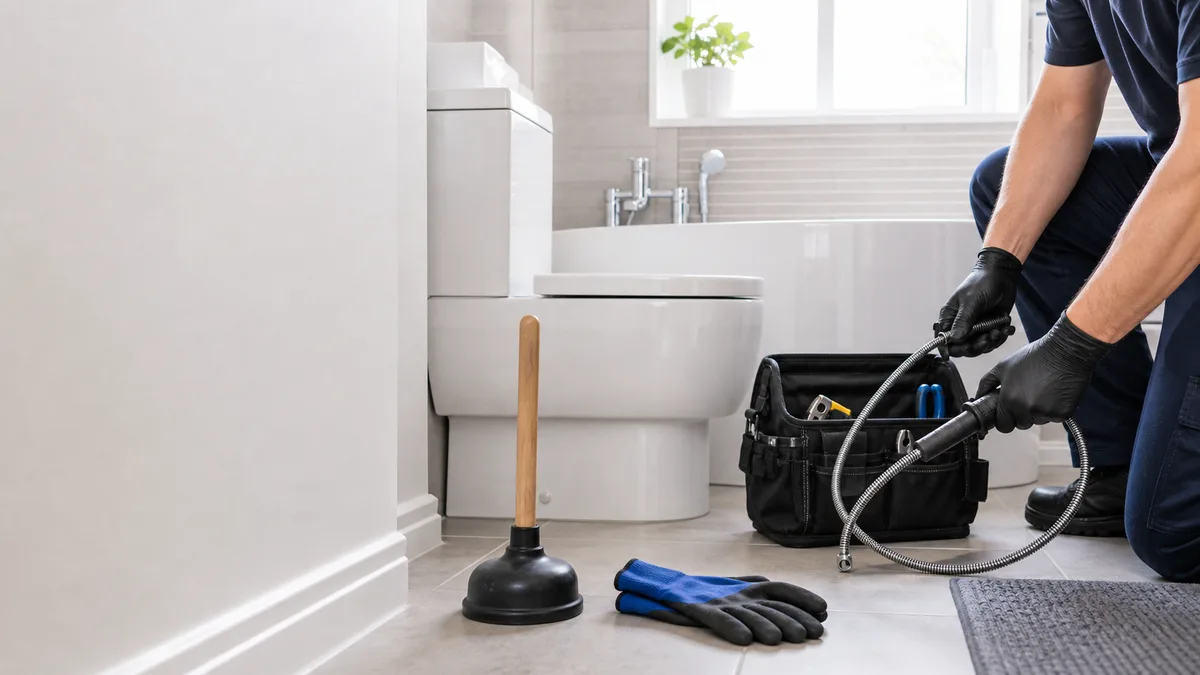
Clean bathroom drainage tools prepared for a blocked toilet callout

Toilet Repairs and Installation in Paisley

We clear 90% of blocked toilets without lifting the pan — saving the sealant, tile damage and extra labour most plumbers charge for. Serving PA1, PA2, PA3, PA4.
PA1PA2PA3PA4
We route to vetted local engineers covering PA1, PA2, PA3 and PA4 with a 60-minute response target for drain emergencies across Paisley and the surrounding area.

Blocked Toilets in Paisley

Paisley's Victorian terraces (18% of housing) feature high-level cisterns and low-level suites from the 1920s–1980s; Edwardian properties (10%) have ornate low-level pan-and-cistern combinations. Modern Paisley homes (18%, mostly PA2–PA4) use close-coupled suites. Repair and replacement demands differ sharply by era. We specialize in sourcing compatible Victorian cistern kits for Paisley terraces and modern water-saving suites for contemporary homes.

Toilet repair in Paisley depends on era: Victorian terraces (PA1–PA3) often have high-level cisterns needing specialist kits; Edwardian suites require low-level pan seals; modern homes use close-coupled suites. Running cisterns, weak flushes, and leaking seals are common in Paisley's older housing stock.

Drainage in Paisley — what local engineers know

Paisley's combined sewerage system (shared foul and surface water pipes) means blocked toilets have serious consequences—raw sewage can back into lower floors and cellars of older PA1 properties. Renfrewshire Council's older housing stock requires period-appropriate repairs: high-level cisterns (1920s–1950s Paisley) need rare ceramic ballcock assemblies; low-level suites (1960s–1990s) use increasingly obsolete flush valves and seals. Modern water-saving suites (6-liter dual flush) are incompatible with older soil pipes in some Paisley terraces, requiring careful installation. Scottish Water's soft water reduces scale buildup in cistern arms, but corrosion of iron pipes still occurs. We offer Victorian-heritage and modern suites suited to Paisley properties.

  • Soft water supply reduces limescale, but slightly acidic pH can accelerate corrosion of copper fittings and lead joints in older Paisley properties
  • Combined sewerage infrastructure — common in older parts of Paisley — means foul and surface water share the same pipe, increasing surcharge risk during heavy rainfall
  • Moderate flood risk in parts of Paisley — drainage systems near low-lying areas can surcharge after prolonged rain, and sump pump maintenance is advisable
  • With 28% of properties built before 1920, salt-glazed clay drainage and lead-solder copper pipework are common — pipe collapse, root ingress and joint failure are recurring call-out drivers.

What happens when you call us in Paisley

  1. 1 Immediate dispatch. We find the nearest available engineer covering PA1/PA2 and confirm the ETA before the call ends.
  2. 2 On-site diagnosis — no guessing. The engineer inspects using professional-grade equipment including CCTV where needed and quotes a fixed price before work starts.
  3. 3 Job complete, report issued. You receive a written completion report. All work is guaranteed — same fault returns within the guarantee period, we come back free.

Who's responsible for drains in Paisley?

In Paisley, responsibility for a blocked or damaged drain depends on where the fault sits. As a homeowner you are responsible for the drains within your property boundary that serve only your home. Since the 2011 private sewer transfer, Scottish Water is responsible for shared sewers and lateral drains beyond your boundary — even where they run under private land. Road gullies and highway drainage are maintained by Renfrewshire.

This matters because it determines who pays. If our engineer's CCTV inspection shows the fault is in a shared sewer, we'll tell you — and you can report it to Scottish Water rather than paying for the repair yourself. The combined sewer layout that dominates Paisley affects where these boundaries typically fall, and our local engineers know the PA1, PA2, PA3 networks well enough to identify ownership quickly.

Blocked Toilets prices in Paisley

Every Paisley job is quoted as a fixed price before work starts — what we quote is what you pay, with no call-out fee for providing the quote. However, the final price depends on access (an external inspection chamber is quicker than internal-only access), the pipe material and condition , and how established the blockage or fault is. Request your free quote and we'll confirm the price and your engineer's ETA in the callback.

In summary, Blocked Toilets in Paisley is backed by a 12-month workmanship guarantee. Furthermore, every job includes a written completion report. Consequently, you have full documentation if the same fault recurs.

About drainage in Paisley

Local facts our engineers use when they arrive.

Population
10,000
Postcode districts
PA1PA2PA3PA4
Council
Renfrewshire
Water authority
Scottish Water
Flood risk
Medium — affected watercourses: River Tay, River Forth, River Earn
Property mix
Victorian 18%
Edwardian 10%
Interwar 24%
Postwar 30%
Modern 18%
Sewer type combined
Common local issues
Soft water supply reduces limescale, but slightly acidic pH can accelerate corrosion of copper fittings and lead joints in older Paisley propertiesCombined sewerage infrastructure — common in older parts of Paisley — means foul and surface water share the same pipe, increasing surcharge risk during heavy rainfallModerate flood risk in parts of Paisley — drainage systems near low-lying areas can surcharge after prolonged rain, and sump pump maintenance is advisableWith 28% of properties built before 1920, salt-glazed clay drainage and lead-solder copper pipework are common — pipe collapse, root ingress and joint failure are recurring call-out drivers.

This information helps our engineers arrive prepared.

Illustrative example of typical work

PA1 Victorian Terrace: High-Level Cistern Retained with Modern Flush

Area:
Paisley
Service:
Blocked Toilets

A PA1 Paisley terrace owner wanted to keep the period charm but replace a leaking 1940s high-level cistern. We sourced a historically accurate porcelain cistern kit with compatible fittings, installed a modern dual-flush mechanism inside the original case, and routed the overflow safely to the combined sewer. The PA1 property retained its Victorian character while gaining modern water efficiency and reliability.

This describes typical work performed by engineers in our network. Names and specific details have been omitted to protect customer privacy.

Blocked Toilets in Paisley — FAQs

Can I keep my high-level cistern in a Paisley Victorian terrace?
Yes. Many Paisley terraces in PA1–PA3 retain original cisterns for aesthetic reasons. We can repair or replace internal mechanisms (ballcock, flush valve) without disturbing the external porcelain. Modern heritage kits fit inside 1920s–1950s Paisley cisterns, offering dual-flush water savings.
What causes constant running in Paisley toilet cisterns?
The ballcock (float arm) or fill valve wears out, allowing water to leak slowly into the pan. In older PA1 Paisley terraces, deposits clog the valve; in soft-water Paisley, corrosion of iron components is common. We replace the ballcock assembly—usually a 30-minute job.
Are modern low-flush suites compatible with Paisley's combined sewer?
Yes, but combined sewers in older Paisley areas (PA1) are shallower and narrow, so modern 6-liter flushes must be verified by survey. We check the soil pipe gradient and sewer depth before installation. Some PA1 Paisley properties may need a higher-powered flush unit.
Why does my toilet keep blocking?
The three most common causes are non-flushable wipes, excessive paper use, and partial blockages downstream in the soil pipe that need jetting rather than plunging.
Can you fix a Saniflo or macerator?
Yes. We service and repair all major macerator brands including Saniflo, Sanivite and Grundfos, and carry common replacement parts on the van.
Will I have to remove the toilet?
Almost never. We use closet augers and micro-jetting heads that clear the vast majority of blockages through the pan itself.
Is a blocked toilet dangerous?
It can be. Overflowing waste water carries bacterial contaminants, so a prolonged blockage should always be treated as urgent, especially in commercial premises.

Blocked Toilets near Paisley

We cover towns within and around Paisley. Click a town to see local engineer availability.

Our Paisley service area

We route to vetted local engineers covering PA1, PA2, PA3 and PA4 with a 60-minute response target for drain emergencies across Paisley and the surrounding area. We attend callouts across the PA1, PA2, PA3, PA4 postcode districts. Nearby coverage includes Glasgow, Hamilton, Coatbridge, Largs, Airdrie.

View Paisley on Google Maps

Ready to book in Paisley?

We route to vetted local engineers covering PA1, PA2, PA3 and PA4 with a 60-minute response target for drain emergencies across Paisley and the surrounding area.

Get your free quote