Most domestic drain blockages are preventable with a consistent maintenance routine. The tools and treatments needed are inexpensive and the time investment is minimal. Here’s a practical DIY maintenance programme — and an honest assessment of where professional equipment makes the difference.
The case for regular maintenance
However, a drain blockage is a cumulative process: fat deposits, hair accumulates, root growth advances, silt settles. None of these happen overnight. Regular maintenance interrupts the accumulation before it reaches blockage level, keeping your drains working indefinitely without reactive call-outs.
Additionally, the economics are simple: a professional drain clearance costs considerably more than a few minutes of monthly upkeep. A maintenance routine that prevents one blockage per year pays for itself within months and requires about 30 minutes of effort per month.
Monthly: kitchen drains
Pour boiling water down kitchen drains Specifically, (if your pipes are modern plastic — use hot but not boiling if you have older materials). This re-emulsifies any fat deposits before they solidify. One full kettle per drain outlet.
Run the dishwasher with a cleaning cycle For example, monthly. A dishwasher on a hot programme with dishwasher cleaner or a cup of white vinegar and a tablespoon of bicarbonate of soda in the drum cleans the internal pipework and spray arms.
Check under the sink. As a result, is the trap connection tight? Any signs of drips or staining? A loose joint caught early is a 5-minute fix; a joint that’s been dripping for six months has potentially caused floor damage.
Monthly: bathroom drains
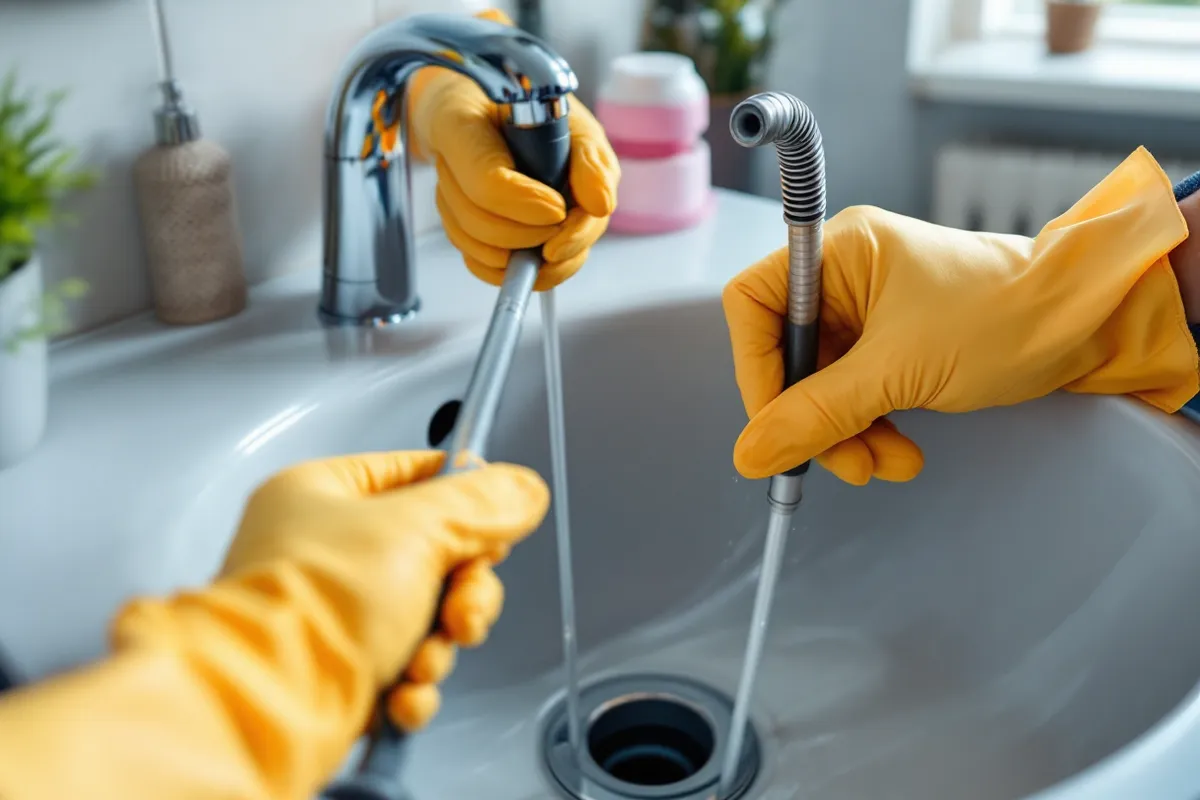
Use a drain hair removal tool Meanwhile, in bath and shower drains. Insert it 10–15cm, rotate, and pull. Even if the drain seems fine, you’ll typically retrieve a small amount of hair each month. This is hair that would otherwise compact into a blocking plug over several months.
Remove and clean drain covers. Furthermore, shower drain covers accumulate soap scum under the rim and around the holes. Scrub clean with an old toothbrush, rinse, replace.
Monthly: biological drain treatment
In particular, apply a biological/enzyme drain cleaner (Bio-Drain, Buster Drain Care, or similar) to kitchen and bathroom drains. These contain bacteria that digest organic matter — fat, soap, hair and food residue — continuously for several days after application.
Consequently, use monthly as maintenance, not just reactively when you have a blockage. Applied monthly, enzyme cleaners keep drain walls clean. Applied once to a fully blocked drain, they rarely do anything useful.
Similarly, pour according to the bottle’s instructions (usually 100ml, left overnight without running water). Don’t mix enzyme cleaners with bleach — bleach kills the bacteria.
Quarterly: outdoor drains
Clear gully pots Moreover, by hand. With gloves, lift the grate and remove accumulated debris — leaves, silt, moss, food waste from kitchen outlets. The gully pot and its trap should be visible and empty. A gully pot full of compacted leaves can’t take the flow from a connected downpipe.
Check downpipes. However, are they securely fixed? Any loose joints? During rain: do the gutters overflow (blocked gutter) or does water emerge at a joint in the downpipe rather than going to the drain (blocked or cracked downpipe)?
Look at the inspection chamber cover. Additionally, is it secure, undamaged, level with the surrounding surface? A cracked or sunken cover admits soil and surface water that accelerates drain blockage.
Annually: comprehensive check
Flush the main drain run. Once a year, run a garden hose at full flow down your kitchen drain outlet while someone checks the outside inspection chamber — the water should appear within a few seconds and the chamber should drain freely.
Check the header tank in the loft Specifically, (if your property has one — older properties with gravity-fed central heating or an overhead cold water tank). Look for: any visible contamination, float valve operation (should float shut when full, run to refill), tank condition.
Bleed all radiators For example, at the start of the heating season. See our bleeding guide.
Test your stopcock. As a result, turn it off and on again. Stopcocks that seize with age can’t be operated in an emergency. If it’s stiff, work it gently; if it won’t move, have it replaced.
Check outside tap. Meanwhile, in autumn, isolate the outside tap at its internal service valve, open the tap itself to drain the pipe, and leave it open until spring. This prevents the external pipe section from freezing.
The jobs that need professional equipment
Furthermore, some jobs are genuinely beyond DIY tools:
Persistent or deep blockages. In particular, dIY rodding and plunging work within 3–5 metres of an access point. A blockage 15 metres down the drain run in an underground section requires jetting equipment.
Root-filled drains. Consequently, hair removal tools and plungers cannot cut through established root growth. A root-cutting jetting nozzle is the appropriate tool.
Condition assessment. Similarly, even clean drains can have structural defects that aren’t apparent from flow testing. A CCTV survey every 5 years (or every 2–3 years for older properties near trees) gives a definitive picture of condition.
Structural repair. Moreover, any cracked, displaced, or collapsed pipe requires either relining or excavation — not something DIY maintenance can address.
Tools to have at home
| Tool | Relative cost | Used for |
|---|---|---|
| Drain hair removal tool | Inexpensive | Bathroom drain hair blockages |
| Toilet plunger (with flange) | Inexpensive | Toilet and sink blockages |
| Cup plunger | Inexpensive | Sink and bath blockages |
| Drain rods (6–10 sections) | Mid-range, one-off buy | Garden drain rodding |
| Biological drain cleaner (e.g. Bio-Drain) | Low-cost, ongoing | Monthly preventive treatment |
| Gully scraper | Inexpensive | Outdoor gully pot clearing |
However, this small toolkit handles the vast majority of DIY maintenance and minor reactive clearing.
What not to use
Chemical caustic drain cleaners (Drano, Mr Muscle foam): Additionally, caustic cleaners (sodium hydroxide) can clear some blockages but are corrosive to older pipework, create hazardous fumes, and are largely ineffective against fat and hair — the two most common causes of domestic blockages. Enzyme cleaners are safer and more effective.
Boiling water on PVC pipes: Specifically, above 60°C, UPVC softens and can distort. Use hot (60°C) but not boiling water for PVC. Boiling water is fine for copper waste pipes and clay drains.
Wire coat hangers in drains: For example, they scratch ceramic, can dislodge pipe joints, and are ineffective compared to a proper drain snake. They’re the DIY equivalent of using a screwdriver as a hammer.