Drain excavation is the most disruptive and expensive drainage remedy, but sometimes it’s the only viable option. Understanding what the process involves, what drives the cost. What alternatives may be available helps you evaluate quotes and decide whether a recommended excavation is truly necessary.
When excavation is necessary
However, not every drainage defect requires excavation. A contractor who recommends excavation for every defect may not have the CIPP relining capability or experience to offer the alternative. See our drain relining guide for when lining is appropriate.
Additionally, excavation is genuinely required when:
Complete pipe collapse: Specifically, the pipe has lost its circular cross-section and the bore has closed. No liner can be installed in a collapsed pipe — it needs physical removal and replacement.
Severe deformation beyond lining tolerance: For example, a pipe deformed more than approximately 25% of its original diameter (beyond the threshold where a liner achieves full contact) requires excavation.
Open fractures with soil ingress: As a result, where cracking has progressed to the point that soil is entering the pipe, the surrounding soil is disrupted and the pipe body is compromised. Lining this section would leave a void.
Structural subsidence caused by the drain: Meanwhile, when a failing drain has caused the surrounding soil to wash away or compact, creating a void under a structure, excavation is needed both to replace the pipe and to address the void.
Inaccessible pipe for lining purposes: Furthermore, very sharp bends, severely constricted access, or obstructions that prevent the liner from being introduced.
The excavation process
Stage 1: Pre-excavation survey In particular, a CCTV survey identifies the exact location, depth, and extent of the defect. This determines the length of excavation needed and informs the specification for the new pipe.
Consequently, service marking is carried out before any excavation — other utilities (gas, electricity, water, telecoms) must be located to avoid hitting them.
Stage 2: Surface preparation Similarly, the surface above the excavation is prepared:
- Turfed gardens: the turf is removed in sections and stacked for reinstatement
- Paved or patio areas: slabs are carefully lifted and stored for reinstatement
- Concrete driveways or paths: concrete is cut with a disc cutter and broken out — this usually results in a visible repair joint even after reinstatement
- Tarmac driveways: tarmac is cut and lifted — repairs in tarmac are also usually visible but match better than concrete patches
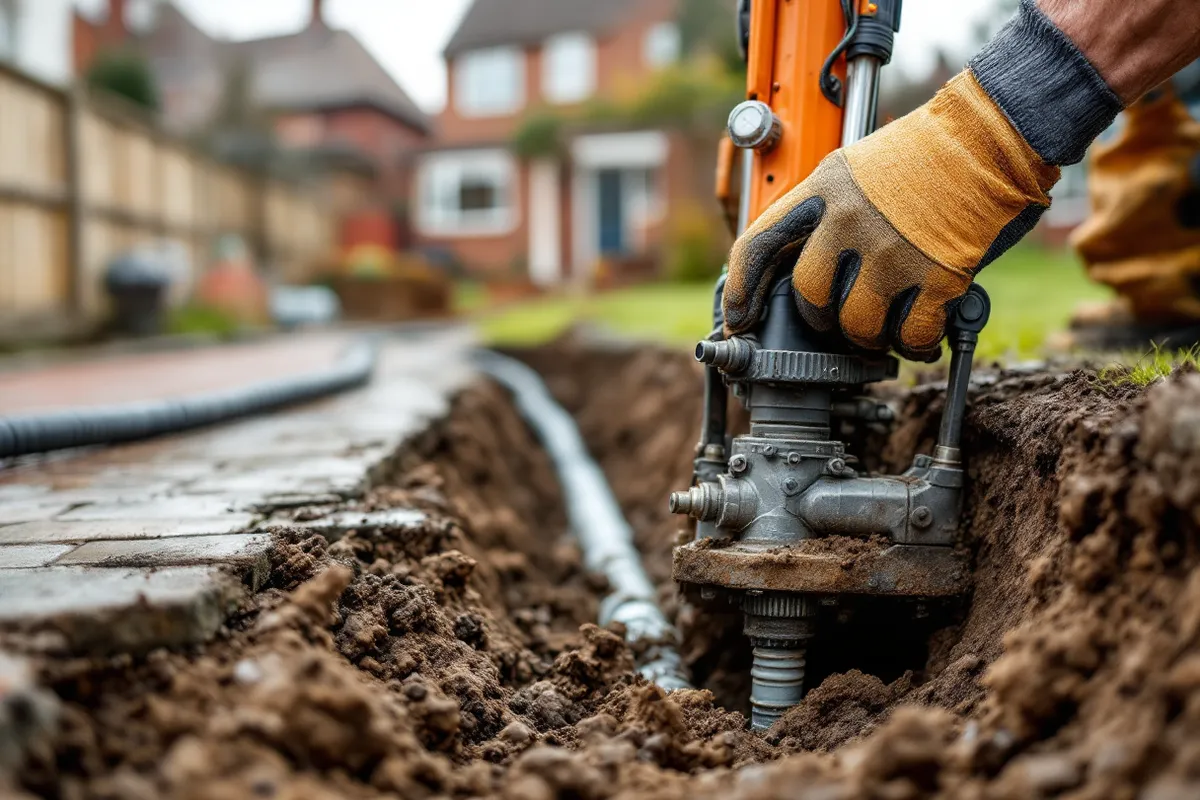
Stage 3: Excavation Moreover, depending on depth and access:
- Hand dig: For shallow drains (under 1m) in restricted access areas
- Mini-digger: For drains at 1–2m depth in open areas where equipment can access
- Full-size excavator: For deeper drains or longer excavations
However, the excavation walls needs supporting (battered or shored) if the depth exceeds approximately 1.2m. This is both a safety requirement and a practical necessity — unsupported trench walls in soft soil collapse.
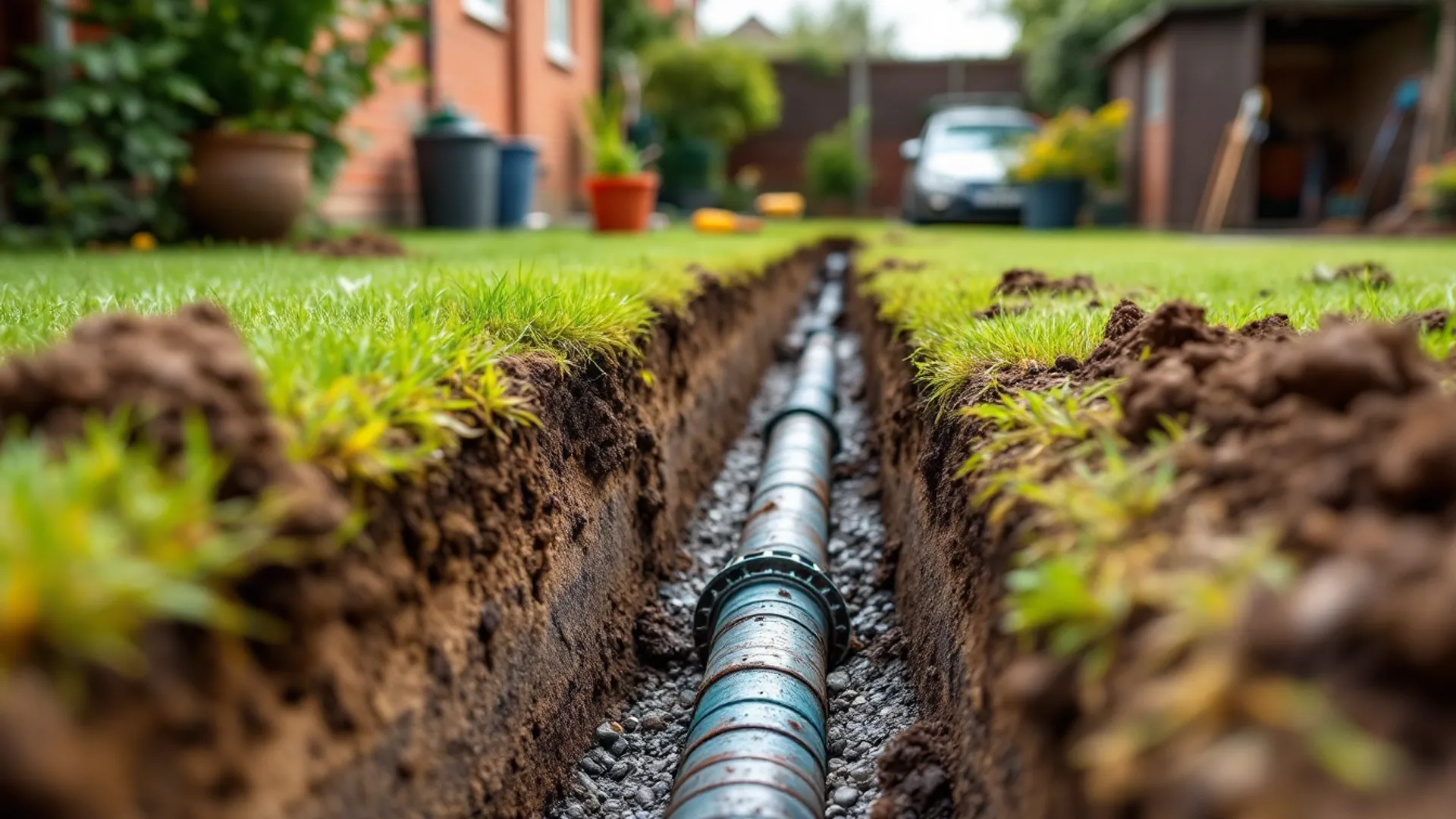
Stage 4: Pipe removal and replacement Additionally, the damaged section is removed. The trench bottom is prepared:
- Laid to the correct gradient
- Granular bedding (pea gravel) is placed to a specific depth
Specifically, new pipe is laid — typically UPVC for domestic drainage (100mm or 150mm diameter). The pipe is jointed with rubber ring push-fit joints, then tested for watertightness before backfilling.
For example, if the inspection chamber was part of the failed section, a new pre-formed plastic chamber or a rebuilt brick chamber is installed.
Stage 5: CCTV confirmation As a result, before backfilling, the engineer should carry out a CCTV confirmation pass to verify correct installation, proper gradient, no leakage at joints, and no foreign material in the new pipe.
Stage 6: Backfill and reinstatement Meanwhile, backfill in compacted layers:
- Granular surround around the pipe (pea gravel to 150mm above the pipe top)
- Then compacted fill in 150mm layers to surface level
- Surface reinstatement as appropriate (new turf, slab relaying, concrete or tarmac repair)
What drives the cost
Depth: Furthermore, deeper drains require more excavation, potentially more support, and more backfill. A 0.6m deep drain is a simple trench; a 2.5m deep drain is significantly more work.
Length: In particular, per-metre costs are fairly linear, but mobilisation costs (bringing equipment to site) mean short excavations (under 3m) have relatively high costs per metre.
Surface type: Consequently, excavating under a lawn is cheapest to reinstate. Paving can be relaid. Concrete produces a visible repair that many homeowners find unsatisfactory. Tarmac requires specialist contractors for an acceptable finish.
Access: Similarly, can a digger get into the garden? Restricted access (through a house, over steps, through a narrow gate) requires smaller equipment or hand digging, adding cost significantly.
Depth of concrete or paved surface: Moreover, a 200mm concrete slab to break out adds cost. A 100mm tarmac layer adds less.
Proximity to structures: However, excavating within 1m of a building foundation requires structural assessment and careful shoring. Excavating within 3m of a public sewer requires notification to the water company.
What drives the price
| Scenario | What affects the price |
|---|---|
| 3m excavation, lawn, 1m depth | Simplest surface to reinstate |
| 3m excavation, concrete path, 1m depth | Concrete is costlier to break out and repair |
| 3m excavation, tarmac driveway, 1m depth | Tarmac needs a specialist finish |
| 6m excavation, lawn, 1.5m depth | Longer and deeper than a standard trench |
| Inspection chamber replacement | A standalone chamber job |
| Excavation under paved area + new inspection chamber | Most involved — paving plus a new chamber |
Additionally, every excavation is quoted individually — actual costs depend on site-specific conditions, access and the scope of reinstatement needed. Request a free quote once a CCTV survey has confirmed excavation is needed.
Getting the work done right
Get a CCTV survey before accepting any excavation quote. Specifically, a contractor who recommends excavation without camera evidence is either not offering relining or hasn’t properly diagnosed the defect.
Confirm the exact length and scope in writing. For example, an excavation quote should specify: exact footage to be excavated, pipe diameter, depth, surface type, whether new chamber is included, and reinstatement standard.
Confirm CCTV confirmation pass is included. As a result, the completed work should be camera-confirmed before the trench is closed.
Understand the reinstatement. Meanwhile, will the surface be returned to its original condition? Concrete repairs are almost never invisible — if appearance matters, discuss this before work starts.