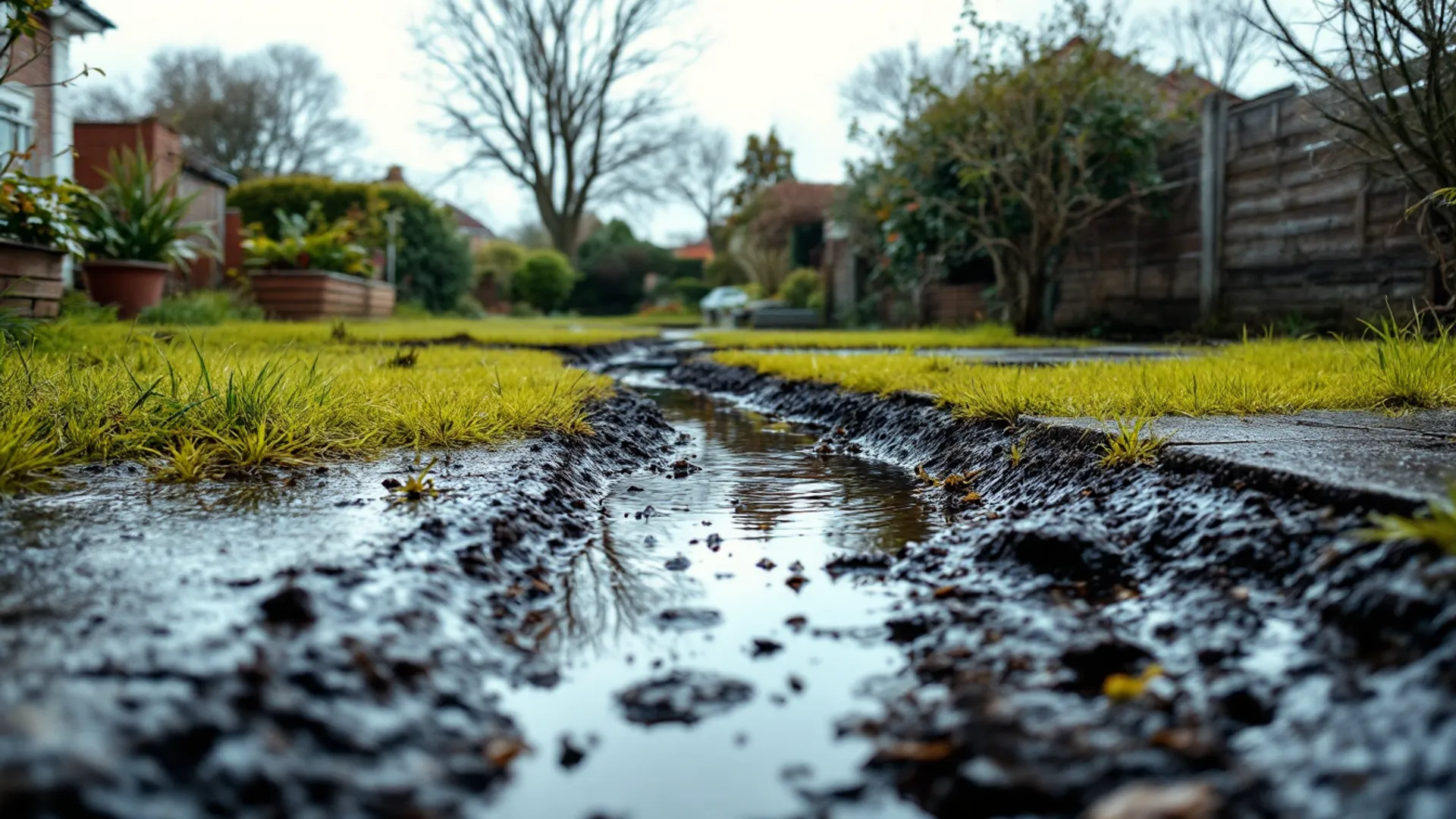
A garden that pools water after every rainstorm, patches of lawn that stay soft and boggy through winter, or areas where grass simply won’t grow despite apparent sun. These are signs of inadequate drainage. Garden drainage problems are common across the UK, particularly in areas with heavy clay soils, low-lying ground, or gardens that have been compacted by foot traffic and construction. Here’s how to diagnose the cause and what the solutions look like.
Understanding why gardens waterlog
However, water accumulates in gardens for one or more of these reasons:
Poor soil permeability: Additionally, clay soils have tiny particles with little space between them. Water moves through clay very slowly — sometimes as little as 0.5mm per hour. When rainfall intensity exceeds this rate, water has no choice but to remain on the surface.
Compaction: Specifically, repeatedly walking, driving, or working on soil compresses the soil structure, destroying the air gaps that allow water infiltration. Garden parties, contractor vehicles, and even regular lawn mowing on wet grass progressively compact soil over years.
Impermeable layers (hardpan): For example, some soils develop a compacted layer a few centimetres below the surface — often caused by repeatedly cultivating to the same depth — through which water cannot penetrate. Water above this layer can’t drain, even if the soil deeper down would accept it.
High water table: As a result, in low-lying areas near watercourses, the water table may be close enough to the surface that drainage capacity is limited even in moderate rainfall. In very wet winters, water tables in low-lying parts of the UK can come within a metre of the surface.
Surrounding land: Meanwhile, water doesn’t recognise property boundaries. If your garden is lower than neighbouring gardens, a road, or an adjacent field, you may be receiving run-off from beyond your boundary.
Blocked or absent drainage: Furthermore, if the property once had functional garden drainage (a soakaway, a French drain, or a drain channel) that has failed, silted up, or been accidentally blocked during landscaping works, the existing drainage system is no longer working.
Diagnosing your garden drainage
The percolation test: In particular, dig a hole 300mm × 300mm and 300mm deep. Fill it with water and let it drain completely (don’t time this). Fill it again and time how long it takes to drain. If it takes more than 24 hours, the soil’s permeability is very low and a soakaway will not function — you’ll need to discharge to a drain or watercourse instead.
Check the gradient: Consequently, which way does water run? In a level garden, water can’t drain passively — it pools where it lands. Even a slight gradient of 1:200 (50mm over 10 metres) significantly improves drainage.
Look for the water table: Similarly, in very wet weather, does the water table reach the surface? Dig a test hole 1 metre deep and observe over several days — does water seep in from the sides rather than percolating down from above?
Solutions for garden drainage
Land drainage (French drains): Moreover, perforated plastic pipes wrapped in geotextile fabric are laid in trenches and connected to an outlet (soakaway, drainage ditch, or surface water drain). Water infiltrates through the geotextile and flows along the perforated pipe to the outlet. French drains are typically laid at 600mm–1m depth, with multiple runs across the waterlogged area at 3–6m spacings.
However, this is the most comprehensive solution for genuinely waterlogged gardens and is appropriate for medium to large gardens on moderate soils. The cost varies with the extent of drainage required for a 100–200m² drainage scheme.
Soakaways: Additionally, a soakaway pit (filled rubble, crate, or ring system) accepts water from a concentrated source (a downpipe, a channel drain) and allows it to infiltrate into the surrounding soil. Soakaways are point solutions — they manage water collected and directed to them, not distributed surface water.
Specifically, not appropriate on clay soils where permeability is too low — the percolation test above determines viability.
Rill and channel drains: For example, a linear drain (a narrow channel drain or a rill) at the lowest point of a sloping garden intercepts water as it runs down the slope and redirects it to an outlet. More aesthetic than French drains and often used in designed gardens. Appropriate where gradient exists and a concentrated flow point can be created.
Raised planting beds: As a result, an alternative to drainage — raising planting beds above the waterlogged soil level gives roots somewhere to grow without sitting in saturated ground.
Soil improvement (for mild compaction): Meanwhile, deep aeration (hollow-tine aeration or spiking to 300mm depth) breaks up compaction and improves water infiltration. On seriously compacted soils, incorporating organic matter through deep rotovation before reseeding can significantly improve drainage.
Permeable surfaces for hard areas: Furthermore, replacing impermeable patio or path surfaces with permeable alternatives (gravel, permeable paving, or resin-bound gravel) reduces surface runoff from hard surfaces.
Legal and planning considerations
Discharge to public sewer: In particular, surface water from gardens should not normally be discharged to the foul sewer (the sewage sewer). Many older properties have combined drainage systems — if your garden drains to the combined sewer, this is legal under the existing connection but wouldn’t be permitted for new drainage.
Discharge to a watercourse: Consequently, if a ditch or stream runs near your property, you may be able to discharge garden drainage to it. This requires the permission of the riparian owner (the landowner whose land the watercourse crosses, which may be you or a neighbour) and potentially the Environment Agency for significant discharges.
New drainage: Similarly, any new drainage connections to public sewers or watercourses for properties requiring planning permission should include a SUDS strategy — see our Building Regulations article.