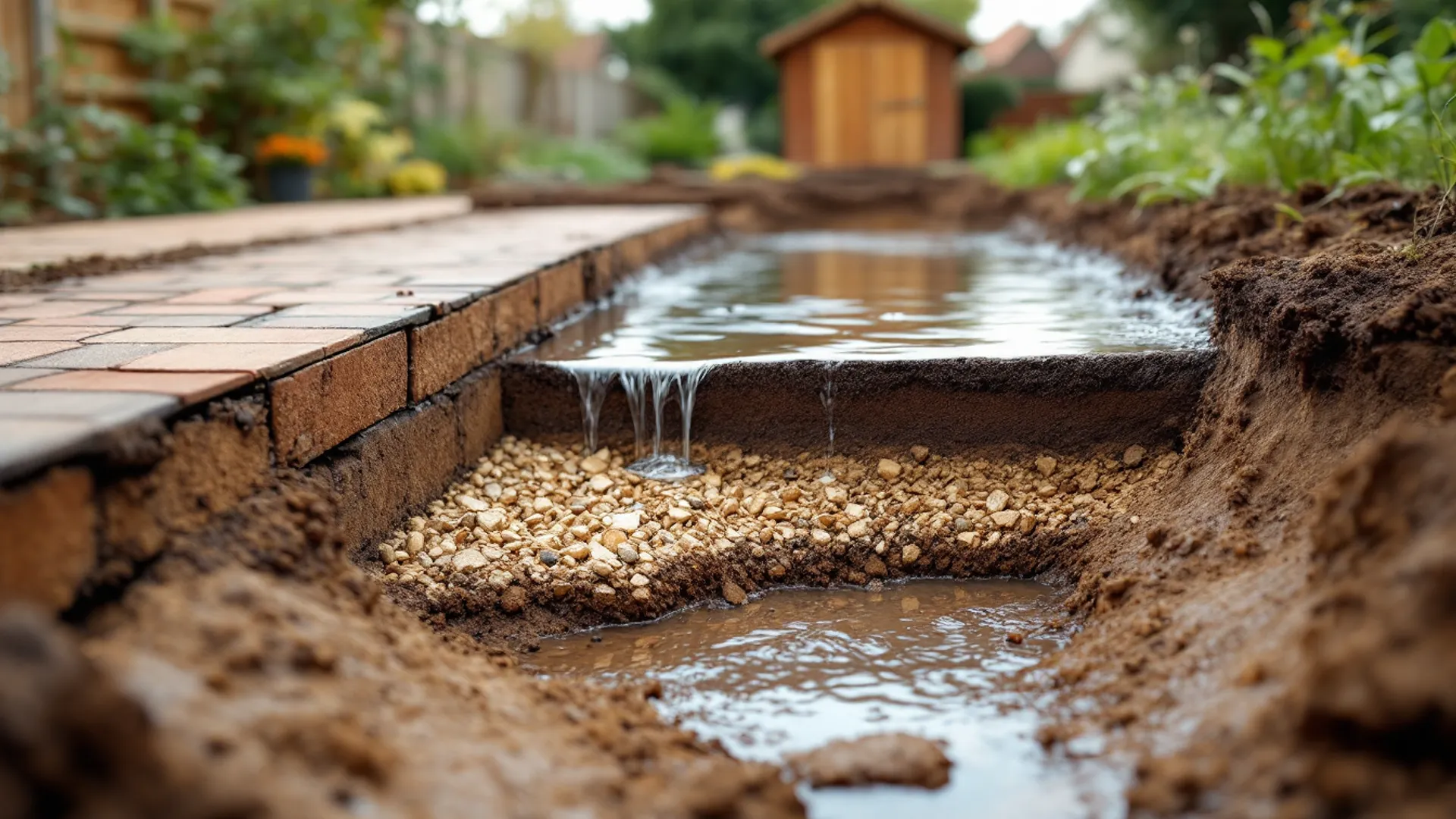
Soakaways are a simple but critical component of many UK property drainage systems. When they work, they’re invisible. When they fail, the consequences range from a waterlogged lawn to garden flooding and, in the case of septic tank soakaways, potential environmental enforcement. Understanding why soakaways fail and what the options are saves time and money when problems appear.
What is a soakaway and how does it work?
However, a soakaway is an underground structure. Typically a pit filled with rubble, gravel, or a plastic crate structure — that receives drainage from either:.
- Surface water: Rainwater from roof downpipes, paths, driveways and patios
- Septic tank effluent: The treated liquid that drains from a septic tank after primary settlement
Additionally, in both cases, the soakaway works by allowing water to disperse slowly into the surrounding soil. The rate at which the soil can absorb water (its permeability, measured by a percolation test) determines how large the soakaway needs to be for a given drainage load.
Specifically, well-designed soakaways sized correctly for their drainage area will work indefinitely. Problems arise when they’re undersized, poorly located, or when the surrounding soil gradually loses its permeability.
Why soakaways fail
Soil saturation and clay soils: For example, in prolonged wet weather, even a correctly sized soakaway will not drain if the surrounding soil is fully saturated — there’s simply nowhere for the water to go. This is particularly pronounced on heavy clay soils, which have inherently poor drainage. If a soakaway floods only in very wet periods, this may be normal behaviour for a marginal site.
Biologically clogged soakaway (septic tank): As a result, the most common failure mode for septic tank soakaways. The effluent from a septic tank contains suspended solids and biological material that gradually clog the soil around the drainage field. Over time (typically 15–30 years), the soil pores become blocked with biomat (a biological layer) and water no longer drains. Signs include: saturated ground over the soakaway even in dry weather, effluent coming to the surface, and sewage backing up into the property.
Oversized catchment: Meanwhile, if new hard surfaces have been added to the property (a new driveway, patio extension, conservatory with downpipe) without increasing the soakaway size, the soakaway may simply be receiving more water than it can disperse.
Structural failure: Furthermore, older soakaways were often just brick-lined pits with rubble fill. These can collapse, lose their permeability as fine material washes in, or become silted up with fine particles washed from the drainage run.
Tree root damage: In particular, tree roots seek moisture and will penetrate a soakaway, filling the available space and blocking drainage perforations in modern soakaway crates or perforated pipes.
Sited in wrong location: Consequently, a soakaway positioned within 5 metres of a building, within 2.5 metres of a boundary, or in a low-lying area that receives run-off from higher ground will fail prematurely.
Testing whether your soakaway is failing
Similarly, a basic test: in dry weather, pour 200 litres of water (from a water butt or hosepipe) into the surface water soakaway inspection access or via the downpipe. The water should drain within 30–60 minutes for a functioning soakaway.
Moreover, for septic tank soakaways, the ground above the drainage field should not be wet or malodorous in dry summer weather. If it is, the soakaway is failing.
However, for a proper percolation test (required for planning a new soakaway), a drainage engineer can carry out a BS 6297:2007 percolation test: a hole is dug to soakaway depth, filled with water to soak the soil, then filled again and the rate of drop measured. The result (a value called Vp, the percolation factor) determines the required soakaway area.
Can a soakaway be repaired?
Surface water soakaways: Sometimes. If the soakaway crate or rubble fill has silted up, excavating and replacing it with a clean installation in the same location may restore function if the surrounding soil is not itself clogged. However, if the soil around the soakaway is compacted or biologically clogged, the same problem will recur quickly.
Additionally, septic tank drainage fields: Very rarely. Once a drainage field has developed extensive biomat, restoration is not practically possible. Options are:
- Rest the drainage field (if a second area is available) — biomat can sometimes recover after several months without loading
- Install a new drainage field in a different location (requiring a new percolation test and possibly planning permission)
- Switch from a septic tank to a package treatment plant with watercourse discharge
Planning a replacement soakaway
Specifically, replacement soakaways must meet current standards. BS EN 752 for surface water and BS 6297:2007 / Building Regulations Part H for septic tank drainage fields.
For example, key requirements:
- Minimum 5m from the building structure (for surface water)
- Minimum 10m from any watercourse
- Minimum 50m from any water abstraction point (well, borehole)
- Sized based on percolation test results
- Not sited in a groundwater source protection zone (consult Environment Agency maps)
As a result, surface water soakaway design and installation is typically permitted development (no planning permission required) unless in a designated area or flood zone. A drainage engineer can confirm.
Meanwhile, septic tank drainage fields require compliance with the Environment Agency’s General Binding Rules (2020 onwards) — see our septic tank guide for full details.
SUDS alternatives to soakaways
Furthermore, where a soakaway isn’t viable (clay soils with very low permeability, high groundwater table, or lack of space), alternative Sustainable Urban Drainage Systems (SUDS) include:
- Attenuation tank with slow release: The water is held and released slowly to the sewer or watercourse at a consented flow rate
- Green roof or rain garden: Rainwater is intercepted and used by plants
- Permeable paving: Allows rain to infiltrate through the surface into a sub-base that acts as a soakaway
- Infiltration trenches: Long, shallow trenches filled with gravel that spread the load over a larger soil area
In particular, these alternatives require design input from a drainage engineer and may need planning permission or building regulations approval depending on the specific scheme.