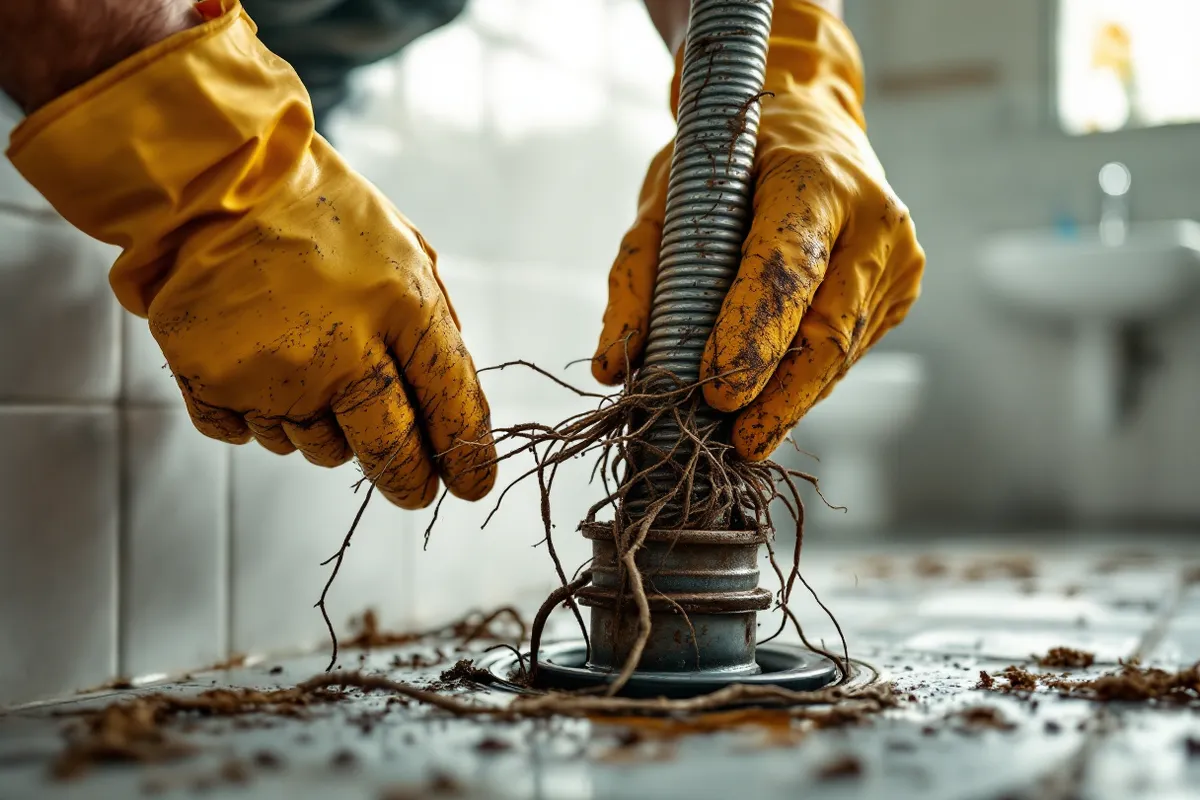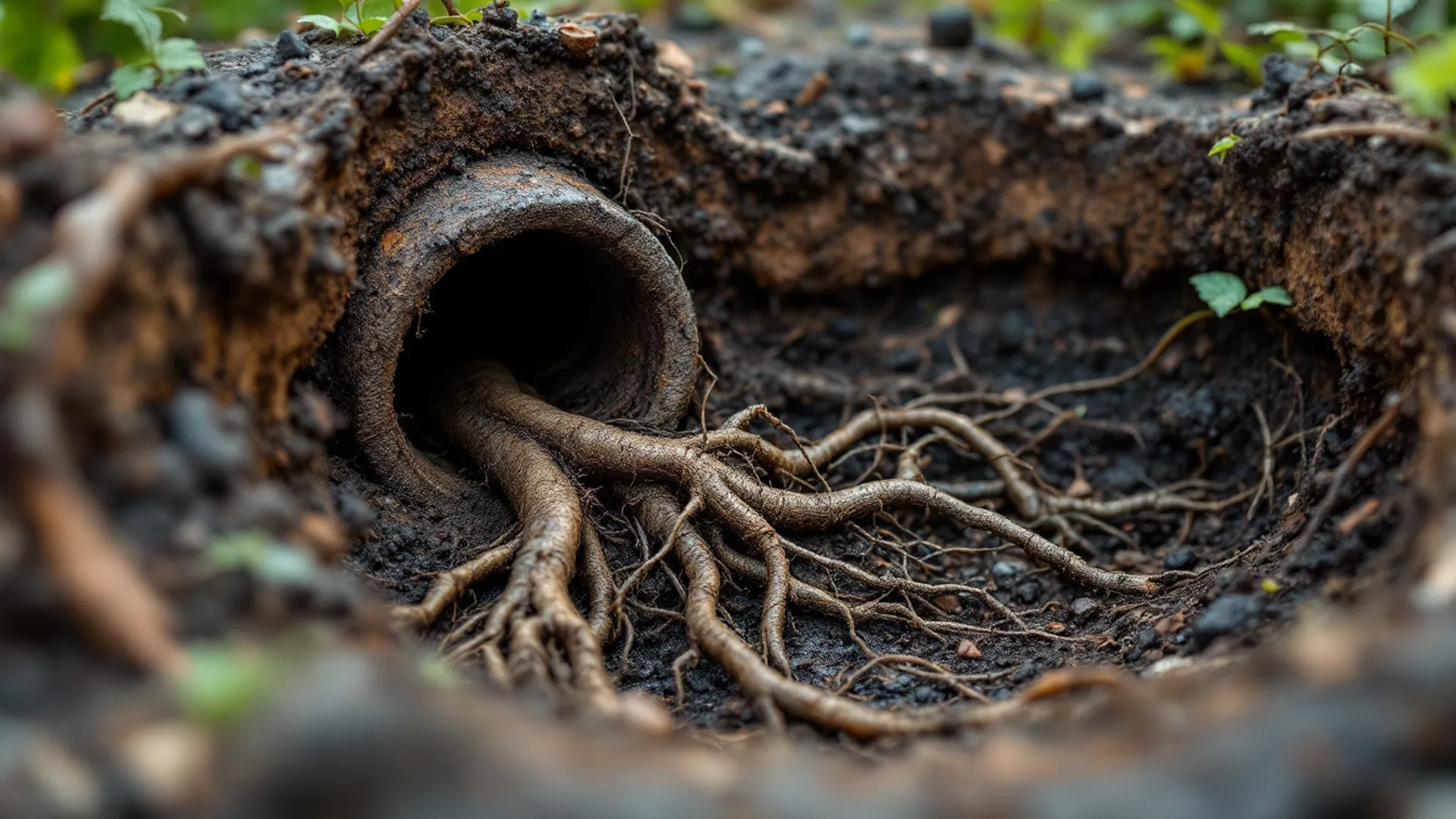
Tree root ingress in underground drains is one of the most common. And most expensive to ignore — drainage problems in UK residential properties. It’s particularly prevalent in Victorian and Edwardian terraces, where mature street trees and garden plantings have had a century to grow near clay pipe drainage. Left untreated, root ingress progresses from a minor nuisance to a complete blockage to structural drain failure.
How roots get into drains
However, underground drains carry warm, humid, nutrient-rich water — a highly attractive environment for root growth. Roots follow moisture gradients in the soil and will seek out any available water source.
Additionally, the entry point is the joint. Victorian clay pipe drainage was jointed with cement-and-tarred-hemp collars. These joints crack as ground moves seasonally on clay soils; the crack opens as the drain settles over decades. A hairline crack in a clay joint releases warm, humid air into the surrounding soil. And root tips, finding this gradient, head for it.
Specifically, once a root tip penetrates the joint crack, it encounters the nutrient-rich drain environment and begins rapid growth. Fine hair roots develop into a dense mat, then into substantial woody growth that eventually fills the pipe bore completely.
For example, root ingress happens fastest in:
- Properties with trees within 10–15 metres of the drain run
- Properties on shrinkable clay soils (common across much of southern and eastern England)
- Victorian and Edwardian properties with cement-jointed clay pipe drainage
- Any drain where the joints have been displacing or cracking for years
Which trees are most problematic?
As a result, not all trees pose equal risk. The most aggressive species in UK conditions:
High risk: Meanwhile, - Poplar and willow: Highest risk. Extremely moisture-seeking, very fast-growing root systems, actively seek drain pipes. Even small poplars and willows at 10–15m distance can have significant drain impact.
- Fig trees: Highly invasive roots. Even ornamental figs (Ficus carica) in gardens cause major drainage problems disproportionate to their above-ground size.
- False acacia (Robinia): Fast-growing, spreading root system.
Moderate risk: Furthermore, - Oak, ash, beech, elm: These large trees pose risk primarily when mature and within 5–10m of the drain.
- Alder: Common in damp areas; root system actively seeks drainage.
- Leylandii: Prolific roots from hedges and screens.
Lower risk: In particular, - Most fruit trees, conifers (except leylandii), ornamental shrubs
- New plantings: Young trees of any species pose minimal risk for the first 10–15 years but plan accordingly.
Note: A recently removed tree doesn’t eliminate the risk. Rotting roots remain in the soil and may still partially block drains while they decompose. CCTV inspection after any significant tree removal is advisable.
Diagnosing root ingress
Consequently, root ingress is almost never visible above ground until the drain is completely blocked. The diagnosis requires a CCTV drain survey:
- Early stage: Fine hair roots trailing from a displaced joint
- Intermediate stage: Root mat filling the lower portion of the pipe, restricting flow
- Advanced stage: Dense root mass filling the full pipe bore, complete blockage, sometimes with pipe fracture at the ingress point
Similarly, a root-filled drain that’s jetting cleared and then camera-confirmed will show the entry point (joint) clearly. Without CCTV, the blockage clears but the entry point remains and the roots return within weeks to months.
Treatment options
Root cutting (jetting with root-cutting nozzle): Moreover, the first step in treatment. A specialist chain-flail or blade nozzle is run through the drain at jetting pressure, cutting through the root mass and clearing the bore. Effective but not permanent — the roots regrow from the same entry point.
Chemical root treatment: However, after root cutting and jetting, a slow-release root inhibitor (typically a copper sulphate-based product) is introduced to the drain. This discourages regrowth for 6–12 months. Used as a maintenance treatment between lining or replacement decisions.
CIPP relining: Additionally, after root cutting and clearance, relining the affected section seals the entry point permanently. The new liner has no joints — roots have no way to re-enter. This is the long-term solution for root ingress that doesn’t involve excavation. See our drain relining guide for full details.
Excavation and replacement: Specifically, required when the pipe has been fractured or deformed by root pressure to the point where relining isn’t viable. Also the right choice where the drain needs to be rerouted away from an established root zone.
Which treatment to choose
| Situation | Recommended approach |
|---|---|
| First root blockage, healthy pipe body | Jet clear + CCTV + consider relining |
| Recurring blockage, hair roots from one joint | Jet clear + reline affected section |
| Dense established root mass | Root cut + jet + reline |
| Fractured pipe at root entry | Excavate and replace |
| Multiple entry points along the run | Full-length relining or excavation |
For example, the economics almost always favour relining over excavation where relining is technically feasible. Relining a 10m section costs considerably less than excavating and replacing the same section under a typical garden.
Preventing root ingress in new drainage
As a result, if you’re laying new drainage (for an extension, a new property, or replacing old drains):
- Use modern push-fit flexible jointed UPVC pipe. The flexible rubber ring joints accommodate ground movement without opening. Root ingress through push-fit joints is rare.
- Locate new drains away from existing trees where possible. Planning regulations require drain routing to consider existing trees.
- Fit root barriers (vertical HDPE sheets in the ground) if drains must pass within 5m of an aggressive species.
- Document the drain routing — record where your new drain runs so future owners know.
When the problem is your neighbour’s tree
If a tree in a neighbour’s garden or on the public highway is causing root damage to your private drain, the situation is governed by nuisance law. Tree roots are considered a natural encroachment — the neighbour has no automatic liability for roots growing towards your drain. However, if they do physical damage to your property and you notify the tree owner, they may have a duty to act.
Meanwhile, street trees causing root damage to private drains are the local authority’s responsibility. Contact the council’s trees and highways team with evidence (usually the CCTV survey report). Some councils will relocate drains at their cost; others will accept a root barrier installation.