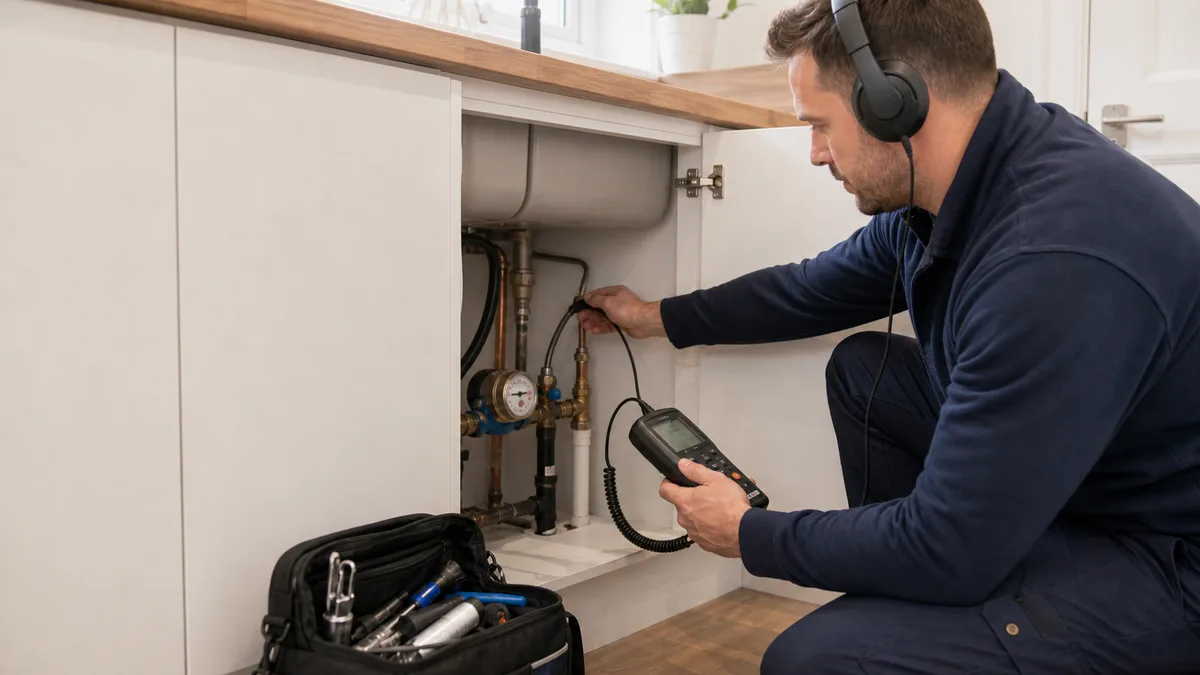
Leak Detection in Cannock
Most Cannock properties use a separate sewer system, and with 32% built before 1920, many still have salt-glazed clay drainage and lead-solder copper pipework. Pin-hole corrosion from Severn Trent Water's hard-water supply is a major cause of hidden leaks across WS11, WS12 and WS13. Non-invasive leak detection—acoustic loggers and thermal imaging—can locate leaks without excavation, and insurance often covers trace-and-access costs.
Leak detection in Cannock uses acoustic loggers and thermal imaging to find hidden pin-hole corrosion in hard-water copper pipes and joint failures in clay drains—without digging. Insurance usually covers trace-and-access in flood-risk areas WS13-14.
Drainage in Cannock — what local engineers know
Cannock Chase council manages one of Staffordshire's highest flood-risk areas, with the River Trent nearby creating vulnerability for basement and ground-floor properties. Severn Trent Water's hard-water supply causes widespread pin-hole corrosion in copper pipes, driving demand for leak detection across WS11-14. The separate sewer system is itself a hazard: misconnections between surface water and foul drains trigger environmental enforcement action and water damage. Victorian and Edwardian properties (32% pre-1920) suffer recurring joint failures in clay soil drains and root ingress. High groundwater in WS13 and WS14 means rising-main and under-floor leaks are persistent threats—particularly for basements near the River Trent and River Soar flood zones.
- Hard water supply causes limescale accumulation in boilers, radiators and soil pipe joints — powerflush and descaling demand is high across Cannock
- Separate sewer system across most of Cannock: misconnections (e.g. washing machines plumbed into surface water drains) are a known local issue and can result in environmental enforcement action
- High flood risk in Cannock: basement and ground-floor properties near watercourses are vulnerable to sewer backflow — non-return valve installation is strongly recommended
- With 32% of properties built before 1920, salt-glazed clay drainage and lead-solder copper pipework are common — pipe collapse, root ingress and joint failure are recurring call-out drivers.
What happens when you call us in Cannock
- 1 Immediate dispatch. We find the nearest available engineer covering WS11/WS12 and confirm the ETA before the call ends.
- 2 On-site diagnosis — no guessing. The engineer inspects using professional-grade equipment including CCTV where needed and quotes a fixed price before work starts.
- 3 Job complete, report issued. You receive a written completion report. All work is guaranteed — same fault returns within the guarantee period, we come back free.