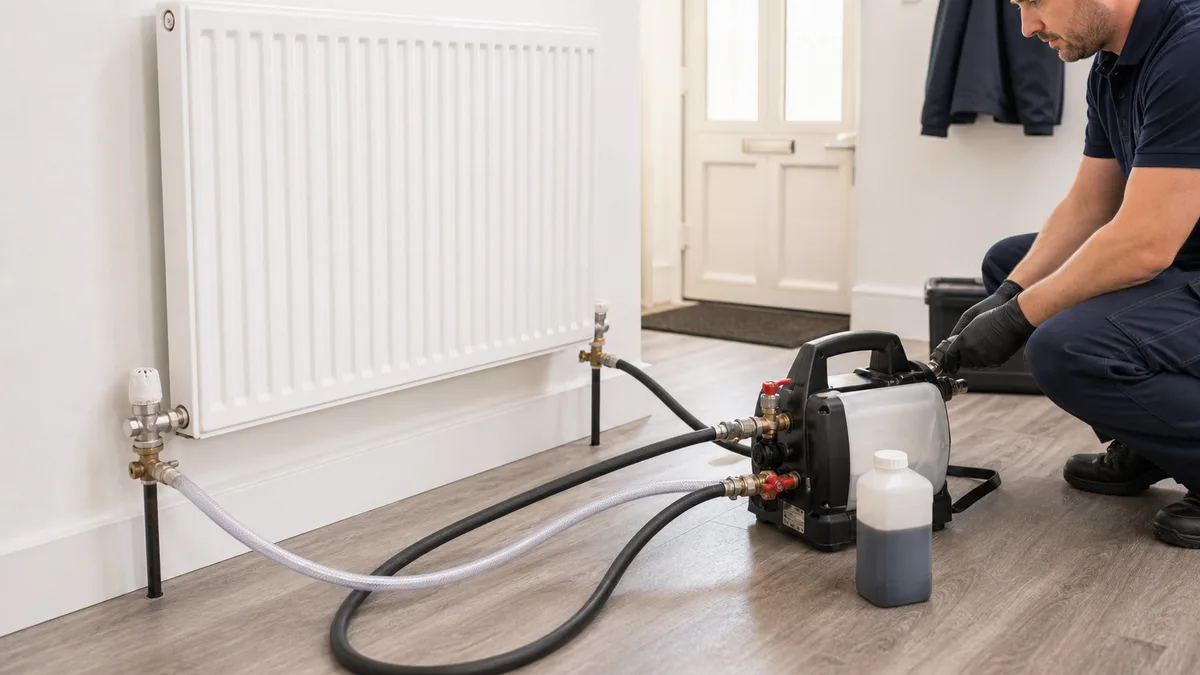
Powerflush in Fleet
Fleet's separate sewer system and Thames Water hard water supply create conditions where boiler and radiator limescale accumulates rapidly, reducing heating efficiency. Properties across Fleet postcodes GU51, GU52, GU53 and GU54 experience this compounding issue, particularly Victorian and Edwardian terrace houses where heating systems are original or decades old. Powerflush removes mineral deposits that throttle flow and waste fuel.
Powerflush removes limescale and sludge from central heating in Fleet using high-velocity water circulation. Boiler flow rates increase, radiators heat evenly, and fuel consumption drops. In Fleet's hard water zone, powerflush extends boiler life and prevents failures that are otherwise inevitable within 10–15 years of hard-water exposure.
Drainage in Fleet — what local engineers know
Thames Water manages Fleet's supply, and hard water affects every postcode from GU51 (town centre) to GU54 (north). Hart Council records show limescale complaints correlate with older housing stock in Fleet's central wards. The separate sewer system in Fleet means surface water drains are often compromised by descaling discharge if not properly isolated—verification is required before flushing. Winter demand in Fleet peaks after January, when heating failures become acute and system blockages cause boiler shutdowns.
- Hard water supply causes limescale accumulation in boilers, radiators and soil pipe joints — powerflush and descaling demand is high across Fleet
- Separate sewer system across most of Fleet: misconnections (e.g. washing machines plumbed into surface water drains) are a known local issue and can result in environmental enforcement action
- High flood risk in Fleet: basement and ground-floor properties near watercourses are vulnerable to sewer backflow — non-return valve installation is strongly recommended
- With 34% of properties built before 1920, salt-glazed clay drainage and lead-solder copper pipework are common — pipe collapse, root ingress and joint failure are recurring call-out drivers.
What happens when you call us in Fleet
- 1 Immediate dispatch. We find the nearest available engineer covering GU51/GU52 and confirm the ETA before the call ends.
- 2 On-site diagnosis — no guessing. The engineer inspects using professional-grade equipment including CCTV where needed and quotes a fixed price before work starts.
- 3 Job complete, report issued. You receive a written completion report. All work is guaranteed — same fault returns within the guarantee period, we come back free.