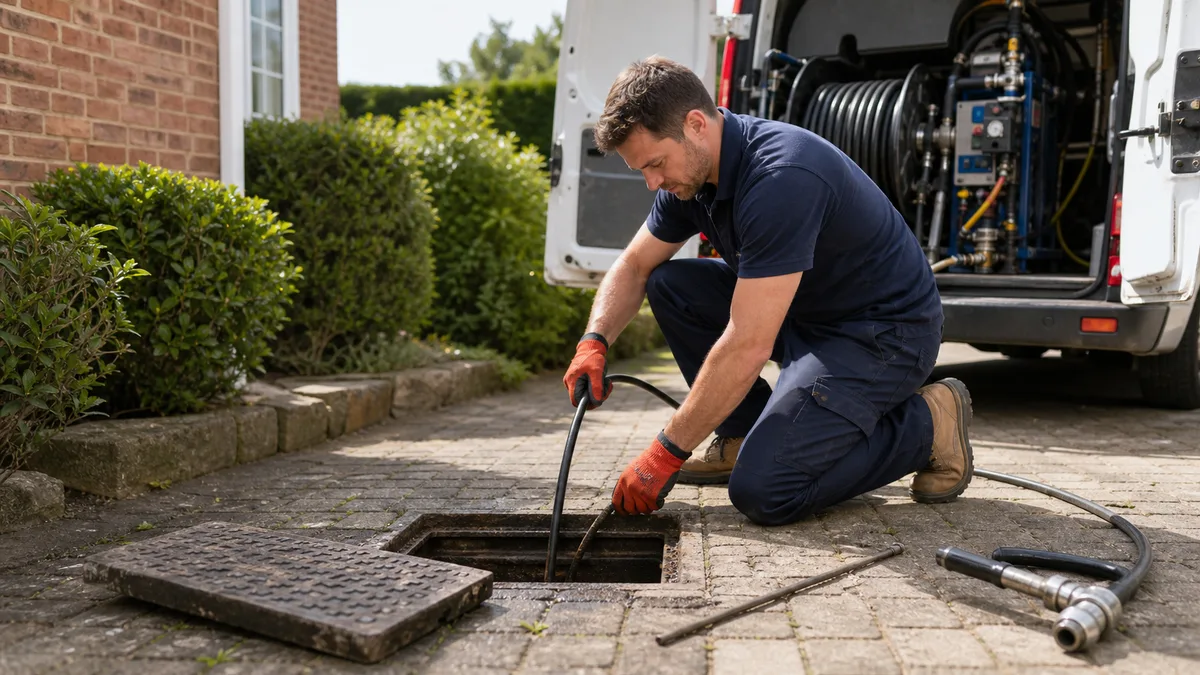
Blocked Drains in Fleet
Fleet's separate sewer system and hard water environment create distinct blockage patterns. Victorian and Edwardian terraces (together 34% of Fleet's housing) are prone to root ingress into clay pipes, while hard water deposits restrict flow in soil pipes across GU51, GU52, GU53 and GU54. Misconnected washing machines and guttering (often fed into surface drains in Fleet) add organic buildup that combines with limescale.
Blocked drains in Fleet are cleared by rodding, jetting and CCTV-guided removal of roots, hard water deposits and debris. Fleet's separate sewer system means surface water blockages are common. Misconnected washing machines and guttering across GU51-GU54 often sit in surface drains, causing backups requiring system realignment to the foul sewer.
Drainage in Fleet — what local engineers know
Fleet sits on Thames Water's hard water supply and Hart council's separate sewer infrastructure, creating a dual drainage challenge. The separate system means surface water (from roofs and drains) travels independently from foul sewage, but many Fleet properties — especially older properties in GU51 and GU52 — have cross-connections (washing machines or internal guttering plumbed into surface water pipes instead of the foul sewer). These misconnections cause odours and backups in Fleet's gardens. Root ingress is common in Victorian and Edwardian clay pipes, while hard water causes mineral buildup in soil pipes. Modern Fleet drainage (in 16% of properties) is usually plastic and cleaner, but still prone to root damage if clay pipes feed into plastic laterals.
- Hard water supply causes limescale accumulation in boilers, radiators and soil pipe joints — powerflush and descaling demand is high across Fleet
- Separate sewer system across most of Fleet: misconnections (e.g. washing machines plumbed into surface water drains) are a known local issue and can result in environmental enforcement action
- High flood risk in Fleet: basement and ground-floor properties near watercourses are vulnerable to sewer backflow — non-return valve installation is strongly recommended
- With 34% of properties built before 1920, salt-glazed clay drainage and lead-solder copper pipework are common — pipe collapse, root ingress and joint failure are recurring call-out drivers.
What happens when you call us in Fleet
- 1 Immediate dispatch. We find the nearest available engineer covering GU51/GU52 and confirm the ETA before the call ends.
- 2 On-site diagnosis — no guessing. The engineer inspects using professional-grade equipment including CCTV where needed and quotes a fixed price before work starts.
- 3 Job complete, report issued. You receive a written completion report. All work is guaranteed — same fault returns within the guarantee period, we come back free.