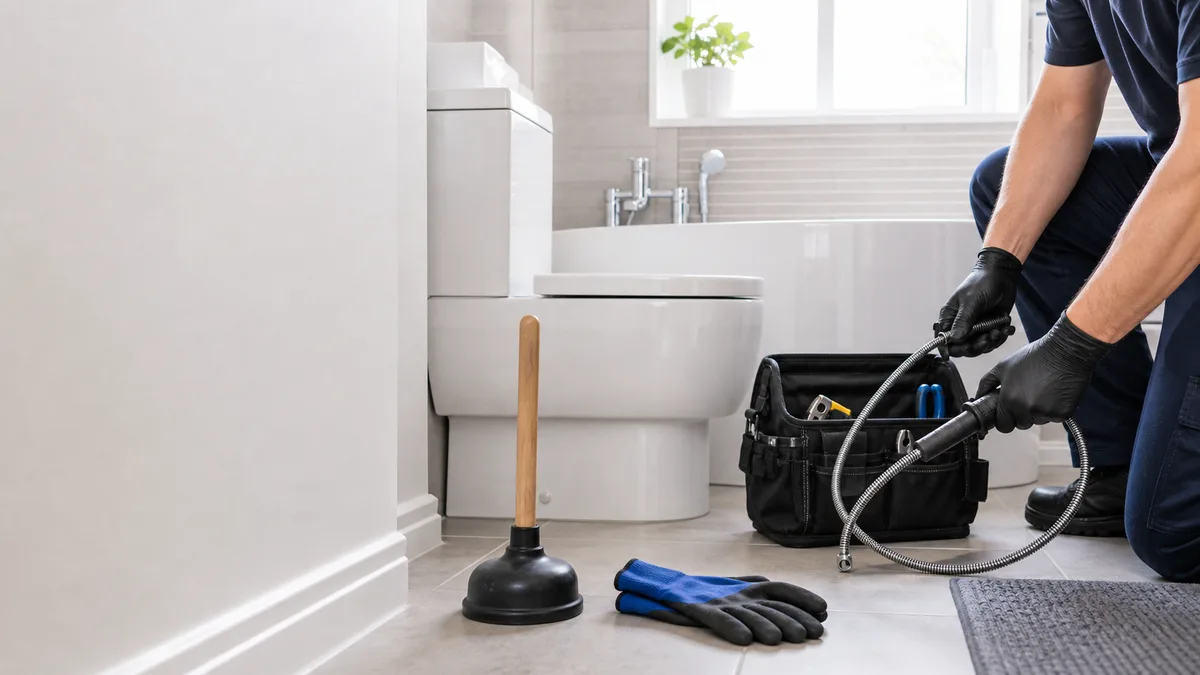
Blocked Toilets in St Ann's
St Ann's's Victorian and Edwardian housing stock (32% of properties) retain original high-level or low-level cistern configurations that now require specialist repair knowledge. Modern close-coupled toilets are common in post-war NG4 and NG5 rebuilds, but early 1900s designs still dominate central St Ann's. Hard water deposits from Severn Trent Water affect flush mechanisms and seals in St Ann's across all NG3-NG6 postcodes, and St Ann's residents often need specialist sourcing for replacement parts.
Toilet repair and installation in St Ann's covers high-level cistern restoration, seat and pan replacement, and silent leak detection. Victorian NG3 properties often need specialist sourcing; modern homes in NG4-NG6 benefit from close-coupled designs that resist hard water mineral buildup from Severn Trent Water.
Drainage in St Ann's — what local engineers know
St Ann's's 1880-1930 properties commonly feature high-level cisterns (mounted above the pan, with a long chain pull) or pedestal low-level designs — both now obsolete. Nottingham City Council has identified St Ann's NG3 as having the highest concentration of original Victorian plumbing. Replacement cisterns for pre-1950 designs are harder to source and require bespoke installation. Severn Trent's hard water causes float mechanisms and fill valves to jam with mineral scale. The NG5 ward contains terraces where toilets still use siphon discharge systems and cast-iron cistern frames, making modern parts incompatible without alteration.
- Hard water supply causes limescale accumulation in boilers, radiators and soil pipe joints — powerflush and descaling demand is high across St Ann's
- Separate sewer system across most of St Ann's: misconnections (e.g. washing machines plumbed into surface water drains) are a known local issue and can result in environmental enforcement action
- High flood risk in St Ann's: basement and ground-floor properties near watercourses are vulnerable to sewer backflow — non-return valve installation is strongly recommended
- With 32% of properties built before 1920, salt-glazed clay drainage and lead-solder copper pipework are common — pipe collapse, root ingress and joint failure are recurring call-out drivers.
What happens when you call us in St Ann's
- 1 Immediate dispatch. We find the nearest available engineer covering NG3/NG4 and confirm the ETA before the call ends.
- 2 On-site diagnosis — no guessing. The engineer inspects using professional-grade equipment including CCTV where needed and quotes a fixed price before work starts.
- 3 Job complete, report issued. You receive a written completion report. All work is guaranteed — same fault returns within the guarantee period, we come back free.